


YARD 2121
Description
This page of the book is from "The New Student's Reference Work: Volume 4" by Chandler B. Beach, Frank Morton McMurry and others.
YARD
2121
yellow fever
which is also connected by steamer with various points on the Missouri. The state hospital for the insane and Yankton College (Congregational) are located here, as are also floviring-mills, a brewery and large works for the manufacture of fine hydraulic cement. Artesian wells supply the city with pure water. Population 3,787
Yard, The Impe'rial, is the Britisn standard of length, being the distance between two parallel lines on gold studs (or plugs) driven into a bar of bronze, deposited at the Standard's Office in London and used at a temperature of 620 F.
Yates, Edmund Hodgson, English novelist and dramatic critic, was born at Edinburgh, July 3, 1831, and, after serving for a number of years in one of the departments of the London postoffice, retired in 1872. He successively edited Our Miscellany, Temple Bar and The World, besides writing novels and dramas. His best-known novels are Broken to Harness, Black Sheep and Kissing the Rod. He died at London, May 20. 1894.
Yates, Richard, was born at Warsaw, Ky., Jan. 18, 1818, and after graduating at Illinois College studied law and was admitted to the bar. He served a number of terms in the Illinois legislature, and during the Civil War was governor, a position in which he won an enviable reputation for zeal and patriotism as well as for vigor and efficiency in organizing and equipping troops. So great was his popularity with the people, among whom he was familiarly known as "Dick" Yates, that, as soon as his term as governor expired, he was chosen to a seat in the United States senate, which he filled till March 4, 1871. He died at St. Louis, Nov. 27, 1873.
Yazoo', a river of Mississippi formed by the union of the Tallahatchie and the Yal-lobusha, runs southwestward in a very serpentine course in a deep, narrow, sluggish channel — its length being about 300 miles — and empties into the Mississippi, ten or 12 miles above Vicksburg. In the winter of 1863-64 General William T. Sherman sailed up the Yazoo with a considerable military force for the purpose of capturing the fortified position of Haines' Bluff from the Confederates, preparatory to an attack on Vicksburg. The expedition was unsuccessful.
Yeast, the common name of species of Saccharomyces, a genus of low plants (fungi) probably belonging to the Ascomycetes. The yeast-plant is a single, simple cell, which produces new cells by a peculiar budding-process. Usually the cells thus produced cling together in short chains. The most generally known of the 25 de-
scribed species is S. cerevisiæ, the yeast used by brewers and bakers. The use of yeast is due to its great activity in the process of fermentation. When placed in sugar-containing solutions and exposed to a proper temperature, the cells multiply with great rapidity, and in their living cause the sugary solution to "sour." In this "souring" process 'the gas — carbon dioxide — is given off, arid if it is held by
some tenacious substance, . as dough, it will puff it up, that is, make it "light." The process of adding yeast to dough is simply sowing yeast-plants that they may grow. See Ascomycetes.
Yed'do. See Tokio.
Yel'low Bird, the name in general use for two different birds of the United States. One of them is the goldfinch, which is one of our most attractive birds. It is about five inches long, and in the summer has a yellow body, with black on the crown and black and white or the wings and tail. It also is a winter resident, but the winter dress is different, being grayish-brown, with a yellowish crown and soiled white below and a yellowish throat. The name is also given to the yellow warbler, which is also locally called the wild canary. See Goldfinch and Warbler.
Yellow Fever (Yellow Jack), an acute specific disease occurring within certain geographical limits; mostly in the West Indies, whence it is carried to climates where the temperature is above 720 F It is characterized by a fever of short duration, a yellow tint of the skin, gastrointestinal disturbances and hemorrhages into the skin and mucous membranes. The precise nature of its virus is unknown. A severe visitation occurred in the lower Mississippi Valley in 1874, with 5,000 deaths in New Orleans and Memphis. Until the American occupation of Cuba yellow fever was practically never absent from that island. Experiments carried on in Cuba by the medical department of the United States army proved that the disease is communicated from one individual to another only by a single species of mosquito {Stegomyia Fasciata). Sanitary scientists predict con-
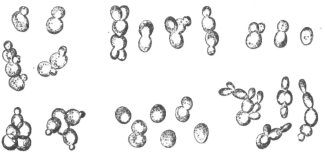
YEAST REPRODUCING BY BUDDING


My Books

