


I. Big Businesses From Little Seeds
Description
This section is from the "The New Student's Reference Work Volume 5: How And Why Stories" by Elinor Atkinson.
I. Big Businesses From Little Seeds
What did you have for breakfast?
Bread and butter, toast, muffins, batter cakes. You had other things, too, but all of you had some kind of bread made of wheat flour. For dinner you will have crackers with your soup, and perhaps pie or cake. Those will be made of wheat flour, too. We use more wheat in America than any other kind of food. Everyone who lives here eats a barrel of flour every year. That is about ninety million barrels. It takes nearly five bushels of wheat to make a barrel of white flour. Four hundred and fifty million bushels of wheat! Yes, indeed! But we really grow about seven hundred million bushels. We have a great deal of wheat and flour to sell to countries across the ocean, where they cannot grow enough to feed all the people. Wheat is the bread of all white people. They use corn and rye and oats, too, but more wheat than all the others put together. The Chinese and Japanese and Filipinos and many other peoples eat more rice. But they are beginning to buy our white flour, too.
Where does all this wheat come from? Just farms. Little farms and big farms, in a great many of our states, grow wheat. These wheat fields cover fifty million acres of our land. Some wheat fields are so big that a hundred men go into them at once. They ride on sulky plows drawn by horses, or they use steam plows. Then they go over the fields again with steel-toothed harrows to break up the clods. They follow the harrows with drill seeders that drop the seed through pipes in rows. Behind each pipe is a little plow like a garden trowel, that covers the seed. In some parts of our country wheat is planted in the spring. In others, where winter is less severe, it is planted in the fall.
Did you ever get your name in a newspaper? You were proud to see your name in print. Our president gets his name in the paper very often. But no one, not even kings and queens, gets a column or so every day in all the big city papers in many countries and in many languages. Wheat does. Wheat is the bread of many people.
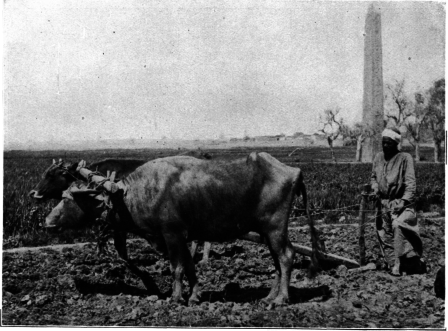
The Old Way. Plowing with oxen and a wooden plow. This is a recent photograph, showing that in Egypt they still plow just as they did thousands of years ago.
Copyright by Underwood & Underwood
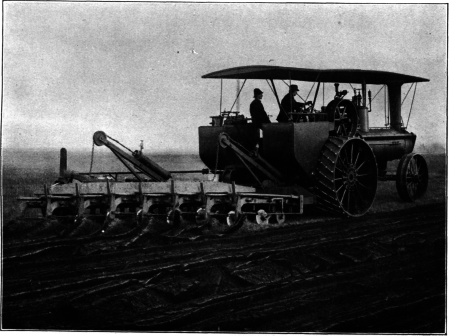
The New Way. A modern gang plow drawn by a traction engine and turning eight furrows at a time.
Copyright 1909 by Underwood & Underwood
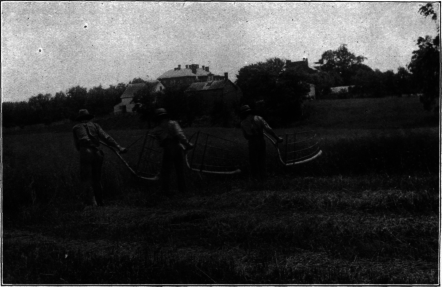
The Old Way. These men are cutting the wheat with cradles. It is then raked into bundles which are bound by hand and gathered into shocks. Later they are hauled on wagons to a threshing machine and threshed, the grain being thus separated from the straw.
Courtesy of International Harvester Company of America.
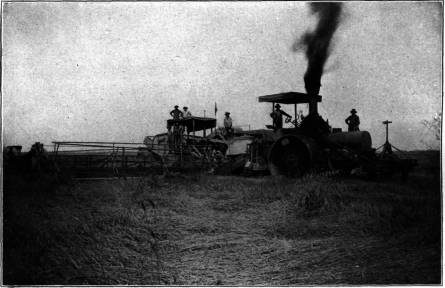
The New Way. A modern combined reaper and thresher, drawn by a traction engine. Here the grain is cut, threshed and delivered in sacks as the machine moves along.
They are all anxious to know if bread is going to be cheap or dear. How much wheat is being planted? the world asks. But that doesn't answer the question about bread, for many things may happen to wheat after it is in the ground.
Continue to:
Other Stories:
- Dandelion, Showing Plant, Flowers And Seed Heads.
- How The Months Were Named
- III. Iron. The Little Pig That Goes To Market. Part 3
- IV. Winter: "The Cradles Will Rock"
- V. Woodworking. When A Tree Is Lumber
- The Story Told In The Rocks


My Books

