


I. Land
Description
This section is from the "The New Student's Reference Work Volume 5: How And Why Stories" by Elinor Atkinson.
I. Land
When you went around the world you found that this earth we live upon is made of just land and water. But what a number of things were made with them. No two countries looked just the same, but they were all beautiful and interesting. Do you want to know how they came to be so different?
You need not go around the world again to find out, but it will help you to understand everything better if you will remember what you saw—the grassy plains, the high, rocky mountains, the green river valleys, the sandy desert. No matter where you live on the earth, there is land and water. In any wood or field or city park you can find out a great many of old mother earth's secrets.
This is a perfectly flat meadow, isn't it? It is covered with grass and flowers. Here is a pond, with water-flags and cat-tails and pussy willows growing about it. The water is as still as if it lay in a wash basin. No, there is a ripple on the other side. A little stream, almost buried in grass, is flowing in there. The water runs very slowly. The land on that side slopes a little toward the pond, or the tiny stream could not flow into it. Water never runs any way except down hill. Here is another little feeder to the pond, and another! Here the water runs out of the pond, through a larger brook. The meadow isn't flat at all. It is made up of little slopes. The pond is a small lake. Some lakes are hundreds of miles long, but they were formed just like this pond. The water from them flows out through a big, river, instead of through a little brook. They are fed by many small rivers, and by springs underneath, too.
Wherever a pond or a lake is made on land, there must be a low place shaped like a bowl, with the land sloping down on all the sides but one. But sometimes, for hundreds of miles, the land slopes from only two sides, making a trough between. There you would find, not a lake, but a river. When the river is very long and deep, like the Mississippi, its valley is hundreds of miles wide. The slopes rise slowly, but they rise high, to the very tops of mountain ranges. Many big streams run down these long slopes to feed the main river, and little streams feed the feeders. If you made a map of the Mississippi river and all it feeders, it would look like an oak tree with no leaves on it.
Don't you want to follow a brook that flows into a river, and find out where it came from? It's a long walk, and up hill all the way. Make up a bouquet of flowers as you go. If you had a boat you could get some water lilies here, or with rubber boots for wading, some purple water flags. There are some pussy willows. How thick and green things grow, on the low river bank. And how soft and black the soil is. Where it is a little higher and dryer, you can pick ferns and buttercups. Higher still, in the maple woods along the brook, you may find violets. On that high, gravelly bank are tall, weedy looking plants. In the fall, if you come here again, you will find golden-rod and purple asters. The brook is getting narrower and shallower, but it runs faster. There it is almost hidden by hazel brush. See that squirrel? He knows there will be nuts here, and acorns in that oak tree he is running up. The brook is only a thread of water, now, but running very fast between banks of scanty grass. There is some ground pine and pink laurel, and dry gray lichens on the rocks, among scattered pine trees.
Why there is a bunch of ferns and a cushion of velvet moss! Part the ferns with your fingers, and find sparkling water gushing out of a little nest of wet rocks. This is a spring. It is the birth place of the brook. These are the only ferns you found up so high. Ferns love water and soft soil. The spring gives them the food they want.
It seems perfectly flat here. You can look over a high, wide country. Here is another spring. But the brook it makes flows the other way ! Then, of course, the land must slope the other way, too. We are on a ridge of land, or divide. Sometimes a divide is called a watershed. It is like the roof of a house. The water flows down each side of a roof to the water troughs under the eaves. The rain washes the roof clean, doesn't it? Well, the little streams wash the land slopes clean. First, they soften the ground they flow over and make mud. The mud mixes with the water and goes along with it. Stones are loosened and rolled along, too. Fill a big gold-fish bowl with this muddy water at the mouth of the brook, and let it stand awhile to settle.
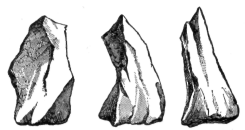
Pieces of rock broken from a cliff by rains, frost, etc., and dropped into a river.
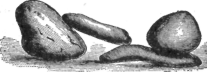
Stones from same cliff after they have been worn and rounded by rolling about in the current of the river.
Through the glass you see clear water at the top, then mud, then sand, then gravel. The gravel falls the lowest because it is the heaviest. The little brooks rob the hill sides of the soil that plants need, as well as of the water. They melt and break up this soil as fine as they can. They even take some sharp corners from the pebbles by rolling them over and over in the water. Running water is a busy miller. It grinds earth to mud, and rocks to sand. Then, when it gets down to low ground, where it flows more slowly, it drops all this heavy matter along the river banks, in the river bed, and far out into the ocean. The gravel drops first, then the sand, then the mud. If you dig a well in the valley you will find a layer of loam on top, then sand, then gravel, on a bed of stiff clay or rock. If you scoop out a river bed you find things in the same order. In the ocean you find the gravel near the shore. It hurts your bare feet when you go in bathing. The sand is farther out, and the mud farthest of all. The water sorts all this earthy matter and puts each kind by itself. Isn't that wonderful? The top layer of loam is a mixture of clay and sand and leaf mold. Leaf mold is added every season by falling leaves and decaying seeds and roots. It makes the soil softer and richer.
This water miller has several stout helpers in wearing down land. One is wind. Wind picks up dust and scatters it. Then it is more easily washed into the streams by rain. Frost is a regular little wedge and hammer. When water freezes in a crack in a rock it swells, or expands, and splits the rock into pieces. The roots of all plants and trees split the soil, too.
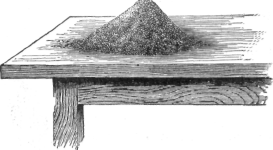
A heap of sand consisting of particles worn from the stones and gravel in the river bed.
Burrowing animals like muskrats, foxes and snakes make little caves that often fall in. Earth worms and beetles honeycomb the ground with tiny tunnels. Finally men loosen the soil by plowing and building. All these things make it easier for the little water miller to wash down the good top soil.
On high mountains, nothing but bare rocks are left behind, and rain, wind and frost work all the time to wear them down. The water scours the river beds deeper, and carries as much earth as it can out into the ocean. What becomes of the good soil that is washed into the ocean? It has been ground to powder or melted to paste.
Continue to:
Other Stories:
- What Are Tears For?
- VIII. Rice Growing. The Bread Of Nogi, Wung Foo And Manuelo
- XV. Water Babies And Other Babies That Drink Milk
- Live Silver—What Is It?
- II. The Little Pale Faces Who Came Over The Sea
- I. Bird Songs And Colors. Part 2


My Books

