


II. The Wonderful Gift Of Good King Cotton. Part 3
Description
This section is from the "The New Student's Reference Work Volume 5: How And Why Stories" by Elinor Atkinson.
II. The Wonderful Gift Of Good King Cotton. Part 3
Perhaps you think all cotton is alike. It isn't. There are as many kinds of cotton as there are of apples. Most of the little cotton hairs are less than an inch long, but we have one kind that is two inches long, and very fine and silky. It grows on tall bushes along sea-coasts and on islands, so it is called sea-island cotton. It is so costly, and there is so little of it, that it is used only for thread and lace and the finest lawns and swiss muslins. Some cotton is very white, some a creamy yellow. In Egypt there is a brown cotton that is the best in the world for stockings and knitted underwear. Cotton traders can tell in a minute what a little sample of lint is best for. They buy the kinds their mills need.
A ship load of cotton goes up a wide river from Liverpool, and through a canal, and is unloaded beside the mill that bought the cargo. In the mill the bales are opened, the crowded lint loosened, beaten to a swan's down fluff again, and fanned free of dust. One bale fills a big room, it is so light and soft. The tiny hairs lie twisted and tangled together. They have to be combed, and made to lie all one way, just like your hair. Think of it. They are only as long as the first joint of your little finger, and as fine as spider webs. Yet they have to be combed and made to lie all one way.
The fluff goes through roller combs set with little steel teeth like sewing needles. One row is laid straight, then another behind it, and another until a sheet is formed. The little hairs lie end to end, overlapping and clinging to each other. The fluff sheet is parted into narrow strips that pass through grooves in big steel rolls. Each strip is rolled over and over into a soft hollow rope as big as your papa's thumb. This passes through smaller and smaller grooves. It is squeezed and twisted and rolled, in one machine after another, until it is a cord as big as twine, but still very soft. Another cord just like it is twisted with it to a fine yarn. All this rolling and twisting is called spinning. It makes a yarn ready for weaving. If you want to know how small this yarn is, ravel a piece of muslin and look at just one thread. That is cotton yarn. It would take six such strands of yarn twisted together, to make fine sewing thread.
The spun yarn is wound on big bobbins or spools for weaving. Cloth is woven as you wove paper and splint mats in the kindergarten. The threads run up and down and across, over and under. In a weaving machine the ends of the lengthwise threads are fastened to a roller. The roll is a yard long, and the threads are so close together that, altogether, they look like thin cloth. Every other thread is lifted, and all at once. The odd threads are lowered. A shuttle carries the cross thread between them. Then the upper threads go down and the lower ones up, and the shuttle flies back. In this way miles and miles of cotton cloth are woven by great looms worked by steam power.

Picking Cotton By Hand.
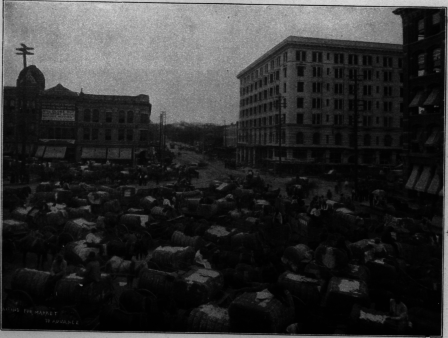
Cotton Arriving At Market.
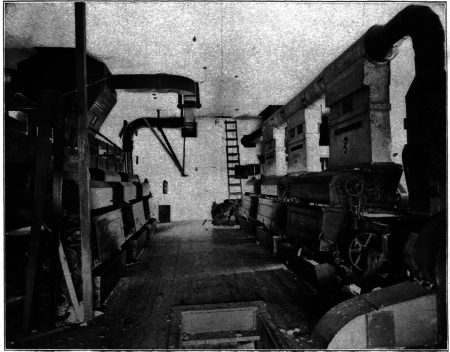
A Cotton Gin Which Separates The Seed From The Cotton.

Interior Of Weaving Room In Large Cotton Mill.
How much work has been done since the little cotton seeds were planted. And yet good cotton cloth is sold for a few cents a yard. A great deal of it is dyed, too, or it is printed in pretty patterns. Sometimes, as in dress ginghams, the yarn is dyed many colors before it is woven. Some looms weave satin like stripes and dots and flowers on the cloth. Knitting machines make stockings and even gloves, without seams. Linen and silk and wool are spun and woven in much the same way, but these are not so cheap as cotton. It is good King Cotton that gives you most of your clothes-See Cotton, page 464; Cotton-Boll Weevil, page 465.
Continue to:
Other Stories:
- What Is An Eclipse?
- What Makes A Mirage?
- Children Of Our Own And Other Lands. I. The Red Child Of The Forest
- IV. Winter: "The Cradles Will Rock"
- What Makes The Music In A Pipe Organ?
- III.2 A Sea Flower That Eats With Its Petals And Moves When It Wants To


My Books

