


III. Air
Description
This section is from the "The New Student's Reference Work Volume 5: How And Why Stories" by Elinor Atkinson.
III. Air
Besides land and water on the earth, there is something that is all around it, and all through both land and water. You cannot see it, or feel it, or taste it, or smell it, or hear it. But you can prove that it is all around you in a great many ways. You can take it to pieces, too, and find out what it is made of. Measure your chest with a tape line. Twenty-eight inches? Now breathe deep, deeper. Hold your breath and measure again. Thirty inches ! You filled your lungs with air. They were just as full of air as this glass pitcher is of water. This drinking glass looks as if it was empty, but it is full of air. Turn it upside down, and press the open end on the top of the water in the pitcher. Push it straight down under the water—steady; don't let the glass tip up.
The water rises outside the glass and overflows. Lift the glass carefully. It is dry inside, except for a narrow rim at the top. Some water did get inside, by squeezing the air in the glass into a little smaller space. See how much water was forced out of the pitcher. Nearly a glass full!
Big boys who dive and swim under water, fill their lungs with air first and hold their breath, so water cannot get into them. That is a very useful thing to learn to do. It saves people from drowning and makes them able to save other people.
Have you ever heard people say: "As light as air?" Perhaps you think air doesn't weigh anything. Did you ever pump water from a well by working a pump handle? You had to pump several times before the water came, didn't you?
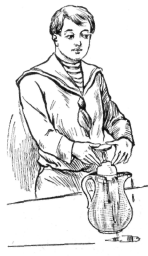

You had to lift the air out of the hollow pump before the water could come in. Pumping air is hard work. There are several simple ways of proving that air weighs something. Empty the teakettle of water and take the lid off. Now lay a sheet of rubber cloth over the top. Put a glass or rubber tube into the spout, and draw the air through the tube into your lungs. Breathe again. Suck all the air out of the kettle. See the rubber cloth sink. The air on top is pushing it into the kettle. There it goes, down inside. There is no air in the kettle to hold it up.
Now blow into a little rubber balloon. See it swell. Blow again, the rubber stretches. See how much air you can blow into it. Ah, it burst! There was more air inside the balloon than there was outside. Fill a glass with water until it overflows. Cover the top with a sheet of thick, smooth letter paper. Press it all around the edges so you are sure no air can get between the glass and the paper, to let the water out. Now take hold of the glass by the bottom and turn it upside down. The water will not spill, the air below holds it up. Turn back to Air in this book and find out what air weighs. Just as fish and sea plants may live at the bottom of the ocean of water, so land animals and plants live at the bottom of the ocean of air. The top of this ocean of air is level, too. Do you think the air on a mountain peak would be as deep or as heavy as the air in a low valley? A glass full of water has no color. But an ocean full of water looks blue. We cannot see air itself, but we can see the color of it. When it is forty miles deep air looks blue, too.
Robert likes to climb trees, so he is just the boy to get up on a step ladder and take down those dusty curtains. Warm up there, Robert? Hot air goes up, so it is always warmer near the ceiling. You remember how warm air carries vapor up to make rain? It is the hot air that carries smoke up from chimneys. Did you ever send up a red paper balloon on the Fourth of July? You lit a tiny candle at the bottom. Soon the sides of the balloon swelled and stretched tight. Air expands when it is heated. That is, it takes less hot air to fill anything than it does cold, so it grows lighter. The balloon floated around the sky until the candle burned out.
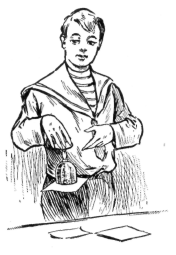
Warm air is always going up and cold coming down. Out of doors Mother Nature attends to this pushing, but in houses we have to help, by letting the warm air out at the top and cold air in at the bottom. Air is always in motion unless it is in prison, and prisoned air is very bad to breathe. Still air is dead; live air is always in motion.
Continue to:
Other Stories:
- XIII. Alice In Wonderland
- VI. A Long Speech By A Little Worm
- X. The Crawfish, The Spider And The Fly
- VII. Glass Making. A Look Through A Window Into One Of Nature's Workshops
- Wonders Of The World We Live On
- VIII. Why Plants Are Like Squirrels


My Books

