


III. Here Come The Elephants!. Part 2
Description
This section is from the "The New Student's Reference Work Volume 5: How And Why Stories" by Elinor Atkinson.
III. Here Come The Elephants!. Part 2
It takes an elephant thirty years to grow up to eleven feet in height, twelve in length, with tusks and trunk six or eight feet long, and a weight of three tons. He has plenty of time, for, if he is lucky, he may live to be a hundred or more years old. The hide of a full grown elephant is an inch thick, and full of folds and creases and wrinkles. The ears of an African elephant are as big and floppy as rubber door mats. He can smell as well as a dog or a bear, and see and hear much better. His legs are as thick and solid as the pillars under a portico, and his feet are scolloped with five thick toes around a pad. An elephant's knees and elbows are so near the ground that it is hard for him to get up and down. He can't curl his legs under him as many animals do, but kneels and sprawls his hind legs out behind. Sometimes he seems to say: "What's the use in trying to lie down at all?" So, when he is sleepy, he just leans up against a big tree, or a rock. And he has a stiff neck all the time. His neck is so short and thick that it is very little use for turning, although he can toss his head up and down like a bull.
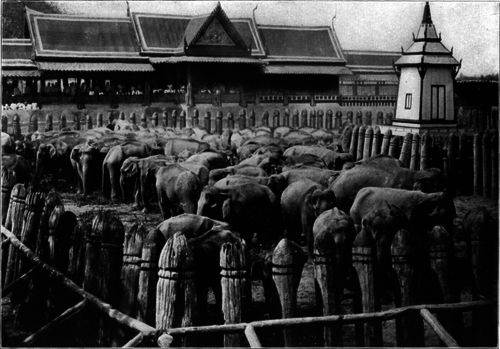
A Herd Of Wild Elephants. Captured and placed in a strong pen. After they have become somewhat tamed they are lassoed and taken out separately.
For such an e-nor-mous animal the elephant is wonderfully active. He can shuffle along, in his clumsy way, nearly as fast as a horse can run. East Indian elephants climb steep mountains as pack animals, and are very sure-footed. All elephants are good swimmers and hard fighters if attacked. They can charge the enemy like cavalry horses. Their tusks are terrible weapons, and no other animal living has such a wonderful tool-chest as the elephant's trunk. It is a nose to breathe and smell with, an upper lip, a finger and thumb, a stout arm, a water tank, a club to fight with, and a musical instrument all in one. As hollow as a garden hose, that trunk is made up of forty thousand muscles laid length-wise, cross-wise and on the bias, in a net-work that gives it great strength and variety of motion. With its trunk the elephant can pick up a peanut, pet its baby, pull a small tree up by the roots, give itself a shower or dust bath, break off a leafy branch and shoo away the flies, slap a saucy tiger senseless, and bellow like the bass horn in a brass band.
But why is it called trunk?
Don't you suppose nearly every little boy and girl in the world has asked that question? And got an answer something like this: "Ch, just because it is." But that is no answer. The name is really trompe, a French word meaning trumpet, for the trumpeting sound the animal makes. English people misunderstood the word and changed it to trunk. Besides it looks like the stem or trunk of a small tree turned upside down ; and there is a hollow tube for forcing pellets through, something like a pop-gun, that is called a trunk. So trunk seems just about as good a name as trompe, doesn't it?
Continue to:
Other Stories:
- What Is "Horse Power?"
- XIV. Birds Of The Water And Birds Of The Air
- Why Does Heat Make Water Boil?
- Why The Earth Is Round
- Good Health
- II. Bird Nests And Babies. Part 3


My Books

