


IV. Pygmy Friends That Fly And Hop And Creep. Part 3
Description
This section is from the "The New Student's Reference Work Volume 5: How And Why Stories" by Elinor Atkinson.
IV. Pygmy Friends That Fly And Hop And Creep. Part 3
Did you ever catch a pretty red, black-spotted lady-bird beetle on a rose bush, and say:
Lady-bird, lady-bird, fly away home.
Your house is on fire, your children will burn!
It fairly leaped in wild alarm, when you let it go. Lady-birds cannot walk well, so they are easily captured, but they can fly. There are black lady-birds with red or yellow spots, too. Do you know why you can find them on rose bushes and fruit trees? They eat those little soft green plant lice, or aphides, that swarm on certain plants. In England gardeners hunt for these neat insects to put into flower gardens, orchards and hop fields. If they couldn't get these little friends in any other way, very likely they'd be willing to pay for them.
French gardeners really do pay four and five cents a piece for ugly, warty little hop toads. Toads eat almost anything—red spiders, flies, wasps, caterpillars and moths. And they just dote on cabbage and green salad worms. Nothing touches the toad. He has no teeth to bite, or claws on his webby feet to fight with, nor a stinger. But he has glands behind his jewel-like eyes with which he can make a dreadful smell. This liquid doesn't cause warts as some people think, but it gives the toad a nice wide field of lonesomeness. He is a night prowler, coming out at dusk. In the daytime he sits in a shady place taking a mouthful of air at a gulp, now and then.
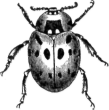
Lady-Bird
The toad, like his water cousin, the frog, has a long tongue, fastened to the front of his jaw. It unrolls, darts out like lightning, catches an insect on a gummy tip, and snaps back quicker than a wink A toad can clear a house of cockroaches, and a few in a garden will give you more sound vegetables and fewer worms. Tree toads are useful in forests and orchards, and frogs in ponds and swamps. The garden spider is useful, too. (See Mrs. Garden Spider "At Home.")
There is another very humble, helpless little friend that you should not harm. This is the smooth, pinkish-brown worm that you dig for fish bait. It is a true worm, and not a caterpillar or larva of an insect. Its real name is earth-worm. It eats earth for the water and decaying vegetables, but every bit that it eats passes through its soft body, and is powdered and enriched so it will grow plants better.
After a hard rain you may see sidewalks strewn with their dead bodies. They cannot live without moisture, but too much rain often drowns them out of their burrows. If a living worm is touched it shrinks to half its six or eight inches of length, which shows that the little blind creature can feel, and be afraid. Then you can see that its body is made up of ring muscles. And under a magnifying glass you can find tiny hook-like feet, and a sharp gimlet of a boring nose. That nose bores through and through the soil. One worm, it is said, can turn up a quart of finely powdered earth in a summer. And it must turn up many insect eggs and cocoons, to be eaten or to die. Earth worms is one sign of good soil. When the soil is naturally poor, or is worn out by bad farming, there will be few earthworms in it or none at all. (See Dragon-fly, Ichneumon Fly, Frog, Toad, Lady-bird, Earthworm.)
Continue to:
Other Stories:
- IV. Pottery. The Wonderful Art Of Making Mud Pies
- VIII. Rice Growing. The Bread Of Nogi, Wung Foo And Manuelo
- IX. Wild Animals Near Home. Part 2
- XIV. Birds Of The Water And Birds Of The Air
- II. Water
- Why Rain Falls In Drops


My Books

