


VII. The Earthworm Puts On Armor
Description
This section is from the "The New Student's Reference Work Volume 5: How And Why Stories" by Elinor Atkinson.
VII. The Earthworm Puts On Armor
You needn't be afraid of him, little friend Earthworm. This armored monster, with his long feelers, his stalk eyes and his great crooked arms with battle axes on the end of them!
"Worse than that," you say, "they're battle scissors!"
So they are, battle scissors. Did I say battle axes?
Well, you needn't be afraid of him, anyhow. He doesn't do half the good in the world that you do. You help make the soil that grows things to eat, while he goes swaggering around—this fierce Mr. Crawfish, and his fiercer big brother, Mr. Lobster—fussing and fighting, and tearing into pieces everything they can lay their scissors on.
We're not afraid of them, are we? "Booh, Mr. Crawfish! Booh, Mr. Lobster!" We'll show them they're only worms, after all.
Why, just look at your insides, Mr. Crawfish. You needn't try to hide them under your jointed armor. We can see right through you!
See that tube running from his stomach to the end of his tail? If that tube didn't swell out into a stomach at one end, and if it wasn't inside of such a queer, armored man-of-war, wouldn't you say he was simply an earthworm? The earthworm lives on very simple breakfast food, the earth he burrows in, and he doesn't need a big stomach to keep it in until it is digested, as the crawfish does; so he doesn't have such a stomach. The earthworm's food passes right through him and digests all the way down—tastes good all the way down, too, very likely, for he doesn't have any special tongue to taste with, either.
But the crawfish and the lobster and all their near relations, eat various things. They eat little fish, scales and all; pieces of each other, shell and all, when they get to fighting, for they are cannibals. So, having many different and very tough things to grind up and digest in their stomachs, they must have a big, strong mill to do it with. Like all fighting animals, they are large eaters. When men spent much of their time in fighting, they spent the most of the rest of it in eating strong meats and drinking strong drinks—which made them want to fight still more. And so they went from bad to worse, just as the crawfish and the lobster do, and died, at last, " with their boots on. " Few of the lobsters die in their beds.
See that little northeast room of the crawfish's stomach? It is not quite shut off from the main living-room. In that room are his stomach teeth. He has to have teeth to grind with, just as a hen does. But the hen, poor thing, has to use false teeth. You have seen her picking them up around the yard—little stones and bits of shell and such things, that she swallows.
The crawfish and his kind have three of these teeth in their stomachs. With these teeth they grind finer the food that they have first torn to pieces with their pincher claws.
The crawfish seems to have started, as a baby, to divide his stomach into three rooms. When he gets to be a bossy cow, eating clover in the pasture, he really does divide it into four stomachs, as you know. The cow stops the food that needs the most digestion in the first stomach. The food that needs less grinding stops in the second stomach. Real fine, partly digested food, like bran-mash, goes straight through, "by express," into the third stomach. All of the food finally goes into the fourth and last stomach. The first stomach rolls the coarser food into little balls. These the cow brings up into her mouth again, and chews them over. Haven't you seen cows chewing their cuds? In the crawfish there is a big front stomach, you see, like the first stomach of the cow, that we call the paunch. In the chicken it is the crop. Next comes the grinding mill in the northeast room, which works like the chicken's gizzard. Beyond this is the back room stomach that opens into the long, worm-like hallway that runs clear down to the tail.
This back stomach of the crawfish is lined with little things sticking out from its walls. These hold back all the food that is too large to go through. Without this " strainer, " pieces of undigested food would get into Mr. Crawfish's little insides, and make him double all up—like a boy who has been eating green apples. Isn't it queer that the stomach of the crawfish in the creek, and of the cow in the pasture, should be so much alike? This just goes to show again that you can't judge by outside appearances alone.
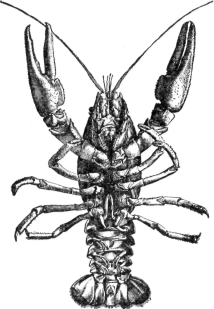
The underside of a crawfish, showing the eyes, two long feelers, the large two-claw feet, four pairs of legs, and the tail with its fringe of little hairy feelers.
Continue to:
Other Stories:
- III. Here Come The Elephants!. Part 3
- How Quickly Do Things Fall?
- I. A Wild Garden And Its Tenants. Part 2
- What Sours Milk?
- I. Bird Songs And Colors. Part 2
- VI. Matches. Just To Light A Fire


My Books

