


The Story Of An Automobile Factory
Description
This section is from the book "The Wonder Book Of Knowledge", by Henry Chase. Also available from Amazon: Wonder Book of Knowledge.
The Story Of An Automobile Factory
In visiting the factory where a half million automobiles are made each year, the visitor first comes to the power house.
In the construction of this building 5,200 tons of structural steel were used, the equivalent necessary to build a modern twenty-story sky-scraper.
Six engines of a combination gas-steam type, housed in this building, develop 36,000 combined horse-power. They are said to be the first gas-steam engines to be put to practical use. Another engine, using steam only, develops 2,000 horse-power, while several pumping engines increase the total horse-power of the plant to 45,000, probably the largest individual unit of any power-plant in the world, and said to be the only one of its kind in actual operation.
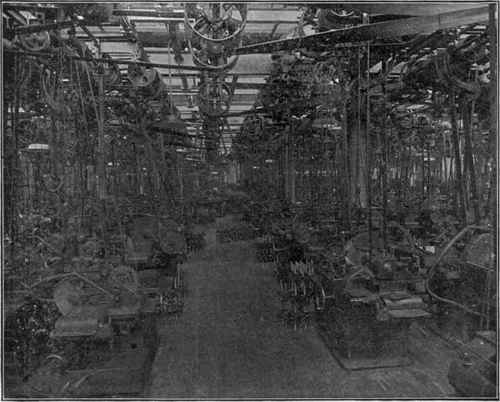
Crank Shaft Grinding Department.
Some idea of the size of the engines is gained from the fact that the stroke is 72 inches, while the gas cylinders are 42 inches in diameter and the steam cylinders are 36 and 68 inches in diameter.
* Illustrations by courtesy of Ford Motor Co.

The Power House Equipment Includes the Largest Direct Current Control Board in the Wobld.
In producing the gas and steam for these engines only twenty-two tons of coal per hour are consumed, which speaks well for the efficiency of the engines. In addition to the steam, the daily consumption of producer gas for power purpose only is 28,512,000 cubic feet. Added to this figure for power gas, is another item of gas used in the factory for various purposes, which averages nearly 1,000,000 cubic feet per day, bringing the per diem consumption of gas by the company up to 29,512,000 cubic feet.
The main factory buildings are 900 feet long and 800 feet wide, four stories in height and of fire-proof construction. They are so designed that every part of the interior receives a full share of daylight.
The heating and ventilating of the factory building is accomplished in a modern, scientific manner. In the winter, warm washed air is forced through long ducts in the floor up into the room. In the summer, cool washed air is handled in the same way, thus providing a clean, healthful atmosphere the year around. By this system the air in the factory is completely changed five times per hour.
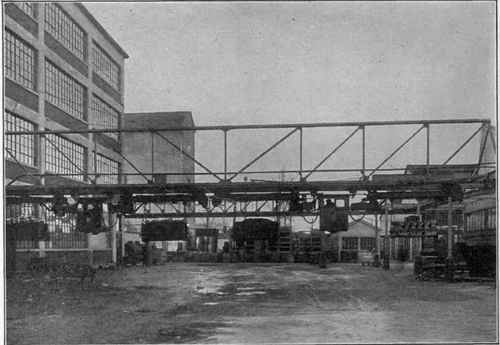
Overhead Monorail System.
At the right as the visitor enters the factory, is seen the tool construction department. Here are employed approximately 1,000 expert tool makers, machinists and die sinkers. These men are engaged in making new machinery (designed in the company shops), tools, jigs, fixtures and other machine shop accessories, and repairing those in use. type, are not all located in a single group or unit. Each department contains all of the necessary machinery to complete every operation on each part or piece it produces. To illustrate, a rough forging or casting is started in a department at one point, and after passing through the machines doing the required operations, it leaves this department, in a finished condition, ready to be assembled into the car.
Overhead are traveling cranes which have a capacity of forty tons each. These cranes facilitate the work of the tool construction department by carrying cumbersome parts of machinery to and from it for alterations and repairs.
Here the visitor is standing upon the roof of a great tunnel, in which are all the heating, water and steam pipes, and the power cables running from the power house to various parts of the shop. This tunnel is large enough to permit the easy passage of a touring car.
Standing in front of the factory office, the visitor is doubly impressed with the magnitude of the view before him. In one continuous room, containing approximately 700,000 square feet of floor space, there are, in round numbers, 8,000 machines in actual operation, representing an outlay of about $5,000,000. These machines use some 2,500 gallons of lubricating oils and 11,000 gallons of cutting fluids each day. For driving the many machines, about fifty miles of leather belting are used, giving the room the appearance of a dense forest.
The visitor who is familiar with machine shop practice will notice at once the peculiar location and setting of machinery in this shop. The machines of a class, or
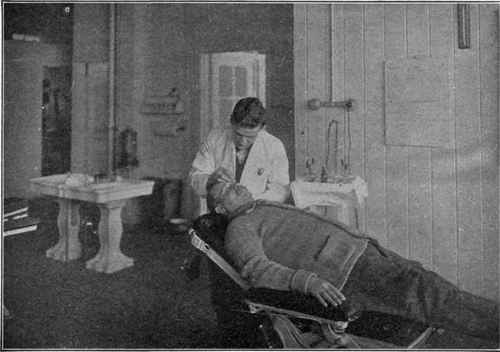
A Corner of the Main Hospital.
Such a system necessitates the grouping together of many different kinds of machines, as well as including brazing furnaces, cyanide furnaces and other special units (most generally found in separate buildings). Chutes run from one machine to another, so that a workman can transport a part from his operation to the next one by gravity. The results of this transportation system are remarkable, making a big saving in trucking expense, loss of material and the absence of usual delays.
As the visitor passes down through the machine shop, he particularly notices the sanitary conditions of the plant. There is a department, enrolling about 500 men, whose duties are to keep the floors swept clean, the windows washed, in fact to keep the sanitary conditions surrounding the workmen as nearly perfect as possible. The floors of the entire plant are scrubbed at least once a week, with hot water and a strong solution of alkali, which removes the grease. Another department of about twenty-five men does nothing but paint the walls and ceilings of the factory, keeping everything fresh and clean.

Piston Machining Department.
To facilitate the inter-departmental transportation of materials in the factory, there is an overhead monorail system, comprising over 1 1/2 miles of I-beam track. On this system are nine monorail cars, each car having two 2-ton hoists, by means of which great boxes and trays of material can be picked up and carried overhead from point to point in the shop.
Continue to:


My Books

