


The Story Of Coal Mining
Description
This section is from the book "The Wonder Book Of Knowledge", by Henry Chase. Also available from Amazon: Wonder Book of Knowledge.
The Story Of Coal Mining
An interesting story is told in an English book by Edward Cressy, of the great coal strike in 1912. Many factories and workshops had to close for want of fuel. A workman from one of these, on reaching home, purchased a sack of coal and set it up against the back door. Then he sat in the kitchen, in which there was no fire. From time to time, when he felt chilly he got up, flung the sack of coal across his shoulders and ran around the yard until he became warm. That was his way of saving fuel. He was only doing in his own fashion what all engineers and manufacturers are trying to do in other ways all the year round.
The extent to which all manufacture and transport, all industry there, was paralyzed during the strike, shows the complete dependence of modern life upon fuel. In spite of the fact that in Great Britain nearly 240,000,000 tons of coal are raised annually, a temporary stoppage of supply threw all the ordinary machinery of existence out of action and revealed the magnitude of the debt that the world owes to those who win precious stores of fuel from the depths of the earth.
Probably no industrial operation excites more widespread interest, when accorded publicity, than the mining of coal, and that because of the dangers which attend it. The annual list of victims buried beneath a falling roof, or mangled by runaway cars, causes little comment, but every now and then the world is startled by an appalling catastrophe in which hundreds of men lose their lives. From the early days when growing industry demanded more coal, inventors have been busy devising all sorts of safety appliances for the miner.
The original safety-lamp, with which practically everyone is familiar, is the parent of scores of others, each claiming to offer some special advantage. All sorts of mechanical devices to prevent overwinding - an accident which would fling the cage with its coal or human freight out of the pit mouth - have been invented, and every section of the work has been made as safe as human ingenuity and human skill have been able to make it. But the number of disastrous explosions has not been materially reduced.
Many varieties of coal give off a gas known as marsh-gas or fire-damp. This is inflammable and, when mixed with air, violently explosive. It is the presence of this gas that necessitates the safety-lamp. There are a few kinds of mines which evolve no gas, and in these naked lights are used. But all mines must be ventilated by forcing air through them with a fan, and this air must be in sufficient quantity to keep the percentage of gas below a dangerous standard. Most mines are examined at regular intervals by a "fireman" who can estimate approximately the percentage of gas present by the size of the faintly luminous "cap" which hovers above the flame of his lamp.
Explosions have occurred, however, in cases where it is extremely doubtful whether gas has been present in dangerous quantity, and attention has been drawn to the possible causes. Many varieties of coal produce a quantity of fine dust which settles in the roadways, on roof, and sides, and floor. For many years there has been a controversy as to the relative importance of gas and dust in producing explosions, and the question is still one which gives rise to a lively difference of opinion. But there is no doubt that a mixture of coal-dust and air is explosive, and that even if an explosion is started by gas the disturbance creates clouds of dust which gives rise to secondary explosions and spread the disaster over a wider field than was originally affected.
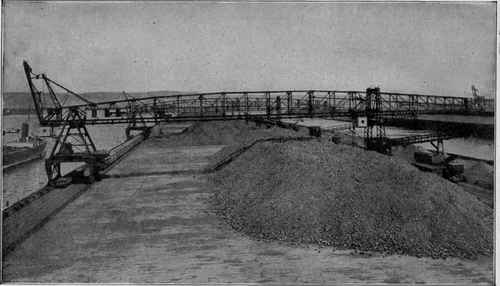
Courtesy of the Link-Belt Co., Chicago, HANDLING COAL.
Four-ton grab buckets operating on the four bridge-tramways pick up the coal from the hold of lake steamers and deposit it either on the dock or in cars. The four machines can be moved to any part of the dock to which steamers are moored and four ships can be unloaded rapidly at one time. The motive power is electricity.
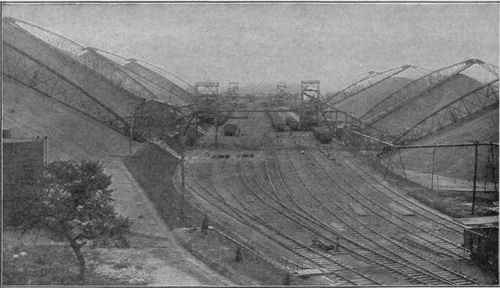
Courtesy of the J. M. Dodge Co. STORING COAL.
A 480,000-ton anthracite coal storage plant. Coal cars are dumped into hoppers under the tracks and the coal carried to the top of the piles by conveyors. It is reloaded into cars by other conveyors operating at the base of each pile. This system has been of great value in preventing a shortage of coal during strikes.
Consequently a plan has been evolved for the ventilating current to be reversed periodically, in order to remove dust which has settled on the side of timbering and crevices, and the roadways to be watered in order to allay the dust. A plan has also been tried of spreading fine stone-dust in the roadways. This mixes with the coal-dust and renders it less inflammable.
Unfortunately the disastrous effects of an explosion do not end with the explosion itself. The main products of combustion, whether of fire-damp or coal-dust, are carbon monoxide and carbon dioxide. The latter causes suffocation and the former is a dangerous poison. It is the dreaded "after-damp" of the miner. Those who survive an explosion are therefore in danger of suffocation or poisoning, and it becomes imperative to restore the circulation of the air with the least possible delay. For even if the fan has escaped injury, fallen portions of the roof may have choked up some of the roadways, or the explosion may have torn down doorways and provided a short cut for the air. But if the atmosphere is dangerous for men in the pit at the time, it is equally dangerous for others to go down and effect repairs or render first aid.
The work of the rescue party is therefore a labor of desperate heroism and often attended by additional loss of life. It has recently been found possible to reduce the dangers of after-damp by providing rescue parties with respirators fitting over the mouth and nose, and supplied with oxygen from two steel bottles of the compressed gas strapped across the back. An effective apparatus of this kind, such as has been adopted by the United States Government for the use of the Bureau of Mines Rescue Crew, is shown in the accompanying illustration. The bag in front is known as a "breathing bag" and has separate compartments for the inhaling and exhaling, the tube at the right leading to the former and that at the left to the exhaling compartment, which usually contains sticks of caustic soda to absorb the carbon dioxide exhaled by the wearer.
Continue to:


My Books

