


The Story Of The Tunnels Under The Hudson River. Part 2
Description
This section is from the book "The Wonder Book Of Knowledge", by Henry Chase. Also available from Amazon: Wonder Book of Knowledge.
The Story Of The Tunnels Under The Hudson River. Part 2
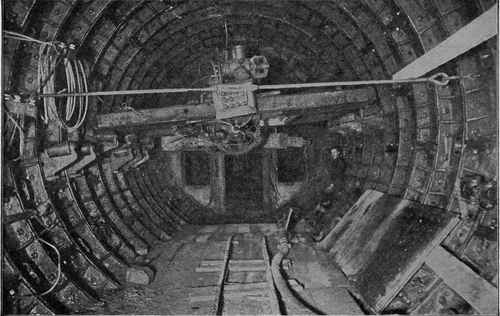
Cutting Shield Head.
made by saying that if the ceiling of a room was weak and threatening to fall - if we filled the room with sufficient pressure of air, it would support the ceiling and prevent it falling in. In tunnel work, air is supplied under compression from the mechanical construction plant located on the surface, and the pressure of air maintained in the working chamber is determined by the depth of the work below tide level, as the hydrostatic head increases with the depth.
Control of air pressure is never entrusted to any but the most reliable, competent and experienced man, as it is of the utmost importance that air pressure be maintained properly. The first impulse of an inexperienced man, should he notice an
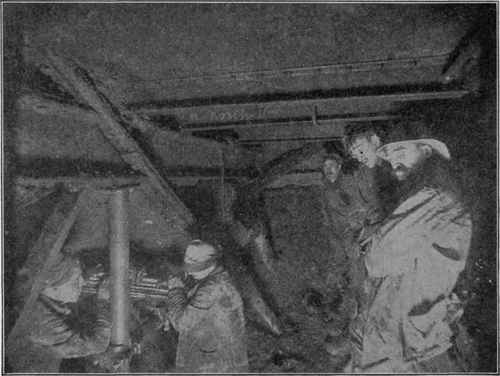
Apron in Front of Shield, Five Minutes Before Shoving.
To improperly or inopportunely raise the air pressure would be quite likely to result in the air blowing a hole through the roof of the tunnel heading, allowing all air pressure to escape, and permitting an uncontrollable volume of water to rush in and flood the work.
The outer shell of the tunnel shield is composed of two- or three-ply boiler plates, and the interior is braced with a system of steel girders. The shields used weighed approximately sixty-seven tons each. Sixteen or eighteen were used. To move the shield forward, each shield was equipped with sixteen hydraulic jacks, arranged around the shield circumferentially. These jacks were controlled by a series of valves, which were so designed that any one jack or any set of jacks desired could be operated. This was necessary as the direction of the shield was, as it were, guided by the pressure of the jacks. When it was desired to alter the direction of the shield, either upwards or downwards, or to the right or left, the jacks on the opposite side to which the shield was to point, were operated. The hydraulic pressure operating these jacks was 5,000 pounds per square inch, and the total energy, when all jacks were employed at the same time, was equivalent to 2,500 tons, which was equal to eleven tons per square foot of heading.
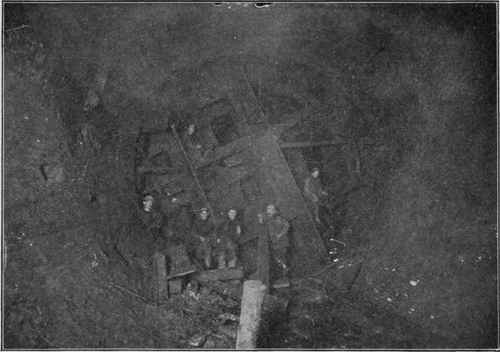
Cutting Edge of Shield in North Tunnel.
Air pressure used to prevent the inflow of water and soft dirt varied from nothing up to forty-two pounds, although a fair average throughout was thirty-two pounds. It varied, of course, according to the condition encountered.
The working chamber is the space between the tunnel heading where work is in progress and the air-lock. The air-lock is a device used for the purpose of enabling workmen and materials to pass from the portion of the tunnel where the atmospheric pressure is normal into the portion where the air pressure is greater than normal; that is, the working chamber. The air-lock is a cylinder, usually about six feet in diameter and twenty feet in length, with a heavily constructed iron door at each end. This lock is placed horizontally in the tunnel at such a level as the conditions of the work necessitate, but usually near the bottom, and around this cylinder, and completely filling the cross-section of the tunnel, a concrete bulkhead is built ana is known as the lock bulkhead. The two doors open in the same direction; the one at the normal pressure end opening into the cylinder, and the one at the heading end opening away from the cylinder. One door is always closed, and both doors are closed during the operation of entering or leaving the air-pressure section.
Going into the air pressure, the door at the heading end is held closed by the pressure of air against it while one is entering the lock, after which the outer door is also closed. A valve is then opened which permits the air to flow from the working chamber into the lock, until the lock becomes filled with air of the same pressure as exists in the heading. As soon as the pressure is thus equalized, the door at the neading end can be opened and the workmen pass into the heading. Going out, the operations are simply reversed. After the heading door is closed, with the workmen in the air-lock, a valve is opened which permits the air in the lock to

Shield Cutting Edge Breaking Through Wall at Sixth Avenue and Twelfth.
Street, Looking South, October 23, 1907 exhaust into the normal air, until the pressure within the lock reduces to the same as that outside, when the outer door can be opened and persons inside the lock pass out. Both operations must be gradual, as a sudden change from normal to high pressure, or vice versa, would be very dangerous to anyone.
In tunneling under the river, nearly every conceivable combination of rocks and soils were met, but for the most part the material was silt. In such material, with a pressure of 5,000 pounds per square inch on the shield jacks, the shield was pushed through the ground as though one pushed a stick into a heap of snow, pushing aside the silt, and thus obviating the necessity of removing any excavated material. Sand or gravel, or any material which would not flow or become displaced by the shield, of course, had to be excavated ahead of the shield, and removed from the heading prior to pushing it forward. In the silt the most satisfactory and economic progress was attained, and a record was made of seventy-two feet of finished tunnel, completely lined with iron, in one day of twenty-four hours.
The most difficult combination that had to be dealt with under the river was when the bottom consisted of rock and the top of silt and wet sand. In such cases, and there were many of them, the upper section of soft ground was first excavated and the exposed face securely supported with timbers ahead of the shield, and the rock underlying then drilled and blasted. This was very tedious and expensive work. Exceedingly small charges of dynamite had to be used and the procedure conducted with the utmost caution.
Continue to:


My Books

