


Chapter VI. Composition Of Liquid And Vapour Phases. Theoretical
Description
This section is from the book "Distillation Principles And Processes", by Sydney Young. Also available from Amazon: Distillation Principles And Processes.
Chapter VI. Composition Of Liquid And Vapour Phases. Theoretical
Simplest Cases
It has been seen that when two liquids are placed together in a closed vacuous space, the vapour pressure and the boiling point can only be accurately calculated from the vapour pressures of the components if (a) the liquids are non-miscible, or (b) they are miscible in all proportions and show no change of temperature or volume when mixed together, this being generally the case when the substances are chemically closely related. A similar statement may be made with regard to the composition of the vapour evolved from the two liquids.
Non-miscible Liquids
The simplest case is that in which the two substances are non-miscible, for the composition of the vapour - like the vapour pressure and the boiling point - is independent of the relative quantities of the components, provided that they are both present in sufficient quantity and that evaporation can take place freely ; the composition of the vapour can be calculated if the vapour pressures and vapour densities of the non-miscible liquids are known.
Calling the vapour densities DA and DB, and the vapour pressures at the temperature t, PA and PB, we shall have, in a litre of the mixed vapour, 1 litre of A at t° and PA mm. pressure and litre of B at t° and
PB mm. The masses of vapour will therefore be and respectively, and the relative masses will be
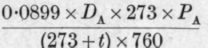
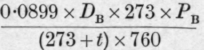

[Naumann,1 Brown 2]
Chlorobenzene And Water
As an example we may again consider the case of chlorobenzene and water, the vapour pressures of which at 90° to 92° are given below.
1 Naumann, "On the Distillation of Benzene, Toluene, etc., in a Current of Steam," Berl. Berichte, 1877, 10, 1421, 1819, 2015; " On a New Method of determining Molecular Weights," ibid., 10, 2099.
2 Brown, "Theory of Fractional Distillation," Trans. Chem. Soc, 1879, 35. 547.
Table 22
Temperature. | Vapour Pressures in ram. | ||
Chlorobenzene. | Water. | Total. | |
90° | 208-35 | 525.45 | 733.8 |
91 | 2158 | 545.8 | 761.6 |
92 | 223-45 | 566.75 | 790.2 |
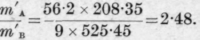
The vapour density of chlorobenzene =56.2 and of water =9.
At 90° the relative masses of vapour
At 91 ,, ,, ,,

At 92 ,, ,, ,,

The percentages of chlorobenzene by weight will therefore be 71.3, 71.2 and 71.1, respectively, at the three temperatures.
In the actual experiment (p. 41), in which 80 grams of water and 110 grams of chlorobenzene were distilled together under a barometric pressure of 740.2 mm. until about 3 grams of chlorobenzene and 40 of water remained in the flask, the distillate was collected in five fractions, which were found to contain the following percentages of chlorobenzene: -
1 . | . 72.5 |
2 . | . 71.5 |
3 . | . 720 |
4 . | . 70.4 |
5 . | . 71.7 |
Mean 71.6 |
Calculated 71.2
Water is apt to adhere in drops to the walls of a glass tube, but chlorobenzene flows much more freely; the first fraction is therefore certain to contain too little water, and it would be fairer to reject it and to take the mean from the other four fractions. This would give 71.4 per cent of chlorobenzene, which agrees better with the calculated value.
The vapour pressure, boiling point and vapour composition can be calculated in a similar manner when more than two non-miscible liquids are present.
Partially Miscible Liquids
If the two liquids are miscible within limits, the observed vapour pressure, boiling point and vapour composition will differ from those calculated in the manner described, but the difference will be small if the miscibility is only slight.
Aniline And Water
A mixture of 50 c.c. of aniline and 100 c.c. of water was distilled under a pressure of 7464 mm. (p. 41). The percentage of aniline, calculated on the assumption that the liquids are non-miscible, would be 23.6, while the values observed were 18.7, 20.1, 19.7, 20.4, 20.4, 19.1. After the sixth fraction had been collected the aniline was in great excess; a large quantity of water was added and the distillation continued, when the distillate contained 19.5 per cent of aniline. The composition of the distillate is clearly independent-within the somewhat wide limits of experimental error - of that of the mixture in the still, but the mean percentage of aniline, 19.9, is 3.7 lower than that calculated.
Isobutyl Alcohol And Water
When the mutual solubility is greater, the difference between the observed and calculated values, as regards both temperature and vapour composition, is more marked. Thus isobutyl alcohol and water are miscible within fairly wide limits. At 0° a saturated solution of water in the alcohol contains 15.2 per cent of water, and the solubility increases as the temperature rises. At 18° one part of alcohol dissolves in 10.5 of water, but the solubility diminishes with rise of temperature, reaching a minimum at about 52°.
From Konowaloff's data1 for the vapour pressures of isobutyl alcohol, the boiling point of the alcohol and water, when distilled together under normal pressure, would be 85.7° if the liquids were non-miscible; the minimum boiling point observed by Konowaloff was actually 90.0°, or 4.3° higher (Young and Fortey, 89.8°). Again, the calculated percentage of isobutyl alcohol in the vapour would be 74.5, while that corresponding to the minimum boiling point is actually 66.8, the difference being 7.7.
It is clear, then, that when two non-miscible liquids are heated together we can calculate the vapour pressure, the boiling point and the vapour composition with accuracy from the vapour pressures of the components, but that, if the liquids are miscible within limits, the calculated values differ from those actually observed, the difference increasing with the mutual solubility of the liquids.
Continue to:


My Books

