


General Remarks. Part 12
Description
This section is from the book "Distillation Principles And Processes", by Sydney Young. Also available from Amazon: Distillation Principles And Processes.
General Remarks. Part 12
Table 82
Reichert-Meissl values. | Polenske values. | |||
Pressure in mm. | Observed. | Calculated. | Observed. | Calculated. |
100 | 22.34 | 22.58 | 019 | 0.19 |
180 | 24.43 | 24.19 | 0.48 | 0.48 |
250 | 25.57 | 2510 | 0.75 | 0.73 |
380 | 26.93 | 26.23 | 114 | 1.19 |
450 | 2713 | 26.69 | 1.61 | 1.44 |
627 | 27.60 | 27.60 | 2.06 | 2.07 |
760 | 27.99 | 2812 | 2.68 | 2.55 |
900 | 28.17 | 28.60 | . . | . . |
1000 | 28.05 | 28.87 | 3.40 | 3.40 |
In other words the Polenske values are not far from proportional to the total pressures, increasing somewhat more rapidly, whilst the Reichert-Meissl values are very roughly proportional to the logarithms of the pressures, increasing somewhat more slowly.
The vapour pressures of some of the fatty acids have been determined at a series of temperatures, and although these temperatures are generally higher than 100° they afford the means of calculating the percentages of acid in the distillates when these acids are distilled with water under different total pressures, the assumptions being made that the vapour densities of these higher acids are normal and that the acids are insoluble in water.
Table 83. Myristic acid, D = 114 ; Water, D=9
T.°C. | Vapour pressures. | | Percentage of acid in distillate. | Total Pressure. | | |
Acid. | Water. | |||||
190.8 | 100 | 9609 | 0.01318 | 1.301 | 9619 | 135 |
207.6 | 200 | 13655 | 0.01855 | 1.821 | 13675 | 133 |
217.4 | 30.0 | 16550 | 0.02296 | 2.245 | 16580 | 135 |
223.5 | 40.0 | 18573 | 0.02728 | 2.656 | 18613 | 143 |
Laurie acid, D = 100 ; Water, D=9. | - | |||||
164.5 | 8.0 | 5210 | 0.01706 | 1.64 | 5218 | 314 |
174.1 | 12.0 | 6576 | 0.02028 | 1.99 | 6588 | 302 |
185.9 | 200 | 8625 | 0.02576 | 2.51 | 8645 | 291 |
195.5 | 30.0 | 10633 | 0.03135 | 3.04 | 10663 | 285 |
203.0 | 40.0 | 12437 | 0.03573 | 3.45 | 12477 | 277 |
Oenanthylic acid, D = 65 ; Water, D=9 | ||||||
144.0 | 50 | 3040 | 0.1188 | 10.62 | 3090 | 3436 |
160.0 | 100 | 4652 | 0.1552 | 13.44 | 4752 | 2828 |
199.6 | 400 | 11582 | 0.2494 | 19.96 | 11982 | 1666 |
2210 | 760 | 17722 | 0.3097 | 23.65 | 18482 | 1280 |
 •
•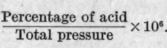
It will be seen that with myristic acid the calculated percentage of acid in the distillate is just about proportional to the total pressure. In the case of lauric acid, although the percentage of acid increases with the total pressure, the increase is relatively less rapid. With oenan-thylic acid there is still an increase in the percentage of acid in the distillate, but the ratio of the percentage of acid to the total pressure shows a marked fall as the pressure rises.
Although butyric acid and the acids of still lower molecular weight are miscible with water in all proportions. one may calculate the values of to ascertain how they would behave on distillation with water it they were insoluble in it and if their molecular weights were normal. The calculation indicates that if these conditions were fulfilled the percentage weight of butyric acid in the distillate would increase with rise of total pressure far more slowly than that of oenanthylic acid, while the percentage of acetic acid would actually diminish.

One may therefore take it as a rule, with probably no exceptions, that when the insoluble aliphatic acids are distilled with water under a series of different pressures, the higher the molecular weight of the acid the more rapid is the relative increase in the percentage of acid in the distillate, with rise of total pressure. The results obtained by Kirkham are in conformity with this rule, but, as he points out, the problem is greatly complicated by the fact that the mixture distilled contains, in addition to water, a large amount of glycerol, in which the higher acids are nearly insoluble, as well as sodium sulphate and some free sulphuric acid. There are also relatively very large quantities of palmitic and oleic acids with which the lower acids are miscible in all proportions and which are themselves nearly non-volatile at the temperature of distillation. On the other hand the quantities of caprylic and capric acids are relatively very small indeed.
The presence of a large amount of non-volatile acids would certainly diminish the volatility of small quantities of the lower homologues, and Mr. Kirkham informs me that by adding margarine to butter the Polenske value and even the Reichert-Meissl value is actually lowered.
Continue to:


My Books

