


2. The Sea
Description
This section is from the book "An Introduction To Geology", by William B. Scott. Also available from Amazon: An Introduction to Geology.
2. The Sea
The destructive work of the sea is accomplished mainly by means of the waves which the wind raises upon its surface and by wind and tidal currents. The great ocean currents are, as a rule, so far from shore, and flow in such deep water, that their erosive power is comparatively small. The Gulf Stream is said to scour the bottom in the Florida Straits and off the Carolina coast, but this is exceptional.
Waves act continually upon all coasts, but with very different force at different times and places. According to observations made for the Scotch Lighthouse Board, the average wave pressure on the coast of Scotland is for the five summer months 611 pounds per square foot, and for six winter months 2086 pounds. These are average figures and are greatly exceeded in storms, when the force of the breakers often rises to many tons per square foot.
The effect produced by this great force depends upon the character of the rocks of the coast, its height, and the angle at which it rises out of the water; also, in the case of stratified rocks, upon the attitude of the beds, whether they are horizontal, or inclined toward or away from the sea. When the coast is high, steep, and rocky, the waves continually wear away its base, partly by dislodging the blocks into which all consolidated rocks are divided, and partly by using as projectiles the blocks which it has dislodged, or which have been loosened by the frost. In heavy gales great masses, weighing tons, it may be, are hurled with tremendous violence against the base of the cliffs, cutting them into caverns, which are further excavated by the ordinary surf. Eventually, the cliff is undermined, and the unsupported masses above fall in ruins.
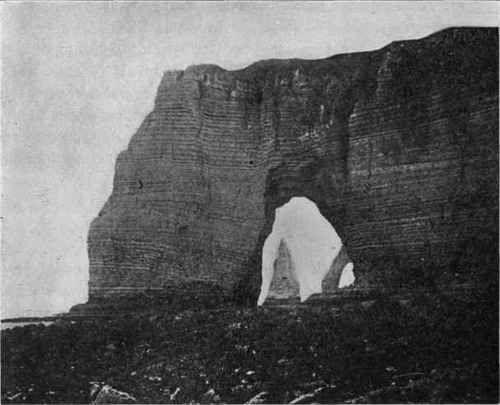
Fig. 74. - Wave erosion; Etretat, France.
Waves are not so entirely dependent for their effectiveness as rivers are upon the hard materials which they dash upon the coast for their efficiency as destructive agents. The force of the mere blow given by a storm breaker is very great, and the hydrostatic pressure which first forces the water into every fine crevice of the rock, and then withdraws it, together with the sudden compression and reexpansion of the air contained in these fissures, assists materially in the loosening of the blocks.
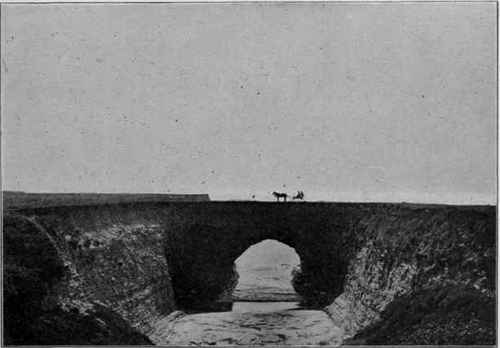
Fig. 75. - Wave-cut arch, coast of California. (U. S. G. S).
Along coasts which are composed of hard rocks the work of cutting back the land by the sea is comparatively slow, but when the rocks are soft and yielding, and yet rise abruptly from the ocean, the waste is so rapid as to attract every one's attention. The coast of Yorkshire in England is washed away at an average rate of nearly seven feet per annum. The island of Heligoland, near the German coast, has suffered great loss from the attacks of the sea within historic times; the small eastern island was cut off from the larger island, Heligoland proper, by a great storm in 1720.
At Long Branch, New Jersey, the sandy bluffs must be artificially protected against the attacks of the sea; yet in spite of such protection, almost every severe gale does considerable damage.
Sandy coasts which are low-lying and flat often suffer less from the inroads of the sea than rocky and precipitous ones, especially as they are.apt to be lines along which material is accumulating. Even such coasts may, however, be rapidly cut back, as is shown in the familiar example of Coney Island, where great damage has been done of late years. When the sea is eating away a sandy shore, the homogeneous material prevents the occurrence of such irregularities of the coast-line as occur in rocky districts. So long as the coast is neither elevated nor depressed, the surf cuts it back at a continually decreasing rate, because the retreat of the coastline leaves a shelf covered with shallow water, in passing over which the waves are retarded by friction and strike the shore with greatly diminished force. Just how far such a coast may be cut back is not definitely known, but it probably does not exceed a few miles, at most. On the other hand, if the land in question be slowly sinking, the sea gains a great advantage and may continue its destructive work indefinitely. Indeed, several high authorities are of the opinion that this is the only method by which great areas can be planed down to an approximately level surface.
Again, it should be noted that when the sea is advancing over an ancient land surface, it finds ready to hand an immense body of soft materials which are speedily removed. The deep decay of the rocks into soil and the deposits made by the wind, rivers, lakes, etc., have all prepared the way for the erosive action of the sea. When the coast is elevated, the sea cuts a succession of terraces.
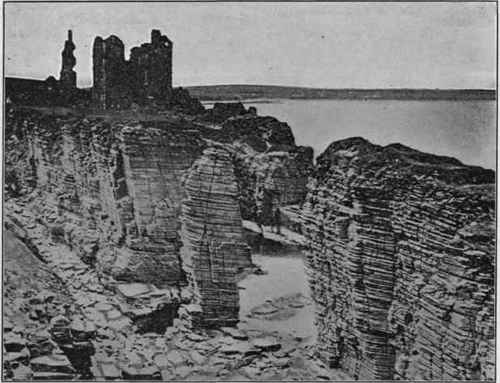
Fig. 76. - Wave erosion, strata dipping seaward; Orkney Islands, Scotland.

Fig. 77. - Wave erosion, strata dipping landward; Duncansby Head, Orkney Islands.
Besides cutting back its shores, the sea continually grinds up the material which is brought into it by the rivers, and that which it obtains by its own wear of the coast. The great blocks on the shore are rolled about in storms, and worn into rounded bonlders, which are gradually reduced to smaller and smaller size. All the minerals softer than quartz are rapidly ground into fine particles and swept away by the undertow into deeper and quieter waters, leaving the larger quartz fragments to form the pebbles and sand of the beach.
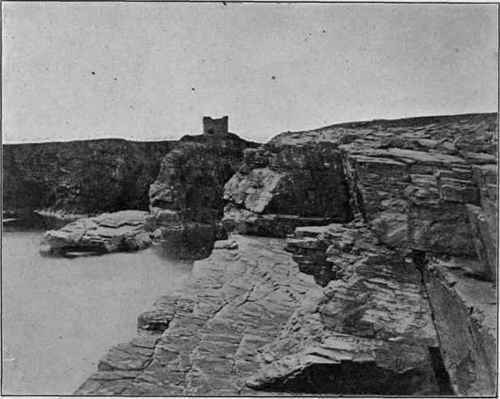
Fig. 78. - Joint-block partly dislodged by the surf on wave-cut terrace; Wick, Orkney Islands.
The action of the waves is limited vertically, ceasing to be effective in quite shallow water, not far below the low-tide mark. In violent storms the waves often accomplish much destruction far above high tide, but the principal work of the waves is confined to a belt extending from a little above high tide to somewhat below low tide. However, Graham Island, near Sicily (see p. 67), which was thrown up in 1831, has been so completely removed by the waves that not even a shoal remains. Below the low-water mark the wave work is often efficiently supplemented by tidal currents, which under favourable circumstances acquire great velocity and depth, scouring away loose materials and even cutting into solid rock. When an island of considerable extent is exposed to the incoming tide, the latter travels around the island in both directions, and if the shape of the mainland is favourable, one of these currents will be much higher than the other, which will produce a "race" between the island and the mainland. Hell Gate, New York, is an example of this; the tide advances through New York Bay and Long Island Sound, being higher at flood, lower at ebb, in the sound than in the bay. The consequence is a swift current into the bay at flood-tide and into the sound at ebb.
The floor of the British Channel, over which the tidal currents run very rapidly, is swept bare of sand, which is carried into the North Sea. By such means as this, the sea cuts away the land to depths much greater than unassisted waves can effectively reach.

Fig. 79. - Igneous rock, corroded by sea-water, about 1/2 natural size. (Photograph by van Ingen).
Rocks are also attacked chemically by the solvent and decomposing action of sea-water. The silicates, such as the felspars, augite, hornblende, etc., are attacked much more rapidly than in fresh water. In shoal water and on the shore this action is obvious only in spots sheltered from the direct assault of the waves, because the products of decomposition are immediately removed by the surf and the mechanical work is so much more striking. Limestone coasts suffer from solution by sea-water, and are characterized by long caverns and tunnels, though sea caves are worn by the surf in all classes of rocks In the profound depths of the oceanic basins, where the water is never disturbed and where its motion is extremely slow, chemical activity becomes relatively very important. Calcareous shells are completely dissolved, and the volcanic debris, which covers the sea-bottom over vast areas, is disintegrated into a characteristic red clay.
Continue to:


My Books

