


3. Organic Accumulations
Description
This section is from the book "An Introduction To Geology", by William B. Scott. Also available from Amazon: An Introduction to Geology.
3. Organic Accumulations
The organically formed rocks are those whose materials were accumulated by living beings, on the death of which more or less of their substance was preserved, added to by successive generations, and finally compacted into rock. In preceding chapters we have read of these processes as going on at the present time, in peat bogs, in the coral reefs, shell-banks, limestone plateaus, and organic oozes of the ocean. Similar processes have been at work in all the recorded ages of the earth's history since the first appearance of living things, and very extensive rocks have thus been built into the solid crust of the globe. An exact classification would require us to place certain of these rocks among the mechanical sediments, because the actual work of accumulation was performed by mechanical agencies, such as waves and currents. But it will be more convenient to examine together all those rocks which are principally made up of organic materials, especially as it is not always easy to distinguish the results of one mode of formation from those of the other.
A. Calcareous Accumulations
Limestone is a very abundant, important, and widely distributed rock, the commonest of the organic accumulations. It is composed of carbonate of lime in varying degrees of purity, hardness, fineness of grain, and crystalline texture. Sand or clay is frequently present as an impurity, and by an increase in these materials, the limestones pass gradually into sandstones and shales. In some varieties of limestone the organic nature of the rock is most obvious, shells, corals, crinoid stems, and the like being conspicuously shown, especially on weathered surfaces. In other kinds the microscope is required to make this organic nature clear; while in others, again, the calcareous materials have been so ground up by the action of the waves, or so completely modified by crystallization, that all traces of organic structure have disappeared. The example of the reef rock now forming in many coral reefs (p. 264) is a warning that the absence of even microscopic structure in a limestone cannot be relied upon as a proof that the rock is not of organic origin.
The great limestones are almost entirely of marine origin, though quite extensive fresh-water limestones are known. The chemically formed ones are never very widely extended, though they may form quite thick masses. As a rule, the limestones are deposited in deeper water than the sandstones and shales, but not necessarily so, freedom from large amounts of terrigenous sediments being more important than depth of water. This is shown by the great calcareous banks of the Gulf of Mexico and the Caribbean Sea (p. 259), and coral reefs are always formed in water of less than twenty fathoms in depth.
The classification of the limestones is very difficult, and cannot be readily made on any single principle; mode of formation, purity, texture, and nature of organic material, all being employed for the purpose.
Shell Marl is an incoherent and crumbling rock, formed principally at the bottom of fresh-water lakes and ponds, by the accumulation of shells; it frequently occurs beneath peat bogs, and is an indication that the bog arose from the choking up of a lake by vegetable growth. When the shells are cemented into a hard rock they form a fresh-water limestone.
Chalk is a soft limestone of friable, earthy texture, and frequently very pure; in colour it may be snowy white, pale gray, or buff. The microscope reveals the fact that chalk is principally composed of the shells of Fora-minifera, and closely resembles the foraminiferal oozes forming to-day at the bottom of the sea (p. 270). A chalky deposit may, however, be formed from the debris of corals ground up by the waves.
The ordinary massive marine limestones are named from the character of the organic material which predominates in them. Thus, we have coral lime'stone, foraminiferal limestone, made up of the shells of very large extinct forms of the Foraminifera (Fusulina, Nummulites, Orbito-lites, etc.), crinoidal limestone, shell limestone, and the like.
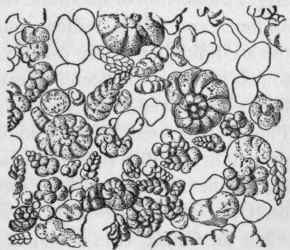
Fig. 148. - Chalk from Kansas X 45. (Drawn from a photograph by the Geological Survey of Iowa).
Though much the larger part of the limestones is of animal origin, yet certain seaweeds contribute extensively to the formation of these rocks, and there is much reason to believe that chemical precipitation is of greater or less importance in nearly all varieties of the rock. Many of the massive limestones, which show little or no sign of disturbance, are quite completely crystalline, due to the action of water upon them. Calcite recrystallizes with the greatest ease, and the interior of coral-masses, which are still alive on the outside, may be so crystallized as to obliterate all traces of their original structure.
Dolomite, or Magnesian Limestone, is a compact, granular rock of white, gray, or yellow colour, composed of the carbonates of lime and magnesia. Nearly all limestones contain some carbonate of magnesia, but the name dolomite is given only to those with a considerable percentage of that substance (5 to 20%). How far this rock is made up of the mineral dolomite, and how far it is merely a mixture of the two carbonates, is uncertain, as is also the way in which the rock was formed. Dolomite contains a much larger proportion of magnesia than the shells or tests of any known animals, and this ingredient must therefore have been added after the accumulation of the calcareous organisms. Opinions differ as to just how this has been accomplished, but probably the magnesia has been derived from the strong brine of lagoons and salt lakes. The frequent association of dolomite with gypsum gives additional probability to this view. A similar process has been observed in the lagoons of coral reefs at the present time (p. 266), and it has been shown that dolomitization takes place much more readily when the CaC03 is in the form of aragonite, as is the case in the shells and tests of many marine animals.
Green Sand is not strictly a calcareous deposit, but has a natural connection with that series of rocks. Green sand is seen by the microscope to be largely composed of internal casts of foraminiferal shells in the mineral glauconite (p. 19). The dead foraminiferal shells which lie upon certain areas of the ocean floor are gradually filled up with glauconite, and then the shells are dissolved, leaving the grains of the mineral, which retain the form into which they were moulded. This process is still going on, and has been observed at several points (p. 269). Glauconite also forms on the sea-floor in nodules, quite independently of foraminiferal shells.
Continue to:


My Books

