


4. The Abysmal Deposits
Description
This section is from the book "An Introduction To Geology", by William B. Scott. Also available from Amazon: An Introduction to Geology.
4. The Abysmal Deposits
The Abysmal Deposits are those the materials of which are not directly derived from the land, but consist of matters carried to the sea in solution and extracted from the sea-water by the agency of organisms, together with volcanic substances in a more or less advanced stage of decomposition. Only rarely are terrigenous materials found in these deposits, as, for example, off the west coast of Africa, where fine sand, carried by the wind from the Sahara, is found in deep water, and ice-borne fragments are common in high latitudes. The pelagic deposits are found far from land, mostly in the deepest oceanic abysses, where the rate of accumulation is almost inconceivably slow, and the remains of extinct animals still lie exposed upon the ocean floor.
(I) Foraminiferal Ooze
The Foraminifera are minute animals, each one a tiny speck of jelly, most of which, in spite of their extreme simplicity of structure, have the power of secreting very beautiful and complex shells of CaC03. The species which are of importance in this connection are those which live in infinite multitudes at the surface of the ocean, and the most abundant at the present time are those which belong to the genus Globigerinr. whence this deposit is frequently called Globigerina ooze. These surface Foraminifera flourish best in warm water and follow the warm currents, often into quite high latitudes. Their shells, which drop to the bottom as the occupants die, are present in almost all marine deposits, but near land the terrigenous materials preponderate to such a degree that the Foraminifera make up but a slight proportion of the deposit. In deeper water, where the wash from the land does not come, the foraminiferal shells become relatively much more abundant, and when 30 % or more of a given sample of the bottom consists of them, it is classed as a foraminiferal ooze.
Other organisms which secrete calcareous shells or tests always contribute more or less to these oozes (coral mud, echinoderms, molluscs, nullipores, etc.). The deposit is purest and most typical in the medium depths of the ocean, far from any land; in such places the ooze may contain as much as 90 % CaC03 and is white, while nearer land the slight admixture of terrigenous minerals gives a pink, gray, brown, or other colour to the mass. Below the depth of 2500 fathoms the proportion of CaC03 becomes much diminished, owing to the increasing percentage of C02 in the sea-water, which attacks and dissolves these delicate shells.
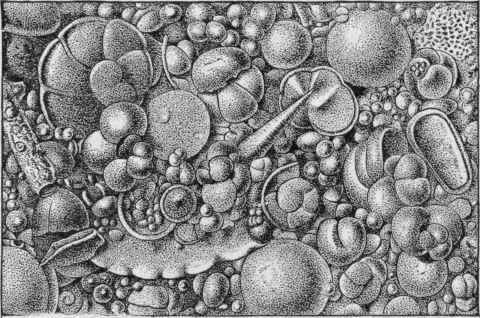
Fig. 142. - Foraminiferal ooze, x 20. (Agassiz after Murray and Renard).
The foraminiferal oozes have a vast geographical extent, estimated at 49,520,000 square miles, and are especially developed in the Atlantic, though they are largely present in all except the polar seas, and range in depth from 400 to 2900 fathoms.
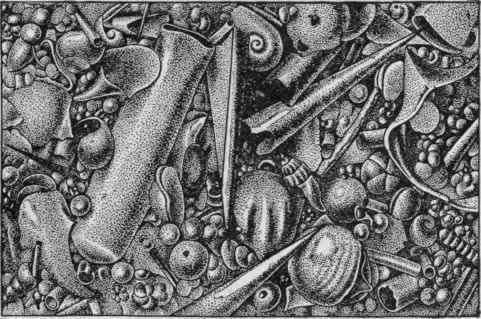
Fig. 143. - Pteropod ooze, x 4. (Agassiz after Murray and Renard).
(2) Pteropod Ooze
The thin and delicate shells of the mollus-can groups known as the pteropods and heteropods abound at the surface of the warmer parts of the ocean, but their dead shells are found only in depths of less than 2000 fathoms. In shallow water (and even in greater depths near land) the shells are concealed by other kinds of material, but in moderate depths, far from any land, these shells sometimes become so frequent in the foraminiferal ooze as to give it a special character. In its typical development this pteropod ooze has been found only in the Atlantic, where it covers some relatively small areas, in depths of 400 to 1500 fathoms.
(3) Radiolarian Ooze
The organisms which we have so far considered secrete only shells or tests of CaC03, but this is not the only substance which is very extensively extracted from sea-water by living beings. Silica is also dissolved in sea-water, and various organisms construct their tests of that substance. The Radiolaria are, like the Foraminifera, a group of microscopic, unicellular animals, which secrete siliceous tests of the most exquisite delicacy and beauty; they live both at the surface and at the bottom of the sea. Radiolarian tests may be detected in all sorts of marine deposits of both deep and shallow water, but it is only in very profound depths that they occur in quantity sufficient to give character to the deposit. When 20 % or more of a bottom deposit consists of radiolarian tests, it is called a radiolarian ooze, but clay and volcanic minerals make up most of the materials. This ooze has been found only in the Pacific and Indian oceans, where, it is estimated, it covers 2,290,000 square miles of the bottom, at depths of 2350 to 4475 fathoms.
(4) Diatom Ooze
In our study of fresh-water deposits we learned that the siliceous cases of the microscopic plants known as diatoms form considerable accumulations in lakes and ponds, and they also flourish abundantly in brackish water and in the sea. Diatoms are found in many marine deposits, but in relatively small quantities. In the Antarctic Ocean, however, is in immense belt of ooze, believed to cover 10,880,000 square miles and extending around the globe, which is largely made up of their frustules. Besides the great Antarctic zone, an area of some 40,000 square miles is known in the North Pacific. The diatom ooze entirely resembles the fresh-water deposit, but may be distinguished by the presence of foraminiferal and radiolarian shells and tests. The depths at which this ooze is found are from 600 to 2000 fathoms.
(5) Red Clay
The profoundest abysses of the ocean, far from any land, are covered with a deposit of red clay, which, though varying much in composition and colour, is yet of a quite uniform character. In these vast depths the foraminiferal shells are almost all dissolved by the carbonated sea-water, but some CaC03 is very generally present, averaging about 6%, and diminishing in quantity as the depth increases. In the less profound abysses the red clay passes gradually into the foraminiferal oozes, the number of shells increasing until the ooze-like character is attained. The clay is derived from the disintegration and decay of volcanic substances, especially pumice, which floats upon water, often for months, and drifts long distances in the ocean currents. The greater part of these volcanic materials is believed to be derived from terrestrial volcanoes, but the submarine vents doubtless contribute largely; particles of undecomposed volcanic minerals and glasses are also common. In some regions the clay is coloured chocolate-brown by the oxide of manganese, and many separate nodules of this substance are found.
The excessive slowness with which this abysmal deposit is formed, is shown by the occurrence, in recognizable quantities, of meteoric iron, which reaches the earth in the form of meteorites, or " shooting stars," and by the presence of the remains of animals which have long been extinct.
Of all the oceanic deposits the red clay is the most widely extended, covering 51,500,000 square miles of the bottom. Almost four-fifths of this vast area are in the great depths of the Pacific; the shallower Atlantic has much more of the foraminiferal ooze than of the red clay. The observed range in depth is from 2225 to 3950 fathoms.
Comparing the marine deposits now accumulating in the sea with the rocks of evidently marine origin which form most of the land, we find that the great bulk of these rocks, the sandstones, slates, and limestones, are such as are formed in water of shallow and moderate depths, while only rarely do we discover a rock that implies really deep water.
Continue to:


My Books

