


II. What May Be Learned From Fossils
Description
This section is from the book "An Introduction To Geology", by William B. Scott. Also available from Amazon: An Introduction to Geology.
II. What May Be Learned From Fossils
The principal value which fossils possess for the geologist lies in the assistance which they give him in reconstructing the history of the globe. This they do in several ways.
(1) In Determining Geological Chronology
The most obvious way in which to make out the relative ages of a series of stratified rocks is to determine their order of superposition, for the oldest will be at the bottom and the newest at the top (see p. 321). But this method is of only local application and will not carry us far in an endeavour to compile a history of the whole earth. It cannot enable us to compare even the rocks of different parts of the same continent, for any exposed section is but a small fraction of the whole series of strata. More embarrassing still, strata change their character from point to point, limestone being laid down in one place while sandstone is accumulating in another. Still less can the order of superposition help to determine the relative ages of rocks in different continents, for this order in North America can be no guide to the succession in Africa or Australia. This conclusion does not imply that order of superposition may be safely neglected; on the contrary, it is of fundamental importance, but it must be studied in connection with the fossils.
Life, since its first introduction on the globe, has gone on advancing, diversifying, and continually rising to higher and higher planes. We need not stop to inquire how this progression has been effected; for our present purpose it is sufficient to know that progress and change have been unceasing and gradual, though not necessarily occurring at a uniform rate. Accepting, then, the undoubted fact of the universal change in the character of the organic beings which have successively lived on the earth, it follows that rocks which have been formed in widely separated periods of time will contain markedly different fossils, while those which were laid down more or less contemporaneously will have similar fossils. This principle enables us to compare and correlate rocks from all the continents and, in a general way, to arrange the great events of the earth's history in chronological order.
The general principle that similarity of fossils indicates the approximate contemporaneity of the rocks in which they are found must not be taken too literally, for it is subject to certain limitations and exceptions.

Fig. 255. - Geological map of Central New York, showing the faunal provinces of the Upper Devonian (Portage stage). (Clarke).
(a) Exact contemporaneity is not meant, for the progress of life is very slow, and rocks formed thousands of years apart may yet contain precisely similar fossils.
(b) Animals and plants differ in different parts of the world, so that contemporaneous rocks formed in widely separated regions will always show a certain amount of difference in their contained fossils. In comparing the rocks of two continents, it is often exceedingly difficult to decide just how much of a given difference in the fossils is to be ascribed to a difference in the time of rock formation, and how much to mere geographical separation. There is a great difference in the value of the various classes of organisms for chronological purposes, the most useful being those which have the most efficient means of very wide simultaneous dispersal. Such are the pelagic organisms, which live at the surface of the open sea and, either alive or dead, are carried for vast distances by the ocean currents.
A geographical distinction which should be emphasized is that of fades, by which is meant the sum total of environmental conditions, organic and inorganic. Deep or shallow water, salt water or fresh, muddy or sandy, or rocky bottom, are all differences of facies, and quite closely adjoining, strictly contemporaneous deposits may display them. Different assemblages of contemporaneous fossils also constitute facial differences; thus we speak of the graptolitic, or the cephalopod facies of a geological division.
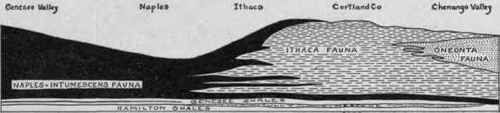
Fig. 256. - East-west section through area given in Fig. 255, showing changes of facies. (Clarke).
A possible source of error in the inferences drawn from fossils lies in the incorporation of more ancient remains washed out of an older rock and embedded in a newer one. Figure 257 is a photograph taken on the York River, Virginia, which shows fossil shells washed out of the bluffs and lying on the beach, where they are mingled with modern organic remains.
Despite these limitations we find that, speaking broadly, the order of succession in the appearance and extinction of the great groups of fossils is much the same for all parts of the earth, and we may confidently assume that the grander divisions of geological time are of world-wide significance.
It will now be easy to understand why the fossils in two groups of unconformable strata are generally so radically different. It is because of the long lapse of unrecorded time at that point, during which organic progress continued; when deposition was resumed, the animals and plants were all new, and so the change is abrupt. If one is reading a book from which a dozen chapters have been torn out, the change of subject will appear violently abrupt; to bridge over the gap one must find another copy of the book.
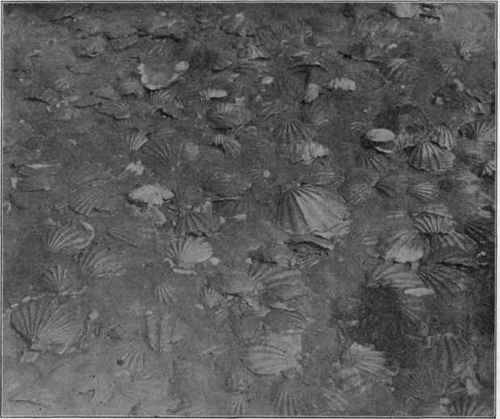
Fig. 257. - Fossil shells (Miocene) lying on a modern beach, York River, Va.
(Photograph by van Ingen).
Likewise, to fill up the gap of a great unconformity, we must go to some region where deposition went on uninterruptedly, and there we may trace the gradual and steady change in the fossils.
Continue to:


My Books

