


Rain. Part 3
Description
This section is from the book "An Introduction To Geology", by William B. Scott. Also available from Amazon: An Introduction to Geology.
Rain. Part 3
Other things being equal, the rapidity with which the rain sweeps away the soil depends upon the steepness of the slope upon which the soil is formed; for gravity largely determines these movements. On cliffs and steep hillsides the soil is quickly removed, and in such places it is thin or quite lacking, while in the valleys it often accumulates to great depths. Even on gentle slopes and almost level stretches the rains slowly wash it downward, and eventually into the streams which carry it to the sea. The soil is thus not stationary, but under the influence of the rains and streams is slowly but steadily travelling seaward. Disregarding the alluvial deposits made by rivers, and soils accumulated by the action of ice or wind, the soil of any district is thus a residual product, and its quantity represents the surplus of chemical disintegration over mechanical removal.
The mechanical action of rain is greatly increased by extreme violence and volume of precipitation; a single "cloud-burst" will do far more damage than the same quantity of rain falling in gentle showers. Those who know only the temperate regions can form but imperfect conceptions of the violence of tropical rains. On the southern foot-hills of the Himalayas, for example, the rainfall is exceedingly great (in some localities as much as 500 inches per annum), and almost all of it is precipitated in six months of the year; especially remarkable is the quantity which often falls in a single day. "The channel of every torrent and stream is swollen at this season, and much sandstone and other rocks are reduced to sand and gravel by the flooded streams. So great is the superficial waste, that what would otherwise be a rich and luxuriantly wooded region is converted into a wild and barren moorland." (Lyell).
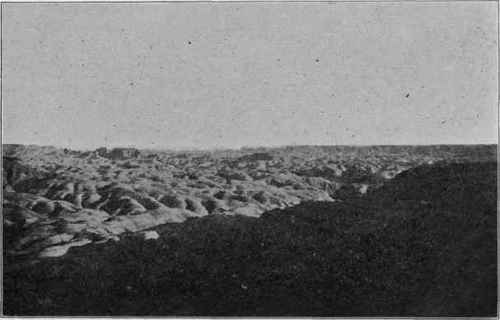
Fig. 35. - Bad lands of South Dakota. (U. S. G. S).
The action of rain is thus by no means uniform, the results depending upon so many and such varying factors, that we may find marked differences in closely adjoining regions, and even in one and the same mass of rock. One of the most remarkable monuments of rain erosion is exhibited by the curious districts in the far Western States known as the bad lands, which cover many thousands of square miles in the Dakotas, Nebraska, Wyoming, Utah, etc. The bad-land rocks are mostly rather soft sandstones and clays, with prevailingly calcareous cements, and formed in nearly horizontal beds or layers. The rainfall is light, though torrential showers sometimes occur; but the absence of vegetation is favourable to its efficiency, and the present aridity of the climate is not of very long standing, from a geological point of view. The chemical action of the rain has disintegrated the rocks by dissolving out the calcareous cement, and then the debris so formed has been mechanically washed away.
At the present time the action of the rain is very slow, because the debris which covers the sides of the cliffs and slopes is almost impervious to water, and holes left after the excavation of fossil skeletons often remain visible for many years; but where the bare rock is exposed, the disintegration often proceeds with extraordinary rapidity, and a single shower will produce notable effects. The different layers of rock resist decay differently, and even in the same bed some parts are much more durable than others. This differential weathering has resulted in that remarkable variety and grotesqueness of form, resembling the ruins of gigantic towers and castles, for which the bad-land scenery is famous. The sculpture of the rain produces this variety in accordance with the arrangement of the more and less durable layers. The varying arrangement of these layers produces a fantastic topography. A variant of bad-land topography is given by the pillars of Monument Park, Colorado, which are due to weathering, the capping of hard rock protecting the soft sandstone below. (See Fig. 38).
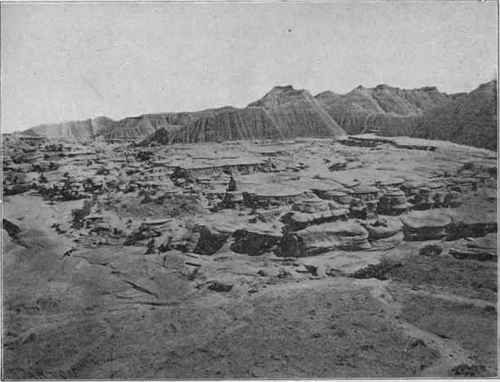
Fig. 36. - Bad lands near Adelia, Nebraska. The rock in the middle distance is sandstone formed in a stream-channel and the bluffs are flood-plain deposits. (U. S. G. S).
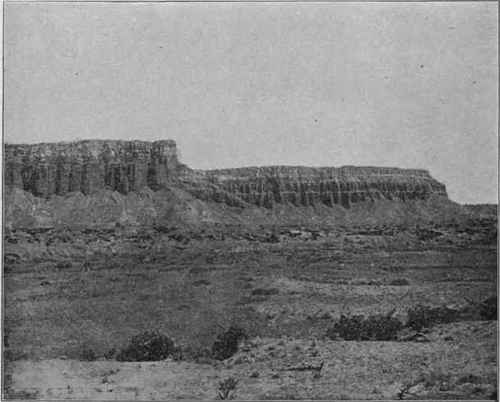
Fig. 37. - Bad lands in Wyoming, with talus slopes. (U. S. G. S).
The mechanical wash of rain is greatly retarded when the ground is covered with dense vegetation, which protects the soil against the impact of raindrops and the wear of rain rills. The removal of the vegetation is often speedily followed by disastrous results, and especially the reckless and wanton destruction of the forests, which has gone on in this country ever since its settlement by Europeans, has been followed by the loss of valuable soil on a vast scale. Speaking of the soil destruction in the old fields of southern Mississippi, McGee says that they are washed away, "leaving mazes of pinnacles divided by a complex network of runnels glaring red toward the sun and sky in strong contrast to the rich verdure of the hillsides never deforested. . . . Whole villages, once the home of wealth and luxury, are being swept away at the rate of acres for each year".
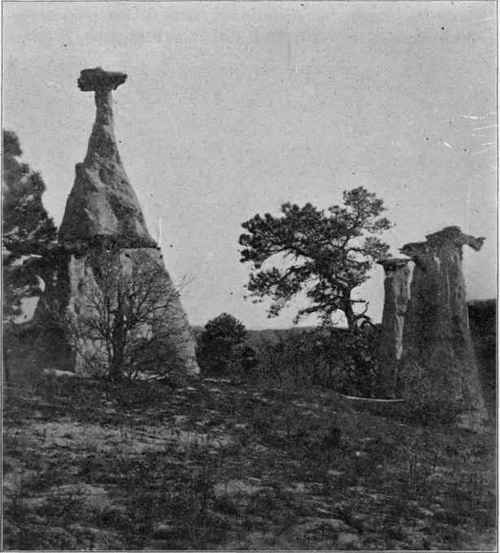
Fig. 38. - Monument Park, Colorado. (U. S. G. S).
It is to be hoped that the work of the United States Bureau of Forestry, in endeavouring to check this terrible destruction, may receive the support it so well deserves from every intelligent lover of his country.
Continue to:


My Books

