


Apparatus - Generator
Description
This section is from the book "Leaching Gold and Silver Ores. The Plattner And Kiss Processes: A Practical Treatise", by Charles Howard Aaron. Also available from Amazon: Leaching Gold And Silver Ores.
Apparatus - Generator
Press
63. Press. To facilitate the drying of the silver precipitate it is pressed into cakes. The press is similar to a cheese press. It is sometimes operated by means of a screw, but a weighted lever is better, because self-acting. A press may be dispensed with if the drying facilities are ample.
64. Pipes and faucets must be provided for the conveyance of water and hypo to the points where they are required. Iron pipes with brass faucets may be used for the hypo. A few paper buckets will be useful.
Chlorine Generator
65. Chlorine Generator. Figure 1, Plate 5, is a section of this apparatus. It is made almost entirely of lead, sometimes heavy sheet, but better cast lead, and is arranged so as to be heated from below, either by a special fire, or preferably, when convenient, by steam. If heated by a fire, it stands on a sand bath, which forms the top of the fire place. If by steam, the generator itself forms the top of an iron steam chest, being supported on strips of wood, which permit the steam to circulate beneath it.
66. The joints of the lead work must not be soldered, but "burned;" that is, joined with melted lead, by means 3 of a gas blow-pipe. Very coarse solder will, however, answer for repairing it. Portland cement also answers, in case of necessity, for stopping a leak.
67. The apparatus consists of a leaden tub a, in which the materials are put, and which is surrounded by a water chamber 6, also of lead, the outer wall of which rises as high as the top of the cover, c, and in which the curtain of the cover rests, forming what is called a water joint. The water should be six inches deep, or more. The pipe, d, is for the removal of spent material. In the cover is a central water-joint opening, through which passes the stem of a stirrer, e, made of iron, covered with lead, and to which is attached a small leaden bell, or curtain, f, which, reaching near to the bottom of the water chamber, closes the opening, while allowing the stirrer to be turned round by means of the cross bar, g. Another opening, h, which is closed either by a water-joint cover, or, as shown in the figure, by a wooden plug wrapped in greased cloth, serves for introducing material without lifting the main cover. For the introduction of acid, there is a leaden pipe, i, which is coiled once round, as shown in the figure, in order that the lower part of the coil, remaining always full of acid, may act as a valve to prevent the escape of the chlorine. The pipe, k; is for the exit of the chlorine.
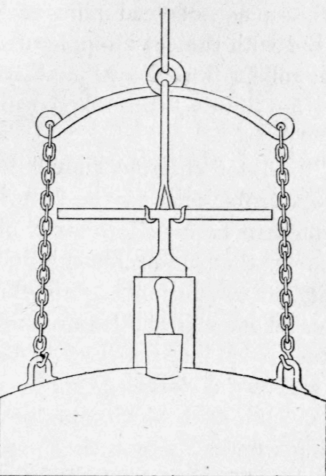
The subjoined diagram represents the cover in a different position, showing the lugs and the chain sling, by which it is raised; also a hook sustaining the stirrer, which might otherwise injure the cover. A lever or tackle is used for the lifting. For further remarks on generators, see "Addenda," near the end of this volume.
Wash Bottle
68. Wash Bottle. Figure 2, Plate 5. This is a bell glass, made from a large bottle, the bottom of which is cut off. It is fixed air-tight, as shown, in the head of a keg, or the tightly fitting cover of a small tub. A piece of pure rubber tube, l, which is connected with the leaden pipe, k, of the generator, passes through the neck of the bottle, and is packed so as to be air-tight, with oiled rags and putty, and terminates two or three inches below the surface of the water with which the tub or keg is filled. The chlorine, rising through the water into the bell, escapes through the leaden pipe, m, and is conveyed to the chlorinating vat by the rubber tube, n. The pipe, m, is passed, water-tight, through a short piece of oiled rubber tube inserted in a hole bored in the side of the keg, and its upper end, reaching nearly to the top of the bell, and well above the water, is bent downward to prevent the entrance of water, which might occur in consequence of the bubbling up of the gas, and which would cause an obstruction in the rubber tube.
Apparatus -- Wash Bottle
If two vats are chlorinated at once, the rubber tube, n, is connected with a forked piece of lead pipe, each branch of which is connected with the lead nipple of a vat by a piece of rubber tube. The connections are quickly made by drawing the tightly fitting oiled rubber tubes an inch on to the pipes.
69. All rubber tubes used for chlorine should be oiled on the inside. It is a valuable fact, for the knowledge of which I am indebted to E. N. Riotte, that oil is a great protection against the action of chlorine, which forms with it a white, waxy substance. For this reason, oil or grease is an excellent material for stopping small leaks in the apparatus.
70. The wash bottle serves the double purpose of washing the gas to remove any acid which may pass over with it, and of showing whether or not the generator is operating properly, by the quantity of chlorine which is passing. The chlorine should rise through the water in a steady stream. If it does not, the reason is either that it is not produced fast enough, or the orifice of the pipe is too large, which may be remedied by flattening the pipe more or less. Other forms of wash bottle will be found described under "Addenda."
Continue to:


My Books

