


Melting Furnace
Description
This section is from the book "Leaching Gold and Silver Ores. The Plattner And Kiss Processes: A Practical Treatise", by Charles Howard Aaron. Also available from Amazon: Leaching Gold And Silver Ores.
Melting Furnace
198. I have seen, in the mining regions, many barbarously constructed melting furnaces, some of which were very inconvenient to work with. A description of the furnace which I build for silver melting, where economy is an object, and of which Figures I and 2, Plate 8, are sections, will probably be useful.
This furnace is suitable for a number 30 or 35 black lead pot, with charcoal as fuel. There is no heavy and expensive cast-iron plate on the top, and the cover may be of sheet-iron, although cast-iron is better.
The interior may be cylindrical, but is better, as shown in the figures, narrowed toward the top and bottom. The grate bars rest on an iron ring, Figure 3, supported by an offset in the masonry. The latter is mostly of a very rough kind, as the furnace is sunk in the ground to within a foot of the top, which, besides affording great convenience in working, obviates the necessity of iron bands or stay-rods to support it against the expansion caused by the heat. The greater part of the lining, 4 inches thick, is of good clay, very slightly moistened, and beaten round a hollow wooden core, for which part of a barrel of suitable size answers very well. It is topped with a course of common brick, and above these is a flat iron ring, Figure 4, with lugs, which may be bolted down, or simply let in flush with the top of the furnace.
Plate VIII.
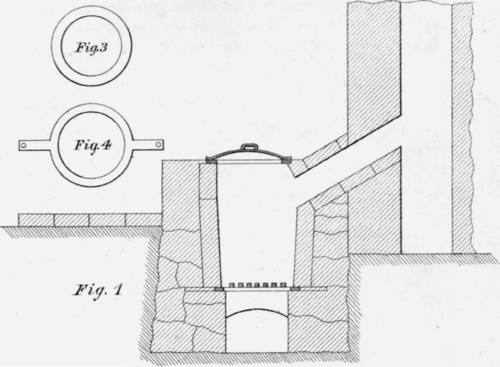

Scale; 1/2 inch = 1 foot.
The grate bars are not built in, but are free to be removed whenever desired. The furnace is constructed, when convenient, at the base of the main smoke stack, with which it is connected by a flue; otherwise a large stove-pipe will answer for a chimney. When the weight of melted metal does not exceed 100 pounds avoirdupois, the pot is lifted out of the furnace by hand, by means of the basket tongs, the mould being placed on the platform of masonry which is seen in the figure on one side of, and level with the furnace. The melter stands on the top of the furnace to lift, then steps to the ground one foot lower, to pour.
If larger quantities of metal are melted at once, a lever may be employed for lifting the pot. The lever is arranged like that of a blacksmith's bellows, being supported by a rope, chain, or swivel, in such a manner as to admit of a lateral as well as a vertical movement, and at a height of not less than six feet above the furnace, the center of which is directly under the shorter arm.
From the longer arm of the lever a rope depends; from the shorter arm a link of half-inch iron, long enough to reach, when drawn downward, into the cavity of the furnace, and terminating in a hook engaging in an eyebolt which forms the pivot connecting the jaws of the tongs.
The tongs being adjusted on the pot, a ring is slipped over the handles to hold them together; the melter steadies them, while an assistant, pulling on the rope at the other end of the lever, lifts the pot out of the furnace, and swings it near to the mould, when the melter pours the metal.
The hands and arms of the melter are protected by gloves, which, in some works, are elaborately made of canvas and padding. To make a glove, I simply take an ore sack, double it lengthwise, and sew it so as to form a narrow bag, of two thicknesses of canvas, into which the arm may be thrust to the shoulder. The gloves may be wetted to prevent burning, but hot articles must not be grasped with a wet glove, because the steam produced will scald the hand; yet, moisture is a good protection against radiant heat, while grasping the cool handles of the tongs.
In melting with charcoal, the best result is obtained, not by keeping the furnace full, but by letting nearly all the fuel burn away, before refilling. A little practice will enable the melter so to manage that there shall be but little coal in the furnace when the time for pouring arrives, so that it is not in the way when seizing the pot with the basket tongs. The lifting must be performed without delay, otherwise the tongs may become red hot, and bend. The feet and legs of the melter may be protected by woolen armor, or by wetting the boots and trowsers; but melters and assayers must not shrink from a little scorching.
If there is much fuel left in the furnace when the melting is ended, the grate is taken out, and the embers fall into the ash pit, where they are extinguished.
Clinkers, if formed on the sides of the furnace, from the melting of the lining, or from dirty fuel, are punched off, while red hot, by means of an iron bar with a chisel end. If they were to be removed after cooling, the walls would be broken.
If making a bar of clean skimmed metal, it is proper to throw a little resin, or powdered charcoal into the pot, a few seconds before pouring. It prevents the sputtering which is often caused by the formation of base oxides. As soon as such a bar is cast, the top of it is covered with charcoal powder, to prevent oxidation while solidifying When the slag or matte is poured with the metal the charcoal is not required.
The addition of sand in melting an impure precipitate, especially when, by over-roasting, a good deal of base metal sulphate or oxide has been formed, is very beneficial in saving the pot, by slagging the oxides by which it would otherwise be attacked.
Charcoal is used to effect the deoxidation of sulphates, which would otherwise take place at the expense of the plumbago pot. It is also employed to prevent the formation of a crust, or to reduce the same if formed, on the surface of the matte.
Continue to:


My Books

