


Concluding Remarks. Continued
Description
This section is from the book "The Pyrotechnist's Treasury: Complete Art Of Making Fireworks", by Thomas Kentish. Also available from Amazon: The Complete Art of Firework-Making: The Pyrotechnist's Treasury.
Concluding Remarks. Continued
Fig 169 is a wasp-light The proper composition will be found among the fuses: drive it into a roman candle case with the rammer, fig, 4. Bring the leader from the mouth b, backwards along the outside of the case, and tie it in a couple of places, as drawn. Evening is the best time to use it: push the end b into the nest, light at a, and retire.
Instead of a five-pointed star, a seven-lance star, fig. 170, may be employed. To form it, have a piece of deal board, half-an-inch thick, 6½ inches square: draw the diagonals, to find the centre; and, with a pair of compasses, stretched to a 3-inch radius, describe a circle Carry the radius 6 times round it; and in the points and the centre drive 7 French nails; cut off their heads, and fix on them 7 lances: the middle one, crimson; the others, 3 green and 3 blue, placed alternately.
In forming a rocket spindle, taper it no more than will just make it deliver: the thicker it is left at the top, the stronger of course it will be. For small rockets, 3/8 or 4/8, a brass, iron, or steel wire, with a few notches filed in it, or made jagged with a cold chisel and hammer, driven into a block, will hold firm without a screw. I have seen them driven into a piece of thick plank, and the nipple formed with an inch-length of wood, cut cylindrical, bored and slipped over the spindle, like c in fig. 155, Indeed, a spindle might be formed from a 5-inch or 6-inch carriage-bolt. At Woolwich Arsenal rockets are charged solid. The fuse is shaped into pellets, something like large peppermint lozenges, or cylindrical cakes of paste blacking, by hydraulic pressure in a mould. These pellets, discs, or cakes, which are almost as hard as a stone, are put into the case, and pressed in tight: the rocket is then fixed upright, and slowly drilled, as I have seen, with a conical borer, working vertically, to let the dust fall and clear itself.
This mode must not be imitated by an amateur; indeed, without accurate machinery, the desired object could not be effected, and there is constant liability to danger.
The fuse of a rocket, when consolidated, assumes the form of fig. 18, with the head sawn off, except that the hollow is tapering, instead of cylindrical; and the rocket stands thus- 1/3 cup + 6 choke & hollow + 1 1/3 solid + 1/3 plaster = 8 diameters.
In the trade, meal powder, saltpetre, and charcoal, go by the names of meal, petre, and coal. Common coal, for burning in fires, is never employed in Pyrotechny; it would produce only dull red sparks and smoke.
Meal, or petre, added to a fuse quickens it; sulphur slackens it. 6 meal, 1 sulphur, make a quickmatch that blows through a leader with great violence, 1 meal, 1 sulphur, will scarcely burn; pure meal only should be used for match, or grain powder with hot starch. It has already been stated that nitre in powder is sometimes adulterated with salt, and that it is impossible to make a rocket with such stuff. Powdered chlorate of potash is sometimes adulterated with nitre: with such mixture it is equally impossible to produce good colours: nitre whitens flame, and overpowers colour.
Chlorate of potash, charcoal, sulphur, stearine, used separately, with discretion, vivify colours; calomel deepens the colour, but slackens the flame.
Star compositions which inflame vigorously in dry summer weather, will often scarcely, burn at all in damp weather; this is especially the case with stars containing nitrate of strontian.
In washing sulphur, stir it with a wooden spoon; if a silver one were used, a black sulphide would be formed on the surface, very difficult to remove. If silver coins in the pocket get tarnished while using sulphur, rub them with salt, or chalk, or whiting.
A magnet is convenient for lifting tacks, small screws, etc, from divisions in nail boxes.
If the brass tube formers get tarnished, scrape off the lacquer with a knife, sand paper them anew, and give them a fresh coat of lacquer.
Let all wheel frames and woodwork be coloured black, either with paint, or with a mixture of vegetable or lamp black and size, or thin glue, to prevent their being seen. A white thread hung upon a bush, is visible many yards off; a black one can scarcely be seen a few feet distant. Black is not only invisible, but it throws the brilliancy of sparks, and the vividness of colours, into stronger relief.
Let every article be dried, reduced to a fine powder, put into a clean bottle, and carefully corked: also let every bottle be labelled: the labels are best stuck on with paste, not gum: gum labels are apt to drop off in damp weather.
Let all metallic articles, liable to rust, be wiped with a tag dipped into olive oil, before being laid by for future use.
Before putting aside the six-inch circular frying-pan, set it over the fire till warm, put into it a lump of tallow, and smear it with a rag: when wanted for use, set it on the fire, put into it a cupful of water and a piece of soda; make the water boil, and stir it well round; pour away the water, and dry the pan over the fire.
Let muslin sieves always be dried before being put aside; also, again, before use. Zinc sieves may simply be wiped dry.
Have a place for everything; and keep everything in its place.
Faraday, the great master in experimental lectures, always devoted many hours to the preparation of his experiments for each lecture* No point, however trifling, bearing upon the success of the experiment, was considered unimportant: he used to try the stoppers of all the bottles he had to use, to see that they had not become fixed, and thus would cause delay by requiring forcible opening. His example cannot be too carefully copied. Before firing a display, all posts, spindles, lines, staples, screws, touch-paper, portfires, pieces of leadered quickmatch, etc, should be carefully provided. A yard of tape Slowmatch, hung to a nail at the top of a post, will supply fire for a long time.
A book should be kept for future guidance, in which should be written the quantity of composition required to make a certain number of articles of a certain size: by attending to this, much waste will be prevented.
Never, upon any account, leave compositions lying about; and let nothing be done by candlelight, except making cases. Quick-match, especially, ought to be kept locked up, so that nobody can get to it.
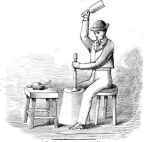
Charging a Case.
Never put squibs, crackers, etc, into the pockets: a stray spark might ignite the whole, and cause most serious mischief.
Continue to:


My Books

