


Section 78. American System Of Land Parceling
Description
This section is from the book "Popular Law Library Vol6 Real Property, Abstracts, Mining Law", by Albert H. Putney. Also available from Amazon: Popular Law-Dictionary.
Section 78. American System Of Land Parceling
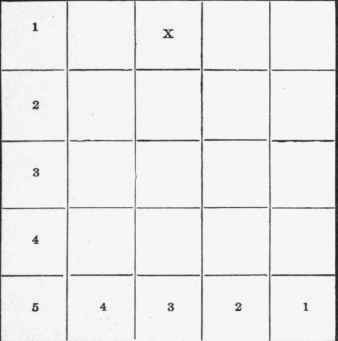
In order to secure a more scientific system of land division and description, the United States Government early adopted a uniform rectangular system of surveying the public lands of the United States. Under this system the public land of the United States when first surveyed, is intersected by principal meridians, running north and south, and base lines running east and west. Starting from these as a basis, the land is then divided into townships, six miles square; the ranges of townships being numbered east and west along the base lines and the numbers of the townships in the range north and south along the principal meridians. Under this system the township marked X in the following map would be described as township five, north, range three, west of the principal meridian.2
1 It has been held that where the grant is of a specified quantity of land, a similar specified quantity can not be excepted from it. This question is a very technical one and not of very great importance. It is safer, however, in such a case to have the exception come before the enumeration of quantity. 2 For a more detailed discussion of the description of land, see the subject of Abstracts in this volume.
N Towns North
W
Range West
(Range Line Principal Meridian.)
E
S
Each township is next divided into thirty-six sections, arranged and numbered as in the following map:
N
W
E
S

The sections are next divided into quarter sections of 160 acres each, which is the quantity generally transferred by the government in its grants. Provisions are made in the law for the correction of errors in the survey caused by the distance between the range lines growing smaller toward the north and for the surveying of fractional townships or sections, part of which are occupied by navigable lakes, streams, etc. The treatment of these provisions belong more properly to a book on surveying than on law.
Continue to:


My Books

