


Chapter VII. Athletic Meetings
Description
This section is from the book "Athletics And Football", by Montague Shearman. Also available from Amazon: Athletics and Football.
Chapter VII. Athletic Meetings
If there be little to say of the individual athlete's requisites,, there is much that is interesting to note in the requisites for the meeting at which the athlete figures. The days are now gone when the champions of each neighbourhood met upon the village-green, and took off their boots to run upon the nearest level piece of turf which was handy. A club which undertakes to hold a meeting has now to find a ground, prizes, officials, and a variety of implements and conveniences, which render the undertaking anything but a simple one. The first requisite of all is of course to get a ground, and it is of grounds,, therefore, that we first propose to speak.
In London, Birmingham, Oxford, Cambridge, and other great centres of amateur athletics there are regular running grounds, which can be engaged by a club which requires them. Nearly all the regular paths are 'cinder tracks,' although of late years one or two have been made (chiefly for cycling purposes)' not with cinders, but with burnt ballast or red brickdust. The making of a good path is a difficult and expensive undertaking, including as it does levelling, draining, and laying down of the cinders or brickdust. Excavation is made to the depth of from 12 to 18 inches, 12 inches being generally considered sufficient with a dry gravelly soil, while in a clay soil the full 18 inches is required. If the excavations be of 12 inches, about 5 or 6 inches of this is filled up with large brick rubbish, or what is known as ballast gravel - i.e. large stones which allow the water to drain through. Over the top of this, 3 or 4 inches of rough cinders are placed, so as to leave room for a layer of 3 inches of fine sifted cinders or brickdust upon the top. These 3 inches of fine stuff have to be put on in thin layers, to be watered from time to time and continually rolled.
For the purpose of assisting the drainage, the centre of the path is usually raised slightly higher (not more than an inch) than the sides, and gullies are made at the side leading down to cesspools to carry off water which may collect after a sudden shower. When a good path is once made it wants little but rolling in wet weather and watering and rolling in dry weather to keep it in good condition. After many years, when the fine stuff off the top has been blown or carried away, and the coarser stuff below is working up, the top dressing may have to be renewed. Perhaps the better course is-after each season to sprinkle a thin layer of cinders over the top of the path to keep it fresh.
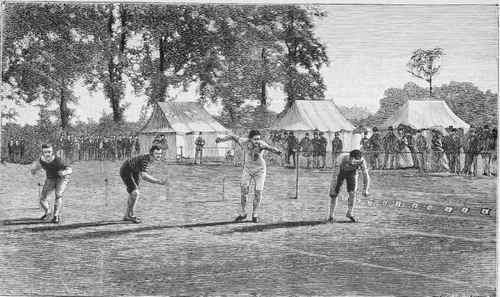
A GRASS COURSE.
Just at the present it would seem that fashion is changing round from black cinders to red brickdust as a top dressing for running tracks. The brickdust was, as we have said, originally used for cycling, but upon the inner path made at Lillie Bridge for wheels many foot-races were held with great success. No doubt the brickdust which has a slight mixture of loam is harder, and thus better suited for wheeling, and the fact that both Myers' 48 3/4 sec. for a quarter and George's 4min. 12 4/5 sec. for a mile were accomplished upon the red track at Lillie Bridge seems to show that it is hardly less fitted for pedestrian contests. Probably, however, Myers and George both chose the inner track at Lillie Bridge, well knowing that the old cinder track upon the outside was getting worn out and in poor condition. The drawback of the red paths is that they get very hard and dead in wet weather, while a really well-drained cinder path like that at Oxford or Stamford Bridge keeps its lightness, in spite of the ram, in a wonderful manner.
We should not be surprised if the cinder track of the future for running purposes were to be a mixture of cinders and burnt brick ballast in equal proportions.
Until 1866 the Oxford and Cambridge sports were held upon grass courses either at the Christchurch cricket ground at Oxford or at Fenner's cricket ground at Cambridge. In 1867, however, the Universities moved up to London to the cinder track at the old Beaufort House at Walham Green, upon which the championship meeting of the previous year had taken place. The Beaufort House track was certainly not a good one, being loose and ill-drained, nor was its oval shape well suited for fair racing; however, it sufficed for championship and Inter-University meetings until 1869, when both meetings were shifted to the newly opened ground of -the A.A.C. at Lillie Bridge. After it was got into working order the Lillie Bridge ground was certainly a very good one, perhaps as good and as fair a track as has ever been made. Like most other good paths, it was a third of a mile in circumference, but its chief merit in our opinion lay in the fact that the turns were well graduated. Although the corners were apparently sharp, by making the path slope downwards to the corner, the runners were prevented from running wide, and were given four straight stretches, one on each side of the ground. This, we think, is the right shape of path for every race under a mile, and especially for handicap races.
The Cambridge ground at Fenner's is also constructed on this principle, there being no long gentle curves as there are at both ends of the ground at Oxford and at Stamford Bridge. Until 1876 the London Athletic Club used Lillie Bridge for their meetings, but the following year they took possession of their own private ground at Stamford Bridge. After that the Lillie Bridge track was undoubtedly left neglected, and in its latest years the old outer track was not good, the gravel underneath having worked up. In many places also the path was treacherous, the new cinders which had been placed at the top giving way under the feet of the runners. The Stamford Bridge track is, we think, about as badly shaped as a ground can be for any short races, but the track itself underfoot is almost as good as possible. The path is only a quarter of a mile in circumference, the lap consisting of two straight stretches of 120 yards each at the sides and two gradual curves of 100 yards each at the ends, and the quarter-mile races, as they were originally run upon the ground, were run over 200 yards out of 440 upon a curve. The ground was soon improved by a very long 'straight' of 250 yards extending up one side.
Continue to:


My Books

