


Football. History. Part 8
Description
This section is from the book "Athletics And Football", by Montague Shearman. Also available from Amazon: Athletics and Football.
Football. History. Part 8
The football was thrown down in the churchyard and the point then contended was, which party should carry it to the house of his respective captain, to Dundraw perhaps or West Newton, a distance of two or three miles. The details of these matches were the general topics of conversation amongst the villagers, and were dwelt on with hardly less satisfaction than their ancestors enjoyed in relating their feats in the border wars.
A relic of a lay of a local minstrel upon one of these contests is given by the same authority and is decidedly amusing: -
At Scales great Tom Barwise got the ba' in his hand, And 't wives aw' ran out and shouted and banned, Tom Cowan then pulched and flang him 'mongt' whins, And he bleddered od-white-te tou's broken my shins.
In another place ('Every Day Book,' vol. i. p. 245) Hone gives a letter written in 1815, describing 'Football Day' at Kingston-on-Thames at that date. A traveller journeying to Hampton Court by coach 'was not a little amused upon entering Teddington to see all the inhabitants securing the glass of all their front windows from the ground to the roof, some by placing hurdles before them, and some by nailing laths across the frames. At Twickenham, Bushy, and Hampton Wick they were all engaged the same way.' The game is then described as follows: -
At about twelve o'clock the ball is turned loose, and those who can kick it. There were several balls in the town of Kingston, and of course several parties. I observed some persons of respectability following the ball; the game lasts about four hours, when the parties retire to the public-houses.
Altogether it appears that the Kingston game in 1815 was not what M. Misson would have called ' utile et charmant.'
There is another allusion to football in the 'Every Day Book' (vol. ii. p. 374) which is also interesting. A correspondent.
'J. R. P.,' writes a letter to say that when he was a boy football was played in his village, in the west country, on Sunday mornings before church-time, the field of play being the 'church-piece '; and the same writer also says that at that date (1841) football was played on Sunday afternoons, in fine weather, in the fields near Copenhagen House, Islington, by Irishmen, who played from about three o'clock until dusk. 'I believe,' he says, 'as is usual in the sister kingdom, county men play against other county men. Some fine specimens of wrestling are occasionally exhibited in order to delay the two men who are rivals in pursuit of the ball.' Whatever the last words may mean, it appears certain that the Irishmen played the collaring and not the dribbling game.
It is obvious from Hone's extracts, therefore, that football as a national pastime was, in the first half of this century, dying out in England. In Scotland, however, it appears to have been more flourishing. Scott would hardly have written in the 'Lay of the Last Minstrel': -
Some drive the jolly bowl about,
With dice and draughts some chase the day,
And some with many a merry shout,
In riot, revelry, and rout, Pursue the football play if he had not seen plenty of football in his time. Indeed,
Hone assists us in another place to an account of a great football match in Scotland with which Sir Walter Scott was personally concerned. In his ' Every Day Book,' vol. i. p. 1554, he says: 'On Tuesday, the 5th of December, 1815, a great football match took place at Carterhaugh, Ettrick Forest (a spot classical in minstrelsy) betwixt the Ettrick men and the men of Yarrow, the one party backed by the Earl of Home and the other by Sir Walter Scott, sheriff of the forest, who wrote two songs for the occasion.' One of the songs is given in extenso, but space forbids our quoting more than a couple of verses: -
From the brown crest of Newark its summons extending Our signal is waving in smoke and in flame;
And each forester blithe from his mountain descending Bounds light o'er the heather to join in the game.
Then strip lads and to it, though sharp be the weather, And if, by mischance, you should happen to fall,
There are worse things in life than a tumble on heather, And life is itself but a game at football.
Luckily, however, though football steadily decreased in popularity throughout the first half of this century, it was rather in. a state of dormancy than of collapse, and was not long in picking up again when in 'the fifties' the revival came from the public schools. It is not too much to say that the present football movement can be directly traced to the public schools and to them alone, though, in a great many centres, when the revival came the game was still known not only as a game for boys, but as a pastime for men. In many corners of England, indeed, the old time-honoured game, without rules or limit to the number of players or size of ground, was being carried on, and even is carried on to the present day. The writer cut the following extract from a local paper of 1887: -
J------B------has attained notoriety. In pursuance of a custom which has been in vogue for centuries, the tradesmen and countrymen of the little town of Sedgefield, County Durham, held a week or two ago their annual football carnival on the old plan, the players being without limit and the field of play about half a mile long, the goals at one end a pond and at the other end a spring. At one o'clock the sexton put the ball through a bull-ring and threw it into the air, and a scrimmage of 400 persons ensued. After a series of ' moving incidents by flood and field' J------B------collared the ball and dropped it into the stream, dived for it, and gained the victory for the tradesmen, who carried him shoulder high.
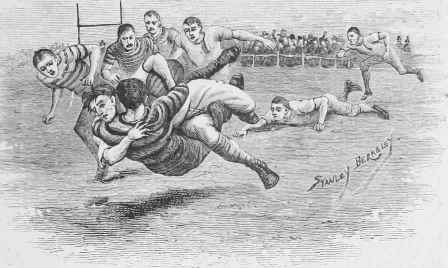
'Collared.'.
The most celebrated, however, of these time-honoured games were those at Derby and Corfe Castle, and both of these deserve some mention before we leave ancient football and turn away to trace the beginnings of modem football in the public schools. The following is the account of the Derby game given by Glover in his 'History of Derbyshire,' published in 1829: -
Continue to:


My Books

