


Football In The United States. Part 2
Description
This section is from the book "Athletics And Football", by Montague Shearman. Also available from Amazon: Athletics and Football.
Football In The United States. Part 2
Whether the Harvard advocates were more expert in their diplomacy than the Yale delegates, or the inherent merit of the Rugby code made itself felt, the compromise rules were certainly nearer the Rugby than the old American. For all that, the strangeness of attempting to combine the two threw both teams badly out, and the match, from the point of view of both player and spectator, was a dismal failure. Harvard, in spite of the many fouls that occurred upon both sides, easily demonstrated her superiority, and defeated the Yale team by four goals and two touch-downs to nothing. One of the concessions made by the Harvard delegates to their Yale petitioners was that, when a foul occurred, the old American rule of throwing the ball into the air should govern. This, in itself, as one can easily imagine, seemed strange in a Rugby contest. Rut the seed of the Rugby Union was sown; the next season the Harvard and Yale delegates agreed upon a match under the regular Rugby Union code, and the contest took place again at New Haven. This time the Yale men had devoted far more time to preparation, and were better trained than the Harvard team.
For all that, Harvard was so superior in skill and understood the science of the sport so much better, that the match was a very close one, and was finally won only by a bucking kick of one of the Yale half-backs which sent the ball over the Harvard goal. The Harvard team made two touch-downs but failed in both instances to convert the tries. From this match dates the real introduction of Rugby Football into the catalogue of American sports; and although the present rules, as they appear in the Intercollegiate Association code, differ in many respects from those of the English, their foundation was the same.
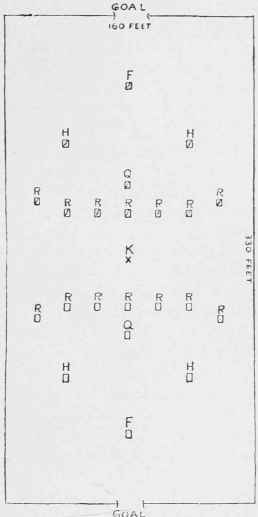
Both games have undergone some changes since that day, but the American game by far the most. The principal reason for this lies in the fact that, while the Englishman had a school where the traditions of what was allowed and what was forbidden in football were as fixed and unalterable as the laws of the Medes and Persians, the American player had nothing but the lex scripta to guide him, and no old player to whom to refer disputed points, or from whom to obtain information. The result in the case of the American was that the first year of Rugby Union was simply full of questions as to interpretations of the code. At the present clay the game of American football is played by eleven men a side upon a field 330 feet long by 160 feet wide. While not absolutely necessary, it is customary to mark the field also with transverse lines every five yards, for the benefit of the referee in determining how far the ball is advanced at every down. In the middle of the lines forming the ends of the field the goal-posts are erected, and should be 18 feet 6 inches apart, with a crossbar 10 feet from the ground. The posts should project several feet above the cross-bar. The ball used is the same as that used in the English game, an oval leather cover containing a rubber inner.
A majority of the players wear canvas jackets.
These fit closely, and lace up in front so that they may be drawn quite snugly. The trousers are of some stout material - fustian for example - and well padded. Long woollen stockings are worn, and occasionally, but not usually, shin-guards by men playing in the forward line. The most important feature of the entire uniform is the shoe. This may be the ordinary canvas and leather base-ball shoe with leather cross-pieces nailed across the sole to prevent slipping. This is the most inexpensive form, but the best shoes are made entirely of leather, kangaroo skin preferably, fitting the foot firmly yet comfortably, lacing well up on the ankle, and the soles provided with a small leather spike which can be renewed when worn down. Inside this shoe, and either attached to the bottom of it or not, as preferred, a thin leather anklet laces tightly over the foot, and is an almost sure preventive of sprained ankles. The cap may be of almost any variety, and except in the cases of half-backs and back, does not play any very important part.
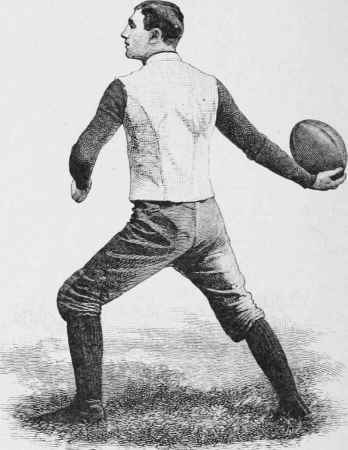
An American player.
These men, however, have caps with visors to protect their eyes from the sun when catching a long kick.
The team of eleven men is usually divided into seven rushers or forwards, who stand in a line facing their seven opponents; a quarterback, who stands just behind this line; two halfbacks, a few yards behind the quarter-back; and, finally, a full-back or goal-tend, who stands a dozen yards or so behind the half-backs. This gives the general formation, but is, of course, varied according to circumstances. In beginning a game the two teams line up, the holders of the ball placing it upon the exact centre of the field, and the opponents being obliged to stand back in their own territory at least ten yards until the ball has been touched with the foot. There are several methods of starting the play. Primarily, however, the ball must lie hit by the foot of the man making the kick-off. He may kick the ball as far as he can down the field or he may merely touch it with his foot and then pick it up and pass it, run with it, or even punt it himself. The method most commonly practised now is for him to touch it with his foot and then pass it to some runner of his own side behind him, while the other forwards mass in the form of a wedge in front of this runner, and the entire body of men, with the runner well protected in their midst, then plunges ahead as far as possible into the ranks of the opponents.
This play is called the V or wedge, and is affected by almost every team, although the methods may differ slightly. As soon as the ball is touched by the foot, the opposing side may charge, and the rushers, therefore, spring at this wedge-shaped mass of players, and get at the runner as speedily as possible, bringing him to a standstill.
Continue to:


My Books

