


Football In The United States. Part 5
Description
This section is from the book "Athletics And Football", by Montague Shearman. Also available from Amazon: Athletics and Football.
Football In The United States. Part 5
Now, as one writer has truly said, the American scrimmage far more nearly fulfils the requirements of such a case than the English scrummage, for two reasons. It preserves the original rights of the side holding the ball, and it sets the play speedily in motion again. It recognises and preserves, to a far greater degree, the original rights of the holder, in that the side having possession when the ball is held and a scrimmage occurs is more securely guaranteed that same advantage when the play recommences. This can be appreciated when one considers that a scrimmage most frequently occurs as a result of a player who is running with the ball being tackled and brought to a stop. Now, in order to preserve these conditions most nearly when the play is started again, a scrimmage should insure for the player a fair chance to have the ball in his hands again. The English scrummage consists of a mass of men kicking and pushing in the endeavour to drive the ball, which has been placed upon the ground, in the direction of the opponents' goal-line. The outcome of the English scrummage is thus ever a matter of doubt. The ball may pop out anywhere, and the method never can insure to the man or side which originally bad possession of the ball the same privilege after the scrummage.
It is in the development of the scrummage that the American game has made the most progress and has lost the features of the original Rugby.
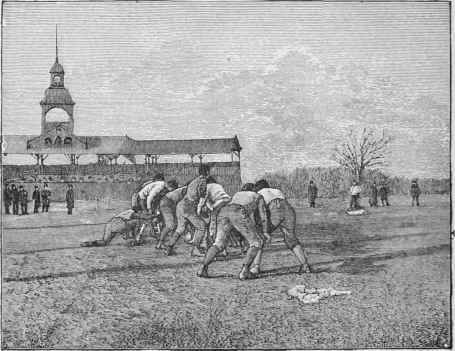
A good scrimmage.
The point that it has at present leached can be judged from the following description of the way it is played at the present date, sixteen years after the adoption of the English rules. When a player, running with the ball, is tackled and the ball fairly held, he must cry 'down,' and a man of his side who has been particularly trained for this work, and who plays in the centre of the line of forwards, takes possession of the ball upon the spot. The two rusher lines spread out more or less across the field, and the man who has the ball (called the snap-back, from his work) places it on the ground with his hand resting upon it. Just a few feet behind him stands, or rather crouches, another player called the quarter-back. He it is who has been called, and with justice, the key to the American game, for, as will be seen, he practically has the entire direction of the play in his hands. At a certain signal which he gives the snap-back, usually by touching him with his hand, this man with the ball snaps it back between his legs directly into the quarterback's waiting hands, and this player passes the ball to some particular player who has been given a signal and is waiting behind him for a kick or a run.
The opponents cannot touch the ball until the snap-back has set it in motion; and while it is, therefore, among the range of possibilities for the play to be spoiled before the ball reaches the runner's hands, the chances are so strongly against this that it may with safety be said that the American scrimmage practically guarantees the side holding the ball the possession of it when the play recommences after every 'down.'
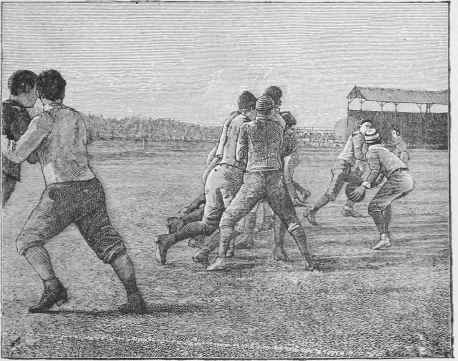
Snap-back and Quarter-back.
It has taken nearly a score of years for the scrimmage to reach this form, for the development has been a gradual and well-considered one. The Americans began upon the English scrummage, and the players massed about the ball, kicked hard and vigorously until they drove the ball out somewhere - anywhere - no one could predict upon which side of the line. A year of this method was followed by a period of study as to how a man ought to act in a scrimmage, in order to gain the most advantage for his side. Should he push and kick, or should he not? If he could so manage it that, when the ball was in front of him, his opponent should kick it through, it was evident that was extremely desirable; for while his opponent was unable to rush after it, being entangled in the scrimmage, one of his own half-backs could get the ball and run around the struggling mass for a considerable gain. Hence the problem became, not how to kick the bail ahead in a scrimmage, but how to make the opponent kick it through. When both parties to the struggle understood this, it became difficult to make the ball come out.
For a time the development seemed likely to follow the English fashion of slow close scrimmages, when clever forwards would keep the ball in the scrimmage, and by steady pressure advance the mass towards the opponents' goal. But this did not last long, for the progress was too slow, and soon rushers acquired the trick of kicking the ball over to the side, and presently dragging it backward with the foot to one of their own side. This was the origin of the snap-back, and men became skilful at it. Before two years had passed it was quite the common play, and another season found the man who was best qualified for this work always stationed in the scrimmage where he might do this. There arose the question, as to how much right to the ball the side had whose man was placing it for the scrimmage. It was eventually decided that the man who put the ball in play was entitled to but half the ball in performing this act, but that his opponents could not put it in play or disturb it until it was put in play. Then the rule was amended to read that the opponent could not interfere with the ball until it was actually in motion. All this time the foot only was used in snapping the ball back, although the player might steady the ball with his hand.
It came to be quite common in this steadying process to use the hand in such a way that both hand and foot assisted in snapping the ball back. Greater accuracy was obtained in this manner, and the rules were again amended so that a man could use the hand only if he desired. This, in the last few years, has become the universal practice, and the ball is rolled back with the hand. One more point completes the comparison between the English scrummage and the American scrimmage, and that is the cessation of the play. 'When does a scrimmage end?' in other words. The original rules provide with great force that no man can pick up the ball in a scrimmage. The law reads: 'In a scrimmage it is not lawful to touch the ball with the hand under any circumstances whatever.' But again: 'A player may take up the ball whenever it is rolling or bounding except in a scrimmage.' Even prominent British players have had heated discussions as to the limits of a scrimmage, and the American players could hardly be blamed for finding even greater difficulty in interpreting this. Of course, if the ball rolled out clear of the mass of players, it was out of the scrimmage; but the players were never massed just alike, and often the formation was quite loose.
Where, then, could the line be drawn? The American solution, while a singular one, was based upon the supposed reason for the rule against handling the ball when so surrounded. A man who attempted to pick up the ball in the midst of the kicking feet was liable to be injured, and hence the rule. The Americans limited their scrimmage finally as follows: The man who snapped the ball back and the man directly opposite him could neither of them pick up the ball until it had touched some third man; that is, any other one of the players. The rapidity with which the American scrimmage sets the play in proper motion again is fully as satisfactory as its preservation of the rights of the side holding the ball when the scrimmage occurred; for no sooner is the ball placed than it is played, and instantly travels to the open through the pass of the quarterback. The man to whom he passes may run immediately up into the line again, but by still another most praiseworthy rule he cannot repeat this indefinitely without material progress. This particular rule is known as the 'five-yard rule,'and has done much to raise football in America to a high standard of popularity.
The rule is as follows: 'If in three consecutive downs or fairs (that is, scrimmages, or putting the ball in from the side of the field), the ball be not advanced five yards, or taken back twenty, it shall go to the other side.' As will readily be appreciated by anyone familiar with the Rugby game, this law insures the rapid progress of the play. The only way to avoid the issue is to kick the ball, and that acts doubly in favour of increased interest, for it changes the situation of the play and also gives the opponents an opportunity to secure the ball. There is one other feature of the American game worthy of especial mention, and that is what is known as interference. This is something of a very recent growth, and has only been practised for a few years. Its origin was in the assistance lent to a half-back when running through the line by two companion rushers. These would so obstruct the opponents as to prevent their seizing the half-back. At first this was really an infringement of the rule prohibiting a man off-side from interfering in any way, and it was not done in an open manner, and when detected was punished. But after a time the possibility of a system founded upon the use of this interference became so attractive that the play was legalised to a certain degree.
The side whose man has possession of the ball may, so long as they do not use their hands or arms in the act, obstruct or interfere with anyone about to tackle the runner. Almost all the play in the American game now depends upon more or less of this interference, and it is this and the scrimmage play that would militate strongly against any contest between English and Americans.
The principal contests in the United States to-day are the final Intercollegiate matches, played toward the end of November. These attract audiences of from twenty to thirty or even forty thousand people, and the interest and excitement are at a fever heat. The matches have become a fashionable event, and the appearance of the crowd is such as one witnesses at no other meeting of any kind in the United States. Scores of coaches, gaily bedecked with the various college colours, and traps of all descriptions line the field, while the immense grand stands are packed to their utmost capacity with eager partisans. The cheering is quite an American feature of the assemblage, for each college has its own peculiar cheer, and although the match is between but two, almost all are represented among the spectators, and take the opportunity of declaring their favourites by first giving utterance to their own distinctive college cheer, and then adding the name of the college whom they favour.
Continue to:


My Books

