


Jumping, Weight-Putting, Etc. Part 3
Description
This section is from the book "Athletics And Football", by Montague Shearman. Also available from Amazon: Athletics and Football.
Jumping, Weight-Putting, Etc. Part 3
The Scotchman J. W. Parsons, who was English champion in 1880 and 1883, deserves a word of notice. Compared with Brooks and Davin, he may be ranked as a small man, and, if our recollection serves us aright, stands about 5 ft. 9 in.; yet in 18S3 he cleared 6 ft. 0 1/4 in., which, when compared with his height, shows him to be a performer almost of the calibre of the other two. The champion of 1885 - Kelly, an Irishman - cleared 5 ft. 11 in., and it may probably be said with truth that the average of high jumping at country sports is better in Ireland than in England. Except, however, in jumping and weight-putting, the average performer at English sports is better than the average Irishman.
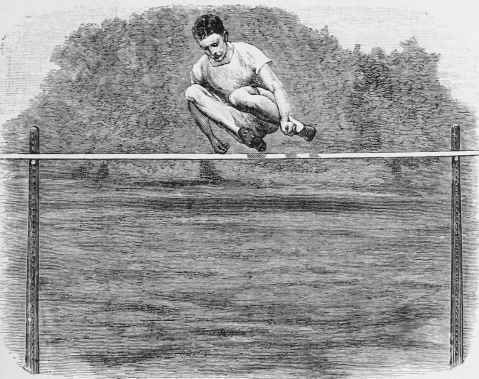
The improvement made of late years in long jumping is even more marked than it has been with high jumping, and it seems almost absurd to us nowadays, when almost every fair sprinter can clear 20 ft., to know that up to 1870 every championship was won with a leap of less than 20 ft. The truth is that it was not till some years after sports had been instituted that the value of speed as a factor in long jumping was discovered. The old jumper took a short run and a big spring; the modern long-jumper starts fifty yards from the take-off, sprints up as hard as he can, and is going his hardest when he takes his leap. The result is that the mere impetus takes him the extra foot or two over the ground by which the moderns excel their predecessors.
In practising, therefore, for the long jump the athlete must prepare himself in much the same way as the high-jumper and sprinter, taking care not to get stiff. There must also be a constant and assiduous practice in jumping, as the main element of success is to get a good take-off at full speed from the right spot, and this is much easier said than done. Indeed, it is the commonest thing, even in championship and other first-class competitions, to see the competitors 'muff' their take-off, or sometimes take off a foot before the line, and so be credited with having jumped a foot less than they have actually covered.
The theory upon which the rules of long jumping appears to be founded is that the jumper is clearing a river or a pit. Thus a board is placed flat with the ground, or a line marked, and the jump is measured from the starting line. The ground after the line should be hollowed out, so as to make it impossible for the jumper, if he over-run the line, to get a jump at all. If he fall back after alighting from his jump, the jump is lost; and the distance is, of course, measured from the taking-offline to the first part where the hindmost heel touches the ground upon alighting.
We have said before that it is no uncommon matter to find a sprinter clearing his 19 or 20 feet, not really because he is a born jumper, but simply from his pace, and from his having learnt to take-off when going at full speed; but out of the scores of men who can cover 20 feet, only very few can reach 21 feet, and the man who can jump that extra foot is a good performer. Nearly all these good jumpers seem to attain the extra foot or more by the kick or jerk which they get from the back either at the moment of taking-off or in mid-air. We have seen many jumpers in mid-air throw out their legs well in front of them with a jerk of the back, and alight a foot farther than the place where they seem bound to touch the ground. There is a good deal of art in knowing exactly how far the legs can be safely shot out, for if this be overdone the jumper will fall backwards and lose his jump. In fact, there is a great deal more skill in long jumping than is generally believed, and it is one of the competitions in which men show most uncertain form, for the slightest attack of the nerves may prevent a man getting anything like a decent take-off, or may make him forget his usual trick of throwing out his legs, causing him to skim along the ground, or jump too high in the air.
Year after year sees men who have jumped 2\\ or 22 feet at Oxford or Cambridge, fail to reach much more than 20 feet at Lillie Bridge; and there is little time to recoup a bad beginning, as at most each jumper does not have more than six tries.
The lcng-jumper, like the sprinter, may be a man of almost any size or weight. He may be a giant like Baddeley or Davin, or a little light-weight like E. J. Davies, a short middle-weight like the Irishman Lane, or a tall middle-weight like Lockton. All these, together with J. W. Parsons, of whom we have spoken before as a high-jumper, have probably been capable of clearing 23 feet upon a good day, and yet it would be hard to say that as regards phisique they presented any one quality in common.
We have said that it was not until 1871, when Davies and R. J. C. Mitchell tied for the championship with 20 ft. 4 in., that 20 feet was cleared at a championship meeting, and before Davies appeared on the scene only one Inter-'Varsity winner had cleared 21 feet, this being in 1868; and at that time A. C. Tosswill, the hero of the performance, was considered an absolute phenomenon. In 1882, however, Davies, who had by this time developed into his true form, threw all the preconceived notions of jumping ability into the shade by showing himself capable of clearing 22 feet almost any day he liked. He won the Inter-'Varsity jump, in 1872, with 21 ft. 5 in., and the championship of the same year with 22 ft. 7 in. In the championship of 1873 he did not compete; but in 1874 he again covered 22 ft. 5 in., having in the Inter-'Varsity jump of that year, a few days before, cleared 22 ft. 10 1/2 in., then the record of the sport. Up to that time, indeed, Davies was as much the superior of the jumpers who had preceded him as was Brooks a few years later in the kindred sport of high jumping, and his case was like that of Brooks in another point, that the first man who rivalled his great reputation came from Ireland. In the Irish Civil Service sports of 1874 Davies was beaten by J. Lane, who cleared 23 ft. 1 1/2 in We never saw Lane jump, but gather from a sporting annual that he was 5 ft. 8 in. in height, and weighed 11 st. 2 lb., a good weight for a man of that height.
Continue to:


My Books

