


Paper-Chasing And Cross-Country Running
Description
This section is from the book "Athletics And Football", by Montague Shearman. Also available from Amazon: Athletics and Football.
Paper-Chasing And Cross-Country Running
At the end of 1867 a few member; (of whom the writer was one) of the Thames Rowing Club at Putney conceived the idea of holding some cross-country steeplechases during the winter season, with the idea of keeping themselves more or less in condition until rowing began again. As may well be imagined, the arrangements of Thames Handicap Steeplechase No. 1, as it was called, were primitive in the extreme, and, indeed, the whole affair was treated more as a joke than anything else. The competitors were taken up to the starting place on Wimbledon Common - the edge of the Beverley Brook by the bridge in a bus, and had to dress how they could, and the race was run in the dark over about 2 1/4 miles of the roughest and boggiest part of the Common, then very different indeed, as to its surface, from what it has now become after recent drainage. Still, there were a dozen starters out of twenty entries, and the affair being the first cross-country steeplechase (not being at a school) that had ever taken place, attracted much attention in the athletic world, which was then getting fairly sure of its foundation after its five years of actual existence.
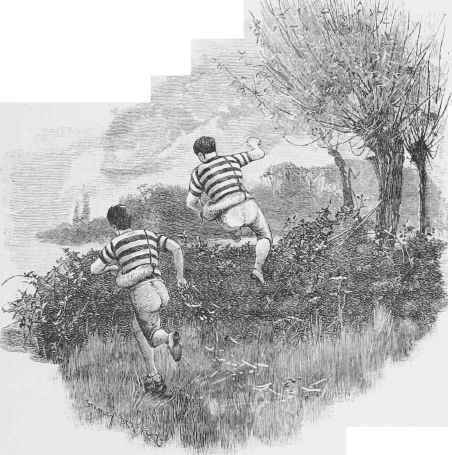
The hares.
The next race was made an open event, and attracted over fifty entries and twenty-four starters, the scratch man being W. M. Chinnery, who did not, however, come to the post, though he afterwards ran regularly with us. Considerable interest was felt in this race, from the fact that two or three old public schoolboys took part in it, and notably Hawtrey of Eton, Rugby and Marlborough also sending representatives; but, as at most other sports, the native Cockney proved equal to the occasion,1 and early training did not have the effect of showing any superiority in the old boys over the Londoners.
The race was one of the finest ever seen, eight men being together at the cross roads - 300 yards from home - King beating Webster by little over a yard, while Chappell, fifteen yards off, was only half a yard in front of Hawtrey. The fine finish was no doubt due to the men not knowing how fast they could go, and so massing together; for the winner took 12.55 for 2 1/4 miles of easy country, which will not for a moment bear comparison with the times of to-day.
1 Foreigners do not seem to take to the game kindly, and Karoniare, the full-blood Indian, who came over with the La Crosse team, was beaten fairly and squarely by C. H. Mason, then our crack runner.
Next winter (1868) it was thought that, as a good many men who were fond of cross-country running had been got together by these steeplechases, there was no reason why they should not try whether paper-chasing proper would not succeed as well among men as among boys. The graphic description of the Barby Hill run by Mr. T. Hughes in 'Tom Brown's Schooldays' had long been before the eyes of paper-chasers, and as he had taken a kindly interest in our movement, and had come down and judged T.H.S. No. 2 for us, there was an additional reason why we should try; though when the writer started the idea, he never thought that the new sport would spread as it has done (roughly speaking, there are now quite thirty clubs in London alone), nor that we should ever have among our members two old Rugbeians, who had both held the records over the Crick and the Barby Hill run, although, singularly enough, neither of them was able to make a record over either of our courses.
Our first run took place on October 17, 1868, from the King's Head, Roehampton, then, as it still is, our headquarters, and the beau ideal in many respects of a paper-chaser's home, being a quaint old wooden-built inn, squatted behind a great wych elm, covered with creepers, and in the middle of real open country. We had secured the written leave of Earl Spencer, who then owned Wimbledon Common, to run over it, and still claim to be the only club who can drop paper over the heath, as having the right before there were such things as conservators and their bye-laws, and all existing rights were saved by the Act.
Among our first visitors were two well-known Cambridge athletes - G. G. Kennedy, now one of the metropolitan police magistrates, and the late J. G. Chambers.
We were not long before our success brought imitators, but they were not very successful at first, for the country they chose was not at all adapted for cross-country running, the Peckham A.A.C., which was the second club, not finding much open land round about Peckham Rye, and having chiefly to confine themselves to path-work. They have now, by circumstances not unlike those which befell the Irishman's knife, come to be known as the Blackheath Harriers, and have a pretty country, a large number of members under a very energetic management, and are by descent the second oldest English paper-chase club. They and the South London Harriers, the next best known club running south of the Thames (between the two a ceaseless feud has always existed), suffered much from the undisciplined zeal of early secretaries, who, not having the faintest knowledge of the 'language of the fields,' used to make themselves supremely ridiculous in the eyes of those who had by the constant use of such words as 'saplings,' while referring to young harriers, and so on, being obviously ignorant of their real meaning.
In the north of London the Spartan Harriers long reigned supreme, but lost their ablest man both as a runner and a secretary when H. M. Oliver left for Birmingham. His advent there, where he was received with open arms, had the result of starting, or rather greatly pushing forward, paper-chasing in the Midlands. Whether his administrative ability operated for the general benefit of the sport is, however, an open question among those who know anything of the subject, the general impression being that the eagerness with which men are caught up into clubs and imported into crack teams has spoiled the old feeling of bona fide competition. Still, as trained teams are mostly composed of men in the same social position as professional cricket and football players, there is no doubt that teams such as the Moseley or Birch-field Harriers are not often beaten, especially by gentlemen teams who do not go away to train and who pay their own expenses.
Continue to:


My Books

