


Running And Runners. Part 3
Description
This section is from the book "Athletics And Football", by Montague Shearman. Also available from Amazon: Athletics and Football.
Running And Runners. Part 3
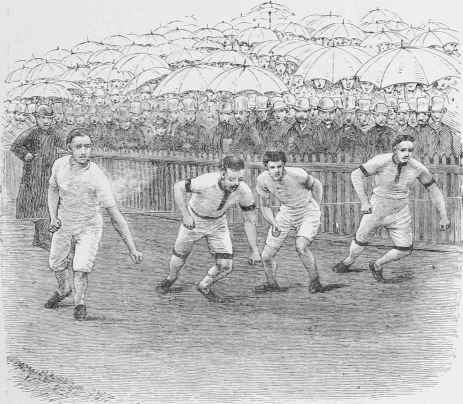
The body should be balanced on the toes with the weight pressing slightly upon the right or rear foot, so that a good kick may be obtained from it with the slightest possible delay when the pistol-shot is heard.
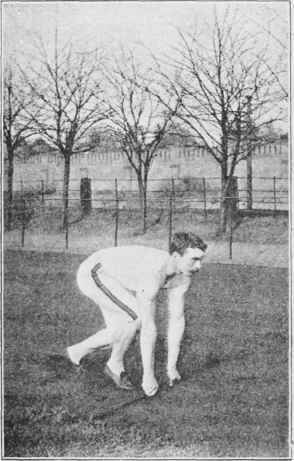
A large number of the best runners now start bending forward with their fingers resting upon the ground. When the pistol is fired they begin to run and raise themselves simultaneously. An additional impetus is said to be gained from the push from the lingers and the recovery to the perpendicular. There can be no doubt of the success of the method with many of its exponents. The new method of starting originated, we believe, in America, and the first amateur who practised it with any success in England was T. L. Nicholas of Monmouth, the amateur champion quarter-miler of 1890. He soon found many imitators, and at first the exponents of the new style were allowed to start with their front foot upon the starting line and their hands touching the ground in front of it, but as this was found to give a very great advantage over those who started erect with their foot upon the line, the rule was changed, and the starters of the new style have now to put their fingers upon the starting line and have their feet and body entirely behind it. There can be little question that those who can really master the new style profit by it, but there can be equally little doubt that the style is less suitable to tall and heavy men than to those who are shorter and more lissom.
In the two illustrations which are given in this volume the exponent of the old style is E. C. Bredin, whose performances are given elsewhere, who has found, after trial, that the new style is not suitable to him. The second picture represents H. T. Bell of the London Athletic Club, who ran second in the Hundred Yards Championship of 1893. Bell is a shorter and slighter man, and scrambles off his mark with great rapidity from the new position.

Starting - Old Style.
Starting - New Style.
Little more need be said of practising on the path for sprints. It must not be forgotten, however, that the sprinter wants to keep himself hard and fit during the time that all his facing practice consists of hard bursts for very short distances. A few miles' walking during the day is always good for health, but great care must be taken by the sprinter never to get stiff, for he has no time during his race to run off even the slightest stiffness. A trot once round the track at a moderate pace with a springy action to stretch the legs is also a good thing; but in these trots the sprinter should never let himself 'get off his toes' - i.e. run so that his heel touches the ground; when his heel begins to come down on the ground it is a sure sign that he is getting jaded, and he had better leave off and walk back to the dressing-room.
Started.
The problem, therefore, which a sprinter has to solve, is how to get strong and muscular without getting stiff or slow from too much exercise. One aid to the solution of the problem is of a kind which would hardly be suspected by the uninitiated. It is to have a rubber. We do not mean that the sprinter should cultivate the study of whist (although we are sure that, if he is sensible, he will do so), nor do we mean that he should wear a golosh and use the American name for that article. A rubber is a man, occasionally a friend, usually a hireling, generally one's trainer, who sometimes with a glove or towel, but mostly with his horny hand, rubs you all over the body, but chiefly over the legs and back, until you are as muscular as a gymnast and as smoothed-skinned as an infant. Well can we recollect the vigorous rubbings of Bob Rogers and the cast-iron hand of old Harry Andrews at Lillie Bridge and the delicious glow and feeling of 'jumpiness' with which we used to stride out of the dressing-room after the operation was over. Well also can we recollect how a kindly fellow-undergraduate, now a muscular Christian, and himself, we hope, in training for a bishopric, essayed to keep the present writer in training when laid up for a fortnight by a sprain, by vigorous vespertinal rubbings.
But your amateur rubber is too perfunctory in his ministrations, and cannot vie with the professional exponent of the art.
The old professional trainers were strongly prejudiced against the use of cold water applied externally. A bath they thought weakening and relaxing, but though we cannot altogether agree with them in this dogma, we thoroughly concur in their belief in the efficacy of the 'dry rub.' It prevents any chance of stiffness, minimises the liability to catch colds, and its effect in hardening the muscles can only be known by those who have tried it. Most well-advised athletes now take their shower-bath first and have their rub afterwards. Some men we have seen combining the maximum of rub with the minimum of wash in the following manner: The rubber fills his mouth with water from a glass, blows it in fine rain over a portion of the victim, and then proceeds to polish that portion first with a towel and then with his hand. The process may be efficacious, but we never felt inclined to try it.
Although a hundred yards takes a very short time in running, a good many amateurs have earned a long and lasting reputation by their performances over the distance. We have heard many speak of W. M. Tennant, of Liverpool, who won the championship in 1868, but to this generation of runners he is but a name. A contemporary of his was E. J. Colbeck, undoubtedly the best amateur of his time, but scarcely so good at 100 yards as at 300 yards or a quarter of a mile. We can recollect Colbeck running a dead heat at Lillie Bridge in a hundred yards with A. J. Baker, who won the championship in 1870, and who was probably the fastest Londoner over the distance until quite recent times. Colbeck was a very tall, heavy man, who sprinted with his chest thrown back, and he owed his speed, we think, more to his tremendous stride than to any true sprinting capacity to make a rush. Baker was a sprinter pure and simple, and, as far as we recollect, 'ran low,' in what is to our mind the best and most workmanlike sprinting style, with his body bent well forward. Whether a man can change his sprinting style is, we think, rather doubtful; but it is obvious that, if the chest be not thrown well forward, the stride must be shortened by the drag which the weight of the trunk will put upon the legs.
Continue to:


My Books

