


The Rugby Union Game. Part 3
Description
This section is from the book "Athletics And Football", by Montague Shearman. Also available from Amazon: Athletics and Football.
The Rugby Union Game. Part 3
Many were the casuistical distinctions drawn as to this piece of etiquette by those who were divided in their desire to do the correct thing and to score a try when the scrummage was near the adversaries' goal-line, and to this day many think it admirable play for the forwards to open their legs to let the ball through, but not good form to heel out, a distinction with about as much difference in moral character as there is between one who steals and one who receives stolen goods - that is to say, supposing that the practice is to be considered wrong at all.
If the forwards, however, had a dull time of it, these were the palmy days of half-backs. The 'half-backs' were then the heroes of the field, and had pretty well all the 'gallery' play to themselves, although the three-quarters-backs gradually and surely rose in importance. The half-backs then stood five or six yards away from the scrummage, and the chief requirement for the place was a capacity to start quickly and to dodge the opponents' half-back; for once well past the half-backs the runner had the whole field clear with only three players between himself and the goal, and the forwards already too far behind to have any hope of catching him. His duty was, in the words of our friend the semi-official authority, to 'get away with the ball at full speed directly it makes its appearance through the forest of legs,' and to stand well back from the scrummage, as by going too near men have 'less time to pick up the ball (strange words, but true enough in the days of tight scrimmaging) 'and lose sight of the movements of their opponents' half-backs.' It is not difficult, then, to see that the most enviable position in the field was that of half-back, and that most 'tries,'most sensational 'tackles,' and most glory fell to these fortunate players.
The best of them, we think, who ever played under the old game was W. C. Hutchinson, of Cooper's Hill. He had a marvellous faculty of dodging without slacking pace just out of reach of the back who awaited his coming, and woe betide the opponent who hesitated for a moment to rush head-down at him and tackle at once. The man who waited for him was lost.
Three-quarter-back play during this period had some points of similarity with the present style of play in that place, but there was less for the 'three-quarter' to do, as most of the attack was carried on by the halves, and passing was much less practised than it is now. The'Rugby Union Football Annual' for 1875, in an article written by an 'Old Rugbeian,' says that for the post of 'three-quarters' a man 'of good speed and a safe tackle should be chosen' (good enough advice at all times), 'and like the backs, it is not so imperative that he should be a fast starter as a strong runner when he has got well away.' In the last clause lies the distinction between the old and present style of three-quarter; the three-quarter of old times was little troubled by the forwards, and seldom had to fall on the ball to stop its progress under a forward rush. One three-quarter was considered sufficient for the English twenty for several seasons, even although the Scotchmen were playing two or three according to the more modern style. What was mainly expected of a three-quarter was that he should be an admirable drop and able to score a dropped goal when opportunity offered. In H. Freeman, the Marlborough Nomad, the English twenty found just the man it wanted.
For two years running, in 1874 and 1875, he won the international match for England by dropping a goal, the magnificent left-foot drop with which he scored upon the first occasion being a traditional theme for discussion amongst football coteries.
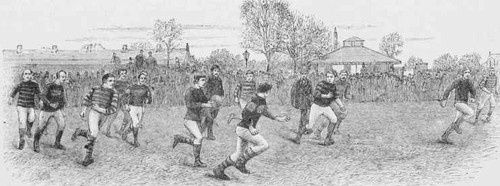
' A fast forward game.'.
With regard to the full-backs under the old game, little need be said at present, as the style of back play never has and never can vary in the Rugby game. Your back is a purely defensive player, and must be able to drop or punt well, and be a deadly tackle. Good backs are the rarest of all rare players to find, as the place is responsible and uninteresting in a winning game. That the right article was even harder to come across in the early days of big matches than now we can readily believe, and time after time the backs chosen for international matches made wretched shows upon the ground; but we shall have more to say of backs later on.
After the substitution of fifteens for twenties in international matches in 1877, the change in the style of play became rapid, and the loose game came into fashion. Many clubs have claimed the honour of introducing the loose game. A Scottish football enthusiast has told us that the Scotchmen at last taught the Englishmen how to play the real game; in London the great rivals Blackheath and Richmond still dispute as to the honour of instituting the new style. In the present writer's humble and perhaps biassed opinion, the change emanated from Oxford. Certainly he knows that when, after playing in London in the season of 1875-76, he played at Oxford in the spring of that year against the best London clubs, the Oxford forwards playing a loose game surprised the Blackheath and Richmond players as to the merits of loose play, and by this time, it must be recollected, the Universities had given up their twenties for fifteens. At any rate, whether any club or county can claim the especial honour of originating loose play, certain it is that it was from about 1876 that the small thick-set forward began to make his appearance upon the field, and the words 'fast forward game' began to be heard of in connection with Rugby football.
Speaking roughly, and in order for the sake of convenience to divide the description of that game into periods, we say that as from the institution of the Rugby Union the first or 'showing' period of the game lasted for half a dozen years, so the next, or 'loose scrummaging' period, lasted for about a similar time, until the latest development of the game, the age of 'passing,' began.
Continue to:


My Books

