


Training. Part 4
Description
This section is from the book "Athletics And Football", by Montague Shearman. Also available from Amazon: Athletics and Football.
Training. Part 4
In fact, to take a broad view of the uses of tobacco-smoking, it appears obvious that the men of the present day are almost universally adopting it, not because they are a degenerate and dissolute lot, but because the high pressure and forced mental activity of modern life have rendered a craving for it as a sedative only natural. But a man who requires a sedative to maintain his nervous balance is hardly likely to be a fit subject for the trainer's hands. By all means, then, let the man in training avoid smoking, and if from suddenly giving up the habit he finds he is unable to sleep, let him wean himself from smoking as quickly as possible.
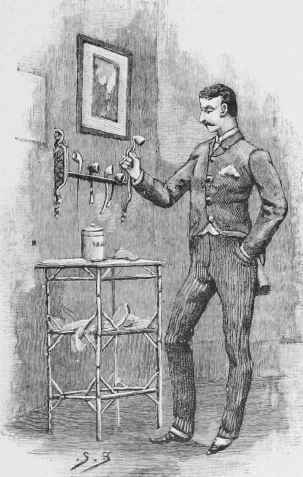
'No smoking.'.
Another mistake which a young lad just taking to training often falls into is to take too much sleep. With the old maxim that 'six hours' sleep is enough for a man, seven for a woman, and eight for a fool,'we do not altogether agree, but experience shows that in ordinary cases seven hours of sleep are quite enough for a man who has not been taking any enormous amount of exercise during the previous day, and that eight hours is the maximum which can under any circumstances be beneficial to a man who is living a regular and temperate life. A young lad of eighteen or nineteen probably requires more sleep than an athlete who has passed out of his nonage and is fully developed, but at the outside more than eight hours' sleep should never be taken. Too much sleep engenders fat and makes the athlete slack, listless, and disinclined for his day's work. We have always wondered how the University freshmen, when they are just sent into training for the spring races, manage to survive the ordeal. They are gorged on meat, eggs, etc., three times a day. They have port wine and figs in the evening, and are sent to bed at ten to sleep until they rise in the morning again at eight o'clock to commence a fresh attack upon mountains of steaks and chops.
Even quite apart from the food they take, the men would be slack and torpid from the amount of lazy sleep to which they are condemned.
Another point which is often disputed is the advantage of early morning work. All are, we think, agreed that a man should get into the open air and clear his lungs before breakfast-By these means he gives himself an appetite for his food, and the improvement in the wind which comes from thus getting out must soon be obvious. But it is a far more difficult matter to decide whether a man should do anything more before breakfast than get air into his lungs. Some men we have known actually to go hard spins before breakfast, others have taken walks of a mile or two, others merely stroll out and walk a quarter of a mile or so just for an 'airing.' Which of these courses should suit any particular individual depends both upon his constitution and his previous habits. Our own opinion is that as a general rule a man should never neglect to get out before breakfast, be it wet or fine, but should refrain from anything like work. We have seen so many men collapse in their training as soon as they tried work before breakfast, that we are sceptical of its good results. But a walk of not more than a mile before breakfast is sure to do good to a healthy man. We need also scarcely say that, wet or fine, warm or cold, he should sleep with his window partly open.
There can be no quiet sleep for a man in a confined atmosphere.
There is no reason why an athlete who makes his training consist of a sound and healthy system of living should break down in health, but without doing that he may nevertheless find himself hors de combat from some minor evils. Before a runner puts on his first pair of running-shoes he should pare his toenails close down to the flesh, or the pounding on the toes will result in the nail being pushed up at each stride. In a few days after this the nails will probably turn black, and in a week or two the runner may find himself minus one or two of them. All danger of this, however, is obviated by not allowing the nail to protrude in the slightest degree beyond the end of the toe. Occasionally the feet get tender from the exercise, and when this happens the athlete will do well to give up the cinder-track for the grass for a day or two. Soaking the feet in alum and water is also much recommended as a cure for tender feet. Prevention, however, is better than cure, and the best preventative is a soft washleather sock coming over the ball of the foot. This is also comfortable, and acts as a safeguard against blisters.
With blisters the best thing is to prick them with a needle as soon as the water has collected in them; after this has been squeezed out, the old skin should be left on to protect the new skin growing underneath. If there are blisters on the foot half-formed, and the athlete is liable to them, the skin is best toughened and rendered least liable to them by taking a salt-and-water footbath in the evening. The tight shoes which are necessarily used by runners are also apt to create corns, which must be treated by the usual remedies which are known to housewives or to practitioners for the removal of these unwelcome visitors. The best means, however, to avoid blisters, corns, and such like ailments is to take a great deal of care in selecting a perfectly fitting pair of shoes; but of this we shall speak anon.
Strains of the muscles are more serious matters, and are sometimes very hard to cure; there is always, too, a danger that a slight strain of a muscle may get worse if rest be not taken. Experience shows that there is very little risk of the muscles giving way from anything but overwork in warm weather, but in cold weather muscles strain or snap without any warning; indeed, so many accidents of this kind happened at Oxford that notices were posted in the dressing-room at the old Marston ground warning runners not to go out into the cold without first rubbing their legs with a horsehair glove or with the hands, and not to undergo any violent exercise without taking a short trot to warm the muscles.
Continue to:


My Books

