


Weight Putting
Description
This section is from the book "Athletics And Football", by Montague Shearman. Also available from Amazon: Athletics and Football.
Weight Putting
At first sight it would seem that jumping and heavy-weight throwing were the very opposite poles of athletic sport, but experience shows this to be very far from the truth, and in many cases the champion at weight-putting or hammer-throwing will be found to be either an active or a retired jumper. The truth is that both strength and elasticity of muscle are required for weight-putting and hammer-throwing, and it is therefore not hard to understand why both these latter competitions are more natural to, and are more practised by, the Celts of Scotland and Ireland than by the English. Both competitions, however, form part of the regular programme of an English athletic fixture, and are included at the Championship and Inter-'Varsity meetings.
The rough-and-ready experiences of the pioneers of the athletic movement decided that a 16-lb. weight and a 16-lb. hammer would give the best test of an athlete's ability to manipulate a heavy weight; at the present day, therefore, in England nearly all the weight-putting competitions are with a 16-lb. weight, which is put 'without follow' from a 7-foot square. In Ireland, Scotland, and America, however, the putting, hurling, or slinging of heavier weights is often practised. In the present work we think it better to confine ourselves to noticing the English practice of the sport alone.
The English rule for the sport of weight-putting as formulated by the Athletic Association runs as follows: 'The weight shall be put from the shoulder with one hand only, and without follow, from a 7-foot square. The weight shall be of iron, and spherical, and shall weigh 16 lb. All puts shall be measured perpendicularly from the first pitch of the weight to the front line of the square or to that line produced.' The definition requires perhaps a few words of explanation. The weight must first be 'put' from the shoulder, not 'bowled.' There have been cases where men with fine muscles of the arm and chest have been able to 'bowl' a 16-lb. weight like a cricket-ball farther than it can be put in the legitimate style. In a legitimate 'put' the elbow is directly below the hand and close to the side where the weight is delivered. Secondly, there must be no 'follow,' that is, after the weight is delivered the 'putter' must draw back and not allow the impetus given to his body to carry either foot over the front line, or he will be 'no-balled,' to borrow a phrase from cricket. Thirdly, the weight must be of iron. There really seems to be very little reason for this restriction, which, as a matter of fact, gives an advantage to men with large hands.
A leaden weight is smaller and more handy, and a man with a small hand has better command over a leaden ball, and can certainly put further with it. The restriction of the nature of the metal has probably been instituted for the purpose of getting one fixed standard for estimating the relative value of performances at different places.
The main point to learn in weight-putting is to 'get one's weight on' - to use a rowing phrase - that is to say, to employ mere arm-work as little as possible, and to get the impetus for propulsion from a rapid spring and turn of the body. The method adopted for securing this by all good weight-putters is the following. The putter balances his body on the right leg (supposing him to be right-handed and putting with the right arm), with his right shoulder thrown back and the weight on his right hand close to the shoulder; he then raises the weight up to the full stretch of his arm two or three times to stretch the muscles, the left arm and leg usually being thrown forward to balance the body. A quick hop is then taken about three feet towards the mark; at the end of the hop the left leg touches the ground, but the right shoulder is kept back, and the weight of the body is still on the right leg. A sharp spring is then taken towards the scratch line and the body swung rapidly round a half-turn, so that when the weight leaves the hand the right shoulder and leg are forward, and the left shoulder and leg behind. The weight is thus propelled more by the swing of the body than by the jerk of the arm.
The best weight-putter, therefore, is not necessarily the tallest, heaviest, or strongest man, but he who can bring, roughly speaking, the greatest momentum by the turn of his body to the delivery of the iron ball. It thus gives a scope for agile strength; youth has its opportunity to compete with the matured power of riper age, and often a quite small light man is able to put really great distances; of course, however, height and weight have great advantages. An attempt was, indeed, we believe, once made to induce Chang, the Chinese giant, to enter for one of the championship meet ings, it being thought that he must necessarily be able to put a great distance, as he would have been like an ordinary mar throwing the weight out of a first-floor window. We fancy, however, that had the Celestial competed he would not have been in the hunt with the more skilful Britons.
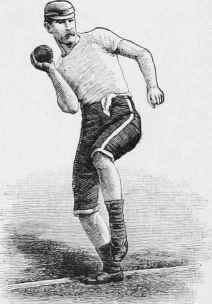
Putting the shot - first position.
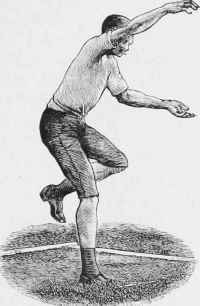
Putting the shot - second position.
For many years the weight-putting record was held by E. J. Bor, a gigantic member of the L.A.C., who put 42 ft. 5 in at the championship of 1872. This was never surpassed until 1885, although there were plenty of fine weight-putters in the interval. R. J. C. Mitchell, the high and long jumper, twice won the championship with puts of over 38 feet, and the two brothers J. and T. Stone, of Newton-le-Willows, also figure in the list of champions, the elder brother having won in 1867 and 1868, and the younger in 1875, 1876, and 1877. The latter was a fine specimen of manhood, weighing 14 stone and being over six feet, but beautifully proportioned, and no mean performer at a sprint. He was, however, beaten in Ireland in 1876 by M. Davin, an elder brother of the two famous jumpers; although, in 1877, Stone in England beat the Irishman, putting over 41 feet with a leaden weight. In 1878, 1879 (summer championship), and 1880 the champion was W. Y. Winthrop, an ex-Cantab and popular member of the L.A.C., whose prodigious feats of strength in other matters would require a volume to record them adequately, the most famous being, if report be true, the upheaval of a flagstaff by his own unaided efforts at a well-known watering-place in the North. In 1882 the championship fell to a Northerner, G. Ross of Patricroft, who was, we believe, a policeman.
Ross 'put' in a most unusual style, and was rather a puzzle to judges and referees. He commenced as if about to bowl the weight, but straightened his arm with a jerk, which brought the elbow into the side just before the weight left the hand. In the championship of 1882 he put 42 ft. 4 in., only one inch less than Bor's record. Ross was not a very big man, nor yet very agile, but had enormous strength of arm, and his remarkable ability was, we think, due to his style of putting, of which he was, as far as we know, the first and last exponent. The next two years' championships fell to Owen Harte, a giant from the Irish constabulary. In 1885 Scotland had her turn, the champion being D. J. Mackinnon, of the London Scottish Football Club, the best weight-putter we ever saw. He was quite a young man, about 6 ft. 6 in. in height, and broad in proportion, although not fleshy. He was always a conspicuous object in the football field, where his gigantic form towered over the scrimmages. He put in his championship win 43 ft. 1/2 in., thus finally disposing of the old record. A few days afterwards, however, this performance was beaten at the Irish championship of 1885 by J. O'Brien, another member of the Irish constabulary, whose performance was 43 ft. 9 in.
This has since been surpassed by the 'put' of a Canadian, G. R. Gray, who accomplished 44 ft. 9 in. at Dublin in July, 1888. Gray was only of medium height and size, which makes the performance still more wonderful.
It is hardly to be expected that the youthful undergraduates of Oxford and Cambridge should produce weight-putters of such excellence as their runners and jumpers. The best exponent of the art at the Universities, J. H. Ware, who won the event four years in succession from 1882 to 1885, was, however, a really first-class performer, having on occasions put over 39 feet, and it was unfortunate that he was unable to compete at the championship in 1886. Ware, like most of the other fine weight-putters, was a giant in height and build.
Continue to:


My Books

