


Golf Clubs. Part 2
Description
This section is from the book "The Game Of Golf", by William Park, Jun.. Also available from Amazon: The Game of Golf.
Golf Clubs. Part 2
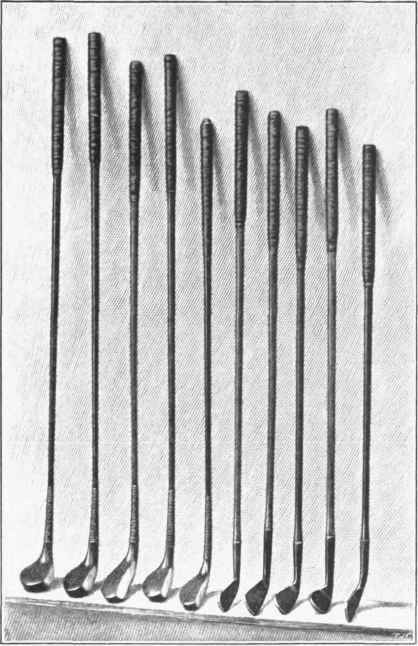
Fig.3 Morden Golf Clubs.
Patent golf-clubs have been mentioned, and it is proposed to refer to such of them as may be considered necessary or desirable as occasion requires. To give a complete list would be impossible, as each day sees the birth of some new patent; and to describe the various clubs which have been patented, and their intended uses, would require a large volume devoted to that subject alone.
No one, not even he who has just heard the word golf pronounced, will ever for a moment imagine that all the clubs before enumerated are identical in character. As a matter of fact, they are very different: and while it is not possible to lay down strictly and definitely the exact purpose or stroke for which each must be used - this depending greatly upon the skill of the player, - I will endeavour to state the primary object for which each is intended. Fig. 3 shows a group of modern clubs, and an idea of the differences in their make may be obtained therefrom. The clubs shown are: - Bulger Driver, Straight-faced Driver, Spoon, Brassy-niblick, Putter, Cleek, Iron, Mashie, Iron-niblick, and Park's Patent Putter. As the simplest method of explaining such differences, the clubs arc dealt with categorically in the order in which they are above mentioned.
The Driver, or play club as it is frequently called, is the most powerful club of a set, and should have a line springy shaft, adapted in length to suit the player and should have little or no loft on the face (i.e. the face should be almost perpendicular when the club-head is laid on the ground); consequently with it the ball can be driven a greater distance than with any other club. It is therefore used for the first strokes at each hole - the tee-strokes, - and also for playing through the green, where the ball lies clear enough to admit of its being used, and when the distance to the hole makes it an advantage to drive the ball as far as possible.
The Brassy-niblick is made with a much smaller head than the driver. It has the face considerably 'spooned' (or sloped back from the bone to the top of the head) with the object of raising the ball in the air, and the sole is shod with a brass plate. The shaft is generally rather less supple than in the driver. It is used largely for playing through the green when the driver cannot be taken, and for playing out of small shallow holes or cups it has no equal the small head allowing it to pick up the ball better than any other club. Brassies - as all clubs shod with metal are usually and briefly termed - are really of modern invention. The brassy was first used on Musselburgh Links. As many readers will know, its southern boundary is the highroad from Edinburgh to Haddington, and a ball driven on to the road had to be played as it lay. Being a hard macadamised road, playing off it with a wooden club - and in these days there were few iron clubs frequently entailed the rather severe penalty of a broken club-head, and the genius of a certain gentleman, whose ball got on to the road with great regularity, suggested the brass plate, which was found to successfully answer the purpose of preserving the club-head from injury. Brassies are therefore well adapted for playing a ball off a hard bottom, where an ordinary wooden club would be liable to fracture.
The Putter, as its name indicates, is intended for putting, or playing short strokes on the putting-green. This club is the shortest of all in the shaft, and it is more upright - in fact, the shaft is little more than at right angles to the plane of the head. The head is heavier, and the shaft very stiff: it should have none of that perceptible suppleness which distinguishes the shafts of all the other wooden clubs. It has been said that the head and shaft lie at little more than right angles to each other; in the more modern putters the angle is greater, or, as it is technically expressed, the head is flatter. This is a matter depending entirely upon the taste of the individual player.
The Clock among iron clubs is what the driver is among wooden clubs. It is the longest of all iron clubs in the shaft, though not so long as a driver, and the blade has least loft, or pitch, as it is more frequently termed when speaking of cleeks. A cleek will thus drive further than any other iron club.
The Iron is deeper in the blade than is the cleek, and has more loft. It will not drive so far as the cleek, but throws the ball higher into the air. This is the club most generally used for playing approaches.
The Mashie is comparatively a modern club. It is shorter in the blade than the iron and has rather more loft, while it is larger than the niblick and has rather less loft, being in fact a compromise between the two. It is mostly used for short approaches, and for playing the ball out of whins and difficulties. Mashies are made in various ways: some have round noses and some square; in the former case they are called mashie-niblicks - the latter are, however, the more useful for general all-round work. In playing approaches with this club few golfers take a full stroke, more usually limiting it to a half, or, at most, a three-quarter swing.
The Niblick is used almost exclusively for bunkers and hazards, and is undoubtedly the best club for (his kind of play. The head is small and round, not much larger than the ball. For bunkers it has no equal; but if it is intended to strike the hall, should it lie clear enough in a hazard, the hitting requires to be somewhat accurate, because the head is so small there is a danger of hitting with the heel.
Spoons are divided into long, mid, and short. The head of the spoon is the same as that of the driver, but the face is made with just about the same degree of loft as a brassy, and the shaft is similarly stiff. The words long, mid. and short refer to the length of shaft, and may also be taken to be indicative of the distance the various spoons will drive, as it is of course possible, other things being equal, to drive further with a club having a long shaft than with one having a shorter. Spoons are almost entirely superseded by brassies and cleeks, but they are still sometimes used for strokes where it is an advantage to drive the ball higher in the air than can be done with a play club. Spoons are occasionally shod with brass on the sole, in which case they are called brassy-spoons. In addition to those above-mentioned, golfers of bygone days used a 'baffy' (or baffing) spoon, which was a modification of the short-spoon with a very stiff shaft and a strong head, having the face very much lofted. With the baffy all strokes approaching the hole used to be played. Instead of hitting the ball 'clean' the stroke was baffed, that is to say, the head of the spoon was made to strike between the ball and the ground, the result being that a back spin was imparted to the ball which lessened the amount of run after alighting on the putting-green. Nowadays the iron has taken the place of this club. To many who remember the brilliant way in which golfers whose names are historic handled these spoons, their disappearance is a matter of regret; but it is to be feared that the iron age of golf has doomed them, and that they will soon be known only as relics of the past.
Continue to:


My Books

