


Distribution Of Weight
Description
This section is from the book "Golf For Women", by Mabel S. Hoskins. Also available from Amazon: Golf For Women.
Distribution Of Weight
After the player has learned to go through all the motions of the drive correctly, there is still another point to be considered and that is the way in which her weight is distributed during the making of the swing. If she stands, and uses her feet and arms in a proper manner, there will not be any question about her weight; it will take care of itself. However, there have been innumerable discussions on the subject and every conceivable suggestion has been offered as to where the weight should be at certain points of the swing. So it seems necessary that the final conclusion of those who know best should be stated here. This conclusion, to put it in its briefest form, is that during the swing and up to the beginning of the follow-through there is very little, if any, transference of weight from one foot to the other.
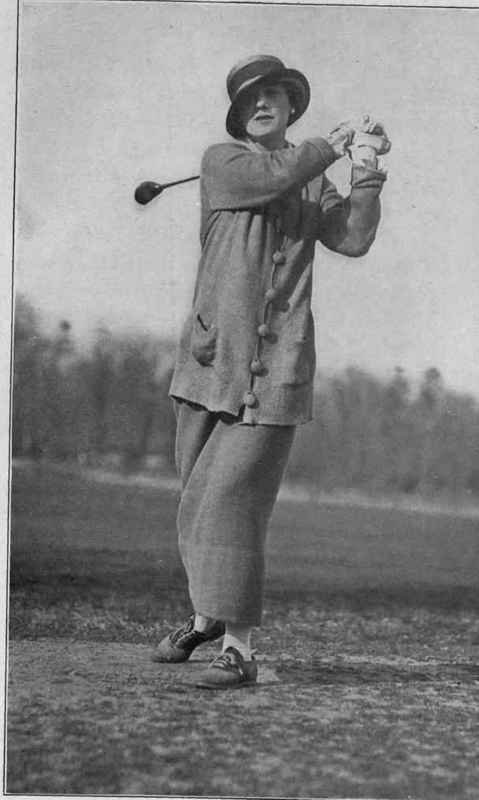
Mrs. Anthony J. Drexel Finish of a drive.
The player takes her stance with her weight equally divided between her two feet. If she does not draw away from the ball, or, in other words, if she keeps her head still, as she is strictly bidden to do, how can she move her weight to her right foot? Yet we are told many times that during the up-swing the weight is chiefly on the right foot. It is interesting to try a little experiment to decide this for oneself. By dropping a string across a fairly large mirror and standing before it so that the string bisects the reflected image through the forehead, nose and chin, and then going through the motion of swinging a club, it is possible to find out just how much extra weight can be put onto the right foot without moving the head. In making this experiment the tightening of the muscles of the right leg from torsional strain must not be mistaken for a sign that they are carrying weight. A few swings made by a player arranged before a mirror in this way, will, I believe, convince her of the fact that her weight cannot be shifted to any noticeable extent, provided she keeps her head still. It is possible that, as the arms and the club are to the right of the player's body midway in the upward and downward swing, they change the center of balance slightly, but the change would be so little as to be practically negligible.
Now as the club reaches the top of its swing, the left knee has bent forward and, on account of the pull of the twisted torso, has the appearance of bending slightly inward. Although the head has not moved, the left leg has come in under the body and therefore it is reasonable to suppose that at this time it is bearing a little more than its half of the player's weight.
As the club descends and the shoulders swing around and the body is returning again toward the ball, the left leg straightens and the weight is once more divided between the two feet. When once the ball is struck, however, the whole body moves after it and the weight is practically all thrown onto the left foot.
Although I have said that, during the course of the upward swing and the downward swing, the weight may be a very little more upon the right foot than the left, it would be a fatal error for the player to attempt in any way to transfer her weight to the right foot. To do so would surely result in her drawing away from the ball, moving her head, and all the subsequent disasters. It is far the best plan for a player to take her stance with her weight evenly divided between her two feet and to resolve to keep her head still and her eye on the ball; if she can stick to this course until she hits the ball she may forget all about her weight and rest assured it will look after itself.
Continue to:


My Books

