


Playing Stymies
Description
This section is from the book "Golf For Women", by Mabel S. Hoskins. Also available from Amazon: Golf For Women.
Playing Stymies
One might think that rolling the ball into the hole presented enough difficulties for the player without having the task of getting around or over her opponent's ball added to her troubles. However, the rules for match play demand that stymies must be played, so the player has no choice in the matter but to do the best she can in the circumstances.
There are so many different positions in which the two balls may lie in relation to each other, to the hole, and to the possible slope of the green that it is hardly possible to mention each one of the situations that may occur. Each separate case presents its own problem and must be dealt with as seems best according to the player's judgment. Lack of confidence in one's own ability is perhaps the greatest difficulty that must be overcome. Stymie shots must be played with a great deal of firmness and decision, and the player who doubts her ability to make the shot has already defeated herself. When a clean, sharp stroke is required, as it is in playing stymies, any suggestion of uncertainty on the part of the person who is wielding the club immediately communicates itself to the ball with the result that the shot goes wrong.
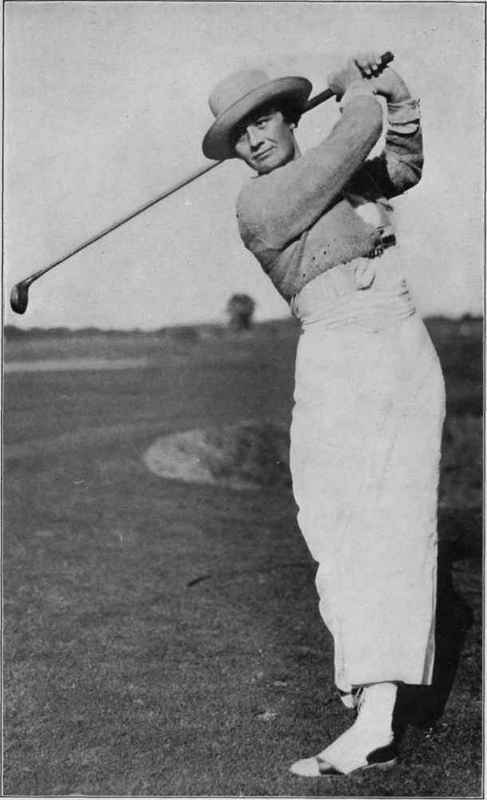
Mrs. Lilian Hyde Feitner A free finish.
If the two balls are lying sufficiently far apart to permit a cut stroke being used, the player has the choice of pulling the ball around to the left or of slicing it to the right. As the sliced shot is far easier to accomplish one is generally predisposed in its favor, and this attitude of mind is quite right if one does not stick to it too rigidly. If the ground should happen to slope away to the left of the balls, it would of course be impossible to expect the ball to go down the slope and up again as it would have to if a slice were played. In that case a pulled ball would be the only one practicable, unless, of course, the ground should rise to the right of the balls, in which case a straight shot played against the rise would circumvent the opponent's ball. When, on the other hand, the ground rises to the left of the balls, if a curved ball is required at all, the conditions for a slice are ideal, as the slope of the ground will help the ball to curve back toward the hole.
The stroke for cutting one ball around another is the same in general theory as the stroke for a slice or a pull, only, of course, the whole operation is reduced to a much smaller scale. For the cut stroke corresponding to the slice, the player stands with her left foot drawn back and pointing toward the hole. She will grip her club, probably a mashie, firmly with both hands and will carry the club back outside the line from hole to ball produced. The forward swing will be strong and decisive, the club head meeting the ball with a glancing blow and finishing to the left.
How far the hands shall be held up or down the shaft of the club and how far the club shall be carried back depend upon the distance that the ball must cover. It is important that the ball should be addressed squarely and that the burden of producing side spin should be laid upon the oblique blow given to the ball by the club's diagonal course. Some persons advise laying back the face of the club so that its toe slopes away from the ball in the belief that side spin may more easily be obtained when the club meets the ball in this way. Such a procedure, however, is far more likely to result in the ball shooting off to the right and not coming back, than in producing the desired curve.
When conditions require that the ball be pulled into the hole the player takes her position as she would for a pulled drive with, of course, the modifications that are necessary on account of the restricted character of the stroke. It is much more difficult to make this shot successfully than it is the one just described, and the player may consider herself very fortunate if she has a favoring slope that will help the ball to curve around to the hole. The calculation of the result of the warring forces, forward propulsion and side spin, requires much experience. The player who has formed the habit of adjusting automatically the length of her backward swing to the distance to be traversed by her ball will find that she has gained for herself a great advantage in managing these cut stymie shots. The habit of holding the body steady and of keeping the eye on the ball will also be of the greatest assistance to her. As a matter of fact, it is only after a player has become a good putter, so far as straight putting is concerned, that she can hope to be able to play stymies with any chance of success.
When the two balls are so close together that there is no room for cutting one ball around the other, a new problem presents itself. If both the balls, so placed, are lying close to the hole, then one must be jumped over the other and either dropped into the hole or allowed to run into it. This shot is best accomplished by using a club with a great deal of loft, a grooved face, and a sharp lower edge. A niblick or a mashie-niblick will probably be selected, as an ordinary mashie has too broad a sole. The ball is addressed squarely and the club carried straight back for a few inches, just grazing the turf. The object is to cut under the ball with the sharp lower edge of the club's head, so that the loft of the face of the club will force the ball abruptly into the air. In order to accomplish this, the club is barely separated from the grass at all but brushes over it as closely as is possible without actually digging into the ground. This shot requires great delicacy of touch, but it is not really so very difficult if the two balls happen to be so situated with relation to the hole that the natural proportion of the length of the ball's run to the extent of its journey through the air will carry the ball into the hole.
While describing this stroke J. H. Taylor,
"Taylor on Golf," page 250, makes the following statement:
"Then, exactly as the club strikes the ball, the wrists must be turned in an upward direction smartly. The result of this is that the ball is lofted over the other, and if hit properly, it will run on and go out of sight as intended."
This advice is very nearly as unsound as though he advocated scooping a ball out of a bunker. Even in such a restricted shot as this the ball must be hit with a distinct blow; it cannot be lifted up on the club's broad face and allowed to drop on the other side of the obstruction. The slope of the club will do the work if allowed to, so the player's one purpose should be to keep the lower edge of the club as close to the ground as possible. If she does that, and has gauged the force and direction of her stroke correctly, she has done all she can toward making the shot a success.
Continue to:


My Books

