


V. In And Out Of Trouble
Description
This section is from the book "Golf For Women", by Mabel S. Hoskins. Also available from Amazon: Golf For Women.
V. In And Out Of Trouble
IN the game of golf, as in the game of life, it is much easier to get into difficulties than out of them. It is almost beyond human capability always to proceed directly down the fairway without straying a little to one side or the other and becoming ensnared in rough and tangled places: or, if the feet walk straight toward the goal, the pace may be too fast or too slow, so that the unfortunate one finds herself facing an obstacle difficult to surmount, or entrapped in an unseen pitfall.
Fortunately, in the game of golf there are well-known and clearly defined ways of recovering from unpleasant situations, and the player has only to keep her head clear, her eyes steady and her grip firm and, ten to one, she will not come out too badly. It may be well to add that she must also carefully bear in mind the rules of the game. Too much stress cannot be laid on the necessity of a player's knowing exactly what she may and may not do when she finds her ball in a bad lie. Frequently players who have had several years of golfing experience will be heard to say, "May I move this stone?" or "I just touched the grass and my ball rolled, what shall I do?" Such exhibitions of indifference to learning the rules of the game cannot but reflect discredit on the person who asks such questions. She lays herself open to adverse criticism not, perhaps, concerning her honesty, but certainly concerning her common sense, or rather her lack of it. There should be no doubt in a player's mind as to what she is privileged to do, and she should waste no time in discussing the subject with her opponent or her caddy.
There are times when a player's heart sinks as she sees her ball drop into long grass or on rough and bumpy ground, yet, on approaching the spot, she may find that the ball has settled in a fairly open space comparatively free from grass and surrounding bushes. In such a case, she would probably take her mid-iron and try to forget everything except the fact that her ball is lying clear, and that she has room in which to swing her club. Such fortunate accidents are not usual, however, and it would be a great mistake to imagine that a mid-iron may frequently be used in long grass. The mashie-niblick and the niblick are safer clubs, and, if there is any doubt at all in the player's mind, it is a wise rule always to consider safety first. Of course, there are occasions when the only chance of winning the hole is by making a long shot and then risks must be taken, but "safety first" is the motto to bear in mind along with "keep your eye on the ball."
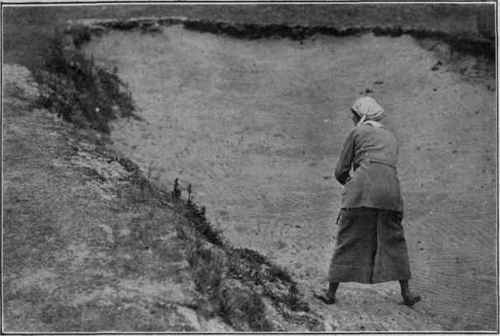
Miss Muriel Dodd Bunkered.
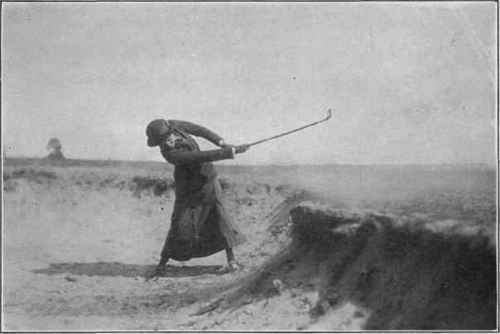
Mrs. Dorothy Campbell Hurd A good bunker shot.
It seems to me that, in this connection, the words "keep your eye on the ball" are very well in intention, but that they are really inexact in expression. When a ball must be taken out of long grass or heavy sand, it is not the ball that must be eyed but the spot behind the ball - in other words the spot that the player expects her club to hit first. A better admonition would be "look where you're hitting and hit where you're looking." Nowhere is woman's lack of powerful muscles such a handicap to her in playing golf as it is when a ball must be chopped out of thick grass or excavated from heavy sand. It requires powerful forearms and wrists to separate the ball from its resting place and to send it any considerable distance on its way to the hole. For this reason it is foolish for a woman to attempt too much; she should be satisfied to get the ball well out, and in such a position that her next shot will be an easy one. Sometimes, if, for instance, there is some obstruction such as trees or a steep bank that prevents the swinging of the club, it may be necessary to play to the left or the right or even directly back, but it is far better to swallow all pride and be content to get the ball clear, than to try a shot that is practically doomed to failure from the start. Head work counts a great deal in getting out of difficulties, and women have no reason for admitting inferiority when it comes to the use of mental faculties.
When the ball is lying in grass so that the player must use her mashie-nibliek or niblick to get it out, careful judgment is required to ascertain just how far back of the ball the club head should strike first. If the player aims too far back, the progress of her club will be checked and probably the face turned outward by the tough,grass blades; on the other hand, if she aims too closely behind the ball, there is great danger of topping. Experience and observation alone can teach the player the safest course, but woe to the one who refuses to be taught and goes blindly thumping and whacking among the bushes. If such is her state of mind she may as well give up at the start, pick up her ball, and walk on to the next tee.*
Firmly settled feet, a steady head, a tight grip, an upright swing, and grim determination are the necessary requisites for chopping a ball out of tough grass. No thought of
"sweeping" the ball anywhere must be allowed to enter the mind, and the follow-through must be left to take care of itself. In all probability there will not be any follow-through worth considering if the grass is very unyielding. The one object is to hit the ball and hit it hard. When the ball is lying in sand a different set of conditions presents itself to the player, but the player's mental reaction should be the same as when the ball is in "the rough." If the ball is lying free and clear, the player may forget the fact that she is in a sand trap, and use her mid-iron with the same stroke and the same confidence that she would if the ball were safely on the fairway. A little sand should be taken in front of the ball in the same way that the turf should be grazed in an ordinary mid-iron shot. Soft sand, if the ball is lying free, offers no difficulties at all.
The case, of course, is different if the ball is partly buried, or has come to rest in a heel print, or has a steep bunker before it. In any of these situations the player would use her mashie or niblick, probably her niblick because, if there is any digging to be done, the heavier club is far more effective. She must be sure to settle her feet firmly in the sand because it is of the utmost importance that the body should be kept absolutely without swaying while the shot is being played. It is advisable and quite permissible that she wriggle her feet from side to side until she feels that her position is fixed and comfortable. There are occasions when the ball is lying in such a position that it is impossible for the player to stand evenly, and she must adapt her stance to the circumstances as best she can. Even though her position is awkward, however, she must do her best to make it so secure that, in swinging her club, she will not inadvertently sway her body. Firmness of stance and firmness of grip are two prime essentials to play in bad ground. Never for a moment must the player allow herself to relax, nor to waver in her determination to accomplish her shot and in her confidence of doing it.
The stance having been taken, the question of where to aim again arises. In order to get under the ball, it is necessary to aim back of it and to take sand. The ball may be in any one of so many possible positions that it would be useless to try to make a rule that would fit all cases. The only course for the player to adopt is to bear in mind the fact that she must not be afraid of taking sand, and, also, that she must not overdo the matter and cut completely under the ball or ground her club. The fine line that lies between enough and too much she must draw for herself.
If it is necessary to make the ball rise very abruptly into the air to clear some obstruction, a variation of the ordinary niblick shot is demanded. The player stands well behind the ball, with feet planted as firmly as the exigencies of the situation permit, and holds the hands low. The face of the niblick is turned back and out, and the ball is addressed by the heel of the club. The backward swing is very upright, and the club is brought down sharply so that the face of the club cuts under the ball from right to left. This is a "cut" stroke and the ball will have a tendency to go to the right. To counteract this, the aim should be taken to the left of the direction in which the player desires the ball to go. It is invaluable to a player to be able to use this stroke with confidence and precision, because situations frequently occur (such as when the ball is under the edge of a bank or has a steep bunker rising before it) when this is the only stroke that will surely and safely extricate it. Braid, in speaking of this shot, "Advanced Golf," page 124, says, "Grip the club firmly, though not in an absolutely tight and unyielding manner, such as would be recommended when playing from heather or gorse. The reason for the distinction is just this, that we want a little play in the wrists, and some slackness of the muscles, in order to nip the ball up and screw it out of its place, as it were, at the moment of impact. This screw-jerk, with very much the same kind of wrist action as is employed when a man is engaged in uncorking a bottle with a corkscrew, is a very necessary feature of the well played niblick shot." If we take Braid at his word and form a mental picture of him playing a niblick shot as he here describes, we would see him in our mind's eye coming down behind the ball with his niblick, screwing the niblick around, and then jerking the ball out. Such a course of action would be so absurd that it is needless to say that no one ever saw Braid in flesh and blood do this remarkable feat. However, I have quoted this passage, not so much to call attention to the fact that Braid has been unable to find words adequately to describe his own actions, as to emphasize again the point that students of the game of golf must consider carefully not only what they are told but also what they read, and must apply to each statement the test of their own intelligent reasoning. It is natural to say to oneself, "If Mr. Open Champion says so, it must be true," and let it go at that. The danger that lies in this mental attitude is that, although Mr. Open Champion is a wonderful player, when he tries to tell others what he does he finds it difficult to describe in words the motions that are easy enough for him to perform. It follows that his words are frequently misleading. I do not wish to decry the usefulness of the books that have been written by great players, but I wish to urge the importance of each woman's sifting out all instruction and advice, and keeping for her own use only what her mind tells her is sound.
These remarks may seem to be a digression but, through the quotations from Braid, they lead back to the execution of the niblick shot. Nothing could be more disastrous to the player getting her ball out of heavy sand behind a bunker than any attempt to "screw-jerk" it out. The niblick is a heavy club, with a sharp lower edge and a face much sloped back. The player has only to hit under the ball at the proper spot with sufficient strength and the club will force the ball out and up. To try to jerk up the ball leads to that gravest fault in bunker play, raising the shoulders and head. Although it may be the natural impulse to try to scoop the ball out, the conditions under which the shot is played demand that in order to hit the ball up one must hit the club down.

Mrs. Clarence H. Vanderbeck Good form in the follow-through.
Continue to:


My Books

