


Chapter IV. Putting
Description
This section is from the book "How To Play Golf", by H. J. Whigham. Also available from Amazon: How to play golf.
Chapter IV. Putting
Every sort of instrument, from a respectable wooden putter to a croquet mallet or a billiard cue, has been used, and used successfully, on the putting green. No style or position is left untried, no muscle unturned which may help the ball to its much coveted resting place. Some grip the shaft at the top, some at the bottom; some stand severely erect in the attitude of command, some crouch low over the recalcitrant guttapercha, that they may the better coax or control its movements. One eminent player uses his cleek as if it were an eggspoon, another astonishes his partner in a foursome by putting in neglige fashion with one hand. Every way is right which fulfills the purpose in view, and each individual is convinced that his style is the best.
It is rather rash, then, to offer advice upon a subject which admits of so much diversity of opinion. The novice will listen to the expert when he lectures upon driving or approaching, for there his superiority grants him a privilege to preach. But when it comes to putting, the part of the game which to the outsider is not only very dull, but absurdly easy, and when the preacher misses in practice an eighteen-inch put which any child could kick into the hole, the beginner is very apt to reserve his judgment and cleave to his own self-cultivated style.
Still, even in putting there is a right and a wrong way. Take the test of experience, and you will find that in the long run the man who puts in the approved method wins the day. The man who handles his putter as he would a spade may do wonders on ordinary occasions when nothing depends upon the result; he is hopeless as soon as the strain begins to tell.
Position
Begin, then, by standing just as you have been instructed to do in playing a short wrist shot; that is, with the line of your feet at an angle of 45° with the line of the hole. Place the ball a little in front of your right foot; in fact, the feet being closer than in driving, the ball should be almost as near one as the other.
The Hands
The hands should grasp the shaft just as they do in the short approach; the club should be held in the fingers of each hand, and the hands should be as close together as possible. Some of the best players, both in putting and approaching, allow the right to overlap the left, in order to have but one fulcrum. This method is not recommended to the average player, because it requires a delicacy and firmness combined, which only comes with long practice. Be careful not to grip the club too loosely, nor to allow the thumbs or forefingers to stray down the shaft. In putting, as in driving, there comes a time when you are totally unconscious of any grip on the club at all; the driver or putter becomes part of the player, just as a good rider seems to be one with his horse. For the ordinary mortal, however, the club is something extraneous and apart, and the method of grasping it is a matter of considerable importance.
The most common fault in putting comes from slackness. Whenever your ball does not travel straight from the club, and especially when you find yourself varying greatly in strength, look to your hands -you are probably holding too loosely, so that the head of the club turns ever so slightly as the ball is struck, which accounts for vagaries in strength and direction. Of course you must not hold your club as in a vise, nor must you allow either hand to dominate the other. The grip should be even with both hands - just tight enough to obviate any turning of the head, and not so tight as to stop the circulation or freeze the muscles. The position of the feet and hands should not be varied with the club, but in other respects there are a few differences in attitude, according to the kind of putter you employ.
The Choice Of Club
You may put with a cleek, a putting cleek, an iron putter or a wooden putter. By a cleek I mean any weapon of the driving iron tribe which you may happen to fancy. It may be a straight-faced driving iron, a driving mashie or a common cleek. What differentiates it from a putting cleek is that it has the ordinary driving shaft, and the angle of the head and the shaft is more obtuse. The putter of every description is an upright club, requiring rather a different attitude of body. It may sound rather an absurd statement, but general practice, I believe, will bear me out, when I maintain that if you are going to use the iron club at all for putting, the ordinary driving cleek is a better weapon than the iron putter, which is made especially for the purpose.
The Advantage Of The Cleek
In the first place, the iron putter, pure and simple, is useless on greens that are at all rough and heavy, because it keeps the ball closer to the ground than any other club. Secondly, the face is so smooth and straight that, unless the stroke is very accurate, the ball is apt to glide from it to right or left. Thirdly, both the head and the shaft are dead; they give no life to the ball, as the wooden putter does. You will observe that these objections would have no weight if you were playing on a billiard table; but putting greens are not billiard tables. Even the best of them have their rough or grassy spots, and therefore the club that does not keep the ball too close to the ground is preferable. Also, if you are to use an iron club at all, there should be that driving power which, in the wooden putter, is supplied by the material from which the head is made.
But there is yet another reason for the use of the ordinary cleek, which I have never seen advanced in any book on the subject. In the second chapter I (Advice To Beginners) recommended a certain uniformity of weight and lie for all the wooden driving clubs. For a similar reason I believe that the more your putter resembles your light iron in weight and lie, the more regular will be your short game.
The Stroke
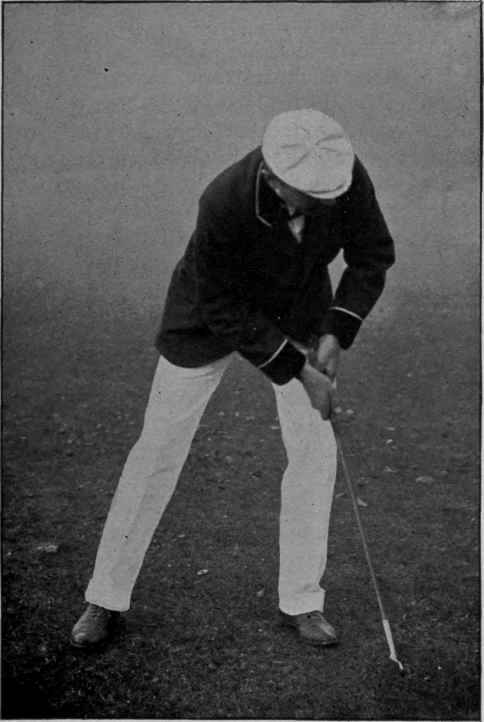
In putting you should begin, as in approaching, about thirty yards from the hole, and work in the opposite direction. Saving the fact that in one case you are playing with a cleek, and in the other with an iron, the stroke should be almost identical. The club should be drawn back close to the ground and in a straight line; the backward movement - it can hardly be called a swing any longer - should be deliberate, but not too long. Most beginners are inclined to draw the club too far back, both in putting and approaching. The left wrist should bend very little, but both the right wrist and elbow should be brought into use. In following the stroke through, the hands should be brought well forward, and the head of the club should point toward the hole.
Practice this stroke from the extreme edge of the putting green, and then as you come nearer the hole you will find that there is only a difference of degree between playing an approach of seventy yards and negotiating a put of seven feet. It is hardly necessary to add that the eye must be kept fixed upon the ball, especially as you get nearer the hole. When you have a bad attack of inaccuracy in your short puts, as every golfer has from time to time, you will generally find that you are looking at the hole instead of the ball. The mistake is peculiarly apt to happen in playing your short puts, because the hole is so close that it catches your eye unawares. Look hard at your ball, then, and make up your mind to hit it clean. If you succeed you will very seldom miss the hole at short range.
Finish Of The Approach Put.

Only one thing more: In putting with a cleek it is advisable to strike the ball rather toward the heel of the club, because the balance is in that direction. With a wooden putter strike rather nearer the toe than the heel.
If you use your cleek for putting in the manner suggested, you will observe that there is nothing of the pendulum motion which is often recommended in the books. The club does not swing evenly backward and forward in front of the body, but is pushed, as it were, away from the body toward the hole. This style of putting is really more like the forward stroke in cricket than anything else; and just as in cricket you keep the left arm and shoulder forward to avoid a pull, so in putting you should, if anything, bend your left elbow a little in dachshund fashion, and thus keep the left shoulder well over the ball. And whatever else you do, do not rest the right elbow on the hip. Your arms should work perfectly freely from the shoulders, and the body should in no way enter into the stroke; if you allow yourself to come forward at all except with your arms, in striking the ball, the results will be most disastrous. And since it is obvious that the body must move if the elbow is resting on the hip, you must discard that method of play at all risks. I cannot conceive where it first originated. There is hardly a single good putter among all the first-class players in Great Britain who does not keep his arms entirely free; and yet I have seen numberless beginners in this country who have been told to put in that way by their professional advisers.
The Iron Putter
In using a putting cleek or an iron putter or a wooden putter, it is necessary to stand more erect because the club itself is more upright; therefore you must be closer to your ball, and your feet should be less far apart.
The best way of using any of these three weapons is rather different from the method recommended above. Your regular putter is a different club entirely from an iron or a cleek, and so you have to learn what is practically a new stroke.
Position For The Iron Putter.

After The Stroke.
Continue to:


My Books

