


Talk II. Learning The Golf Scale
Description
This section is from the book "Intimate Golf Talks", by John Duncan Dunn. Also available from Amazon: Intimate golf talks.
Talk II. Learning The Golf Scale
You may remember that when we were talking about selecting the right golf clubs I said it would be a good thing if a beginner could learn the game without any clubs at all. Sounds physically impossible, doesn't it? Well, as a matter of fact you can travel a long way toward the goal of successful golf without ever laying hands on a club.
This was a poser. Evidently Dunn was about to spring something brand new in golf. It sounded interesting.
For some unexplainable reason, most beginners at golf start in by cramming their heads full of technicalities that are all Greek to them. They foolishly think that this is the way to learn golf. And the harder they cram, the less progress they make.
The thing with which the beginner should really start is the golf scale. He should at first give all his thought to this, just as the aspiring singer confines his voice to the C D E F G of music. You can practise this golf scale without a club in your hand or moving from where you are standing. About the only necessary equipment is perseverance.
I see that you expect to hear of some great mystery. Nothing like it; just a few simple exercises that any one can practise when he jumps out of bed in the morning. Fifteen minutes a day of conscientious work will make you a very fair golfer before you have ever stepped upon a links.
Frankly, morning exercises failed to appeal, and the interviewer advised Dunn accordingly. Years before he had for a time diligently practised some sort of calisthenics. But there had come a morning when it had all seemed so confoundedly futile. Result - no more exercises.
You are quite right. An incentive is what is needed. Any kind of exercises aren't much value without one. But in the particular exercises I am going to tell you about, there is a perfectly bona fide incentive; and that is, good golf. Incidentally, and leaving golf out of it entirely, these exercises will do any one a world of good physically - but you can forget about that, if it worries you. Just remember, good golf; that is incentive enough for any one who wants to learn the game.
Now to get down to brass tacks. Stand with your legs spread apart - not too wide, just comfortably; remember you are not a contortionist. Have your toes in line and then lay a golf club on the floor in front of you, at right angles to this line. You are standing directly over the grip; the club head is away. If you haven't acquired a golf club yet, a walking stick or umbrella will answer the purpose as well (Fig. 7).
You are set for your exercise. First of all, stare the club head out of countenance and continue to do so through all that happens from then on. Place your hands on your hips and bend slightly forward. Keep the stomach well in, and without raising up from the bent position, pivot around to the right until the left hip and elbow are in line with the club (Fig. 8).
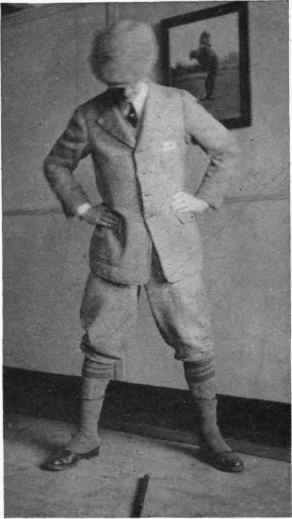
Fig. 7
First position in the pivot exercise. This corresponds to the golf address
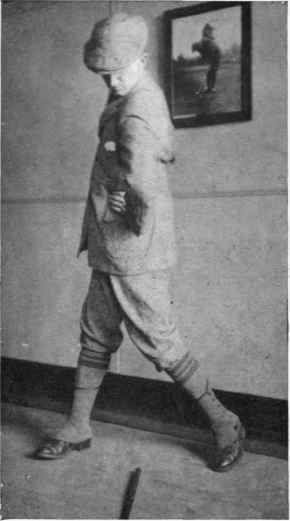
Fig. 8
Second position in the pivot exercise. The top of the swing
While doing this pivot movement, don't let the body carry your head around to the right with it. Keep your head facing forward and perfectly rigid. And keep your eyes glued on the club head. Also, as you swing around, the left knee should bend in a trifle to the right, and toward the end of the swing the right knee becomes almost rigid.
Now for the final movement in this exercise. From your wound-up position, swing the body completely around to the left so that you finish with the right hip and elbow on line with the club (Fig. 9). And you can speed this final swing up as fast as you wish. During its course the right knee bends in a little to the left while the left knee in turn becomes almost rigid. Remember at all times of the proceeding to keep the stomach in, eyes on the ball, body slightly bent, and head in the same rigid position.
The victim, somewhat puzzled, wanted to know the precise reasons for all that had just happened. He couldn't recall anything of the kind in the little paper-covered morning exercise books of former years.
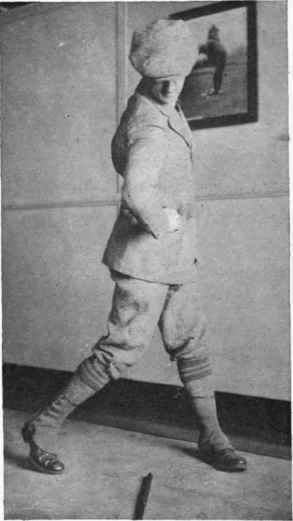
Fig. 9
Third position in the pivot exercise. Finish of the swing
In bending over slightly and keeping the stomach in you bring into play the muscles used in the golf stroke. And likely enough they are muscles that haven't been exercised for a blue moon; no need for so many fat men in the world if these stomach muscles were exercised more. As for keeping your eye on the club head, this is the best possible training for keeping your eye on the ball.
Your first position in the exercise is the golf address; the second the top of the swing and the third the finish. The hand on the hip, bringing the elbow on line with the club on the floor, marks the distance one should pivot around in the golf swing.
Go through these clubless swings about ten times without letting up. Then gradualy increase the count and before you know it you will be in prime shape for the game itself. Doesn't this sound like good sense?
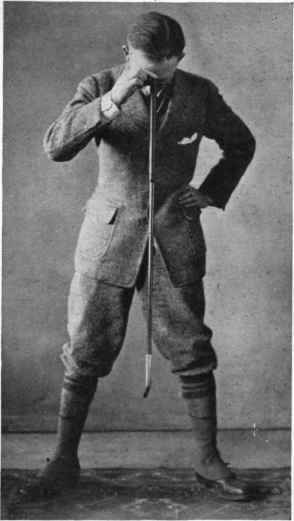
Fig. 10
First movement in the balance exercise
The pupil agreed. After some minutes of the prescribed exercise it suddenly dawned upon him that the body played a greater part in the golf swing than he had ever before realized.
You can't rely upon your arms and hands to do all the work in golf. They are only a small part of the real propelling power. It's getting the body muscles into it that counts; the same solid muscles of the back, thighs, and shoulders that make the oarsman and boxer.
Speaking of boxing, here's another valuable exercise. We'll do a little shadow fighting. Take the same position as before, but hold your right arm out in front of you with the fist loosely clenched.
Pivot the body around to the right until the outstretched moving arm is behind. Then swing the arm around furiously to the first position - just as if you were in a real boxing match. Somewhere between the start of the forward swing and the first position, the fist instinctively doubles up and just the muscles you need to wipe up your man get into play. It's the same way when you hit a golf ball.
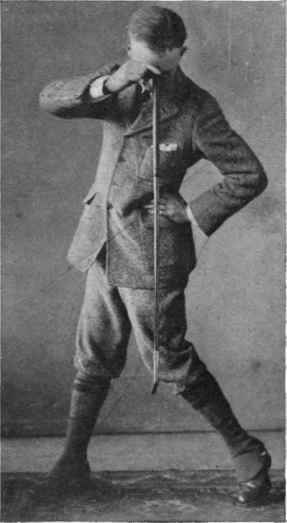
Fig. 11
Second movement in the balance exercise
The interviewing pupil had knocked out a whole row of imaginary adversaries before Dunn called a halt to take up the matter of balance in golf.
Now for a balance exercise. Assume the same bent position as before. Take a golf club or walking stick and hold one end between thumb and forefinger against your forehead. See that the lower end, which is the club head, hangs over a golf ball or some mark on the floor (Fig. 10). Pivot to the right (Fig. 11) and then around to the left (Fig. 12). And keep on going back and forth. Only be sure that the club doesn't move while you are doing it.
Although the interviewer tried faithfully enough, the club moved like a sapling in a high wind.
Not so easy as it looks, is it? But body balance is absolutely essential to good golf. Any sway in the club in that exercise is proof that your body is off balance. Do everything a good golfer does in a swing and it won't sway. In short, keep your head still, stomach in, body slightly bent, and eye on the ball.
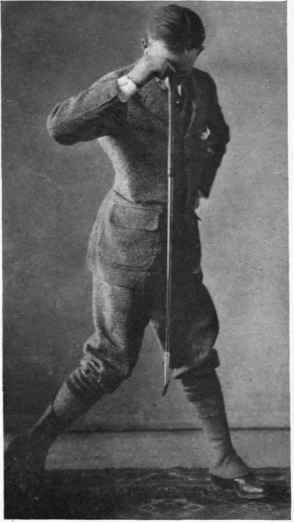
Fig. 12
Third movement in the balance exercise
The direction of the sway of the club in this exercise is a telltale of your particular fault. If it moves away and to the right, you may know that your stomach is out. In case you raise your body, the club will swing toward you.
Practise the three exercises I have mentioned. They'll keep you busy for some time. I'll give you more later on.
Continue to:


My Books

