


Talk XII. Topping The Ball
Description
This section is from the book "Intimate Golf Talks", by John Duncan Dunn. Also available from Amazon: Intimate golf talks.
Talk XII. Topping The Ball
The faults that one cannot fathom are the ones that cause all the trouble in golf. There is a direct reason for every fault, and the longer one goes on in blitheful ignorance of what this may be, the more difficult does good golf become. For in due time the fault becomes a fixed habit and nothing is harder to overcome than habit. However, once you have analyzed matters and understand the exact reason for a fault you can proceed to mend your golfing ways. From then on you are on the lookout for that particular fault and when it crops up you readily recognize it. In time you overcome it.
One of the most common faults in golf is the ancient evil of topping the ball. Of course if a man's swing is perfect in every respect he won't top. But the fact remains that the result is often disappointing even when on the surface the golfer seems to be in perfect form. In such cases, he probably cannot figure out for the life of him the reason for it all. Likely enough this is because the root of the evil is so astonishingly self-evident.
As an example of this we will take the matter of keeping the eye on the ball. Perhaps the golfer who has just topped, on being questioned swears that he has kept his eye glued upon the ball. So far so good. But possibly when we begin to inquire about the particular part of the ball he has eyed, the answer brings forth the cause of the trouble. Likely enough it has been the top of the ball.
Right here is where it pays to stop and reason things out. Reason just why the top of the ball is the wrong place to keep the eye and the side is the right place. A surprisingly large number of golf beginners go wrong on this. I ask a great many of my new pupils about the part of the ball upon which they keep their eyes and in many cases they admit the top. Yet this is obviously quite the unnatural thing to do. Let us reason this out.

Fig. 54
An old cure for looking up too soon; keeping eyes fixed on spot from which ball has flown. Although unnatural, there is no harm in trying it now and then but don't allow it to become a habit
Say a man is driving a stake into the ground with a sledge while another man has his hand around the stake just below the top in order to steady it. If it happens that the man wielding the sledge is unaccustomed to this work it is quite likely that his thoughts are centred upon the other fellow's hand. He is afraid he will hit it.
The one and only spot where his thoughts and eyes should be centred are on the exact top of the stake. But just as soon as his thoughts wander to the other man's hand, his eyes follow suit. So does the sledge. I will leave the rest to your imagination. And doubtless you will see how this principle may apply just as aptly in keeping the eye on the exact spot where you wish to hit the golf ball as it does in the case of the sledge.
Another misconception among beginners that leads to topping and poor golf is the matter of contact between ball and club head.
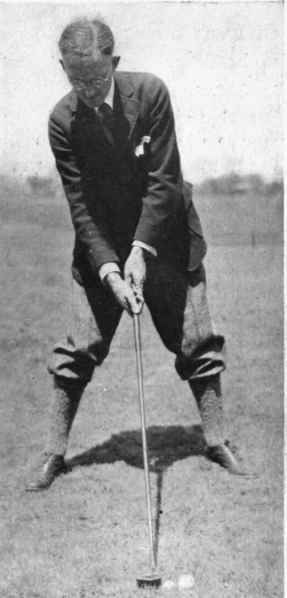
Fig. 55
A cure for topping. Crumple up a piece of paper and lay it behind the ball. Drive the paper.
You will hit the ball fair and square
Very often I ask a new pupil to point out on the club head the spot of contact with the ball. The chances are that he puts his finger on the lower edge of the club head. Of course if that is the spot where he has his mind set upon hitting the ball, that is exactly where he will hit it. And the natural result will be either a topped ball or a very short one.
As I have said in a previous talk, the point of contact should be directly in the centre of the face of the head. When I explain how the concussion of the ball acts you will see the reason for this. Some day after you have made a particularly good shot, examine the face of the club head carefully. Then you will realize just what the concussion of the ball means.

Fig. 56
Sometime, examine the dotted round stamp made by the concussion of the ball. It is nearly as large as a half-dollar piece. See that your club head is large enough to accommodate it

Fig. 57
The wrong way to finish the swing. Shoulders should be on same plane from address to finish
The markings of the ball still remain on the face. These are in the form of a dotted round stamp almost as large as a half-dollar piece. If only a half circle is stamped on the face, this means an imperfect shot. With half the ball on the head and half off you are getting only about half the distance to which you are entitled (Fig. 56).

Fig. 58
The address of a mashie shot. Note height of shoulder above, and in the photo which follows
The greatest amount of topping is due to raising the body up during the course of the swing. The shoulders should be on exactly the same plane from the address to the finish of the swing. But it often takes a good deal of practice before a man can accomplish this. Raising the body is one of the most difficult things in golf to overcome. Offhand you might say that it would be one of the easiest. You must remember, however, that here you have a habit of years to overcome. A man raises up instinctively. That is the way he stands and walks; even though he be in any leaning position he bounds right back to straight again (Figs. 57-58-59).

Fig. 59
Finish of a mashie shot. Shoulder is same height as at address
In the golf address he is forced to lean over to connect with the ball. Just as soon as the club swings back into thin air he often unconsciously straightens his body. The result on the down swing is a topped ball.
On the other hand, he may go from straight to the other extreme. He makes an effort to lean over and as a result the club digs up the ground before reaching the ball. It is important that one keep the body slightly bent all the way through the golf swing, right from address to finish.
Continue to:


My Books

