


Talk XVI. Methods Of Curing Faults
Description
This section is from the book "Intimate Golf Talks", by John Duncan Dunn. Also available from Amazon: Intimate golf talks.
Talk XVI. Methods Of Curing Faults
The acquiring of a perfect golf swing maybe a long and painstaking process. And then just when you think you have it mastered, some single obtrusive fault may come up that spoils it all. If any one part of the golf swing goes wrong, the whole structure is likely to topple down like a ton of bricks. The cure is to recognize and then overcome the faults as they appear. And so long as you do recognize them, the cure is usually more simple than appears at first sight. I will enumerate a few.
In a previous talk upon the subject of slicing, I have said that this common evil is often associated with heeling the ball. And heeling can be very easily overcome. The reason for hitting the ball with the heel of the club is for the most part the centrifugal force which carries the club head outward during the course of the swing.
I will explain this more fully. The club head on the down swing should follow exactly the same path that it has taken to the top of the swing. However, there is a considerable amount of weight to the club head, and in sweeping down fast from the top of the swing, this generates centrifugal force which does its best to take the club head through a path outside of the one traversed in the up swing. If this force is strong enough to amount to anything the result is that you hit the ball with the heel of the club head.
If you are heeling the ball to any extent I would advise as a cure that you change your tactics in addressing the ball. Instead of addressing with the middle of the striking face of the club head, address with the toe of the club. At the same time make up your mind that when the moment of impact comes it will be the toe that connects with the ball. You may be surprised to find that the part of the club head with which the ball actually connects is usually the exact centre, and the result is a fine, straight ball (Fig. 64).
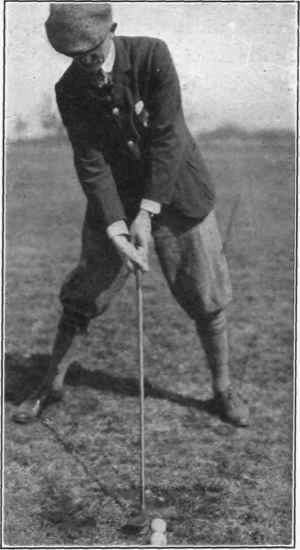
Fig. 76
A cure for heeling. Drive the near ball without disturbing the other
If addressing the ball with the toe of the club doesn't cure your heeling, try another method. Go off by yourself to some corner of the links and do a little practising. Place two balls on the ground before you, these three or four inches apart. The ball nearest to you is the one which you intend to play. Proceed to drive it down the course without taking into account the other ball. If there is any great amount of centrifugal force generated in your down swing, what really happens is that you hit both balls at once (Fig. 76).
The thing for you to do next is to make up your mind that you will drive the near ball without disturbing the other. This is exceptionally good practice and after a certain number of tries the far ball won't bother you in the least. All of which means that you are being cured of heeling.
Another common tendency among golf beginners is that of raising the right elbow as the club travels to the top of the swing. This is awkward and throws one quite off balance. Sometimes you see a golfer with his right elbow raised in the air almost on a line with the shoulders. Keep the elbow down, perhaps not rigid against the side but very nearly so. If you find that the elbow persists in raising up, take out your handkerchief, poke it between your upper right arm and side of the body, under the arm pit and address the ball. Then make up your mind that you will go through the golf swing without allowing the handkerchief to drop to the ground. This is entirely possible. Of course in the ordinary swing, your arm would not be as rigidly against your side as in this case. At the same time, this handkerchief stunt is very good practice, and will get you into the habit of keeping the right elbow down (Fig. 77).
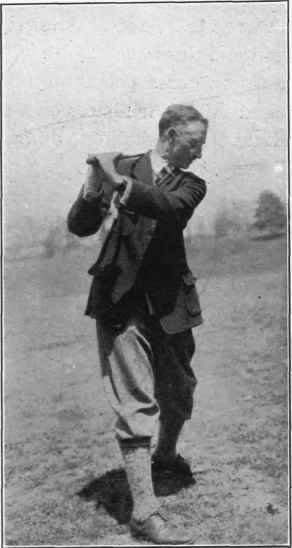
Fig. 77
Keeping down the elbow by the aid of a handkerchief in the armpit
I will now offer a little suggestion for the man who is not following through properly with his iron shots. Lay two balls on the ground, a few inches apart, both in the line of flight. Then take your mashie and make up your mind that you are going to send both those balls down the course on the same shot (Fig. 78).
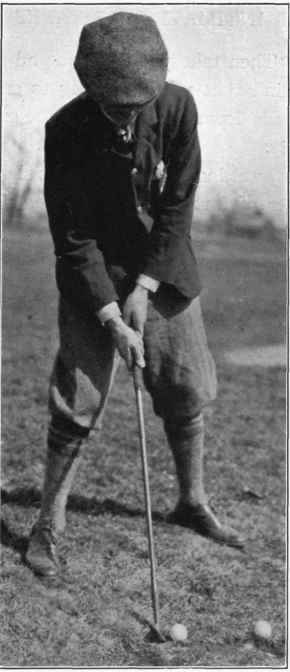
Fig. 78
Hit both balls on the same shot. This will make you follow through
It may not look possible at first sight but as a matter of fact it is entirely so. Common faults in playing iron shots are to turn over the striking face of the club and also not allow the club head to continue its allotted distance in the line of flight after the ball has been hit.
An analysis of the problem of hitting the two balls on the same shot makes it clear that to be successful you will have to keep your club well down in the line of flight and not let it sheer up and off to the left. You put your reasoning into execution with the result that you get both balls, and at the same time learn the feel of a perfect follow through. This is very good practice.
Continue to:


My Books

