


(A) The Swing
Description
This section is from the book "The New Book Of Golf", by Horace G. Hutchinson. Also available from Amazon: The new book on golf.
(A) The Swing
Imagine that you have gripped the club comfortably, taken up your stance and feel quite satisfied, and that the ball is teed ready for you to drive. Now comes the serious business of swinging or hitting the ball as straight and as far as possible. And this is how I attempt to do it.
My first movement causes my hands and arms to pick the club head off the ground at once, inwards, in a direction towards my right leg but well outside it. Note that there is no sign of the club head dragging along the turf. Almost simultaneously my left knee bends inwards, the left heel leaves the ground, and the balance of the body presses the ball of the left foot into the ground. As the club is taken back and up, the right elbow keeps low and slides round the body.
There is but the slightest sign of the hands and wrists turning until the club has gone quite halfway on its journey upwards, but from that point you can plainly see the hands and wrists turn until they fall directly underneath the shaft as the club lies horizontal above the shoulders, with the nose of the head pointing straight to the ground. Meanwhile, the left shoulder has come round, but the body has not swayed backwards. I can still see the ball with both eyes (and if you cannot it is a sure sign that the body has moved), and the balance of weight is still very much as when I started, only it is the inside of the left foot and not the heel that now receives the pressure.
When the club has reached the limit of the upward swing I can feel instinctively where the head of the club is. There is no 'floppiness' of the wrists allowing the club to fall at the top. This is prevented by the grip of the left hand. I have not taken back the club hurriedly, and consequently there is no trouble about where it must stop. The downward swing is begun by the hands, and the right shoulder is made to follow. The wrists and hands do their turning much nearer the ball than in the upward swing. Another difference I am conscious of in the two halves of the swing is, that the head of the club is travelling on the line of flight an inch or two before it reaches the ball. This I attribute to the fact that I always try and hit away from myself. Naturally the club is travelling very much faster, for my intention is not to stop at that little white ball but to go clean through it, and the impetus gained should carry my arms well out, bring my right shoulder round, and drag my right foot from its moorings. My head and body will be after all this at least a foot nearer the hole. So much for the attempt.
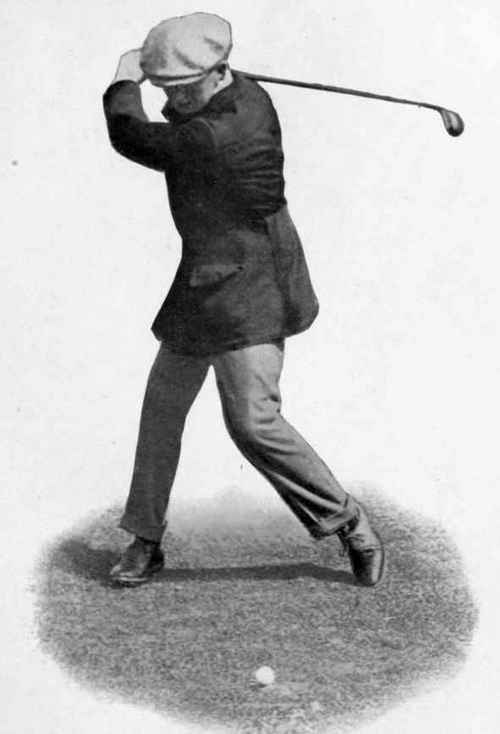
DRIVING: TOP OF SWING.
[To face p. 192.
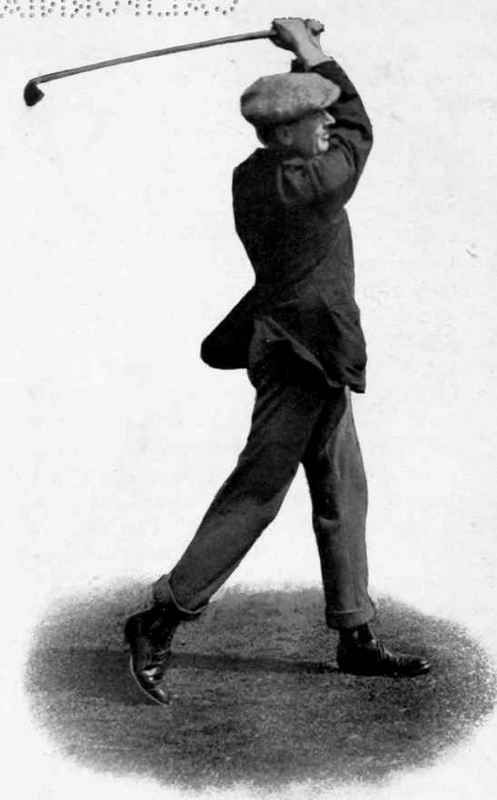
DRIVING: FINISH OF SWING.
To face p. 193.
It will be easily recognised that there are several points in this swing that differ from the general rules of instruction. My footwork starts very soon, there is no waiting until the upward swing drags the left knee round and the left heel off the ground. I hold it is wrong for this movement to begin the swing, it must be made to follow the lead of the hands and arms, but how soon will depend on the nimbleness or clumsiness of the player.
My weight is never transferred from the left to the right leg. Rather, as far as one can tell, it remains the same all through the swing, or at any rate until the ball has been struck, when naturally the following through carries the weight on to the left leg.
I can feel that the downward swing is begun by the hands, and the right shoulder begins coming round soon afterwards. This point should be noticed by all who suffer from slicing. There is no more common fault than to start the downward swing with the shoulders, especially amongst moderately good players who have acquired quite a decent swing. It means that the ball will swerve away to the right at the end of the flight. Another very important point I have alluded to is what I have called hitting away from you. This is not easy to explain on paper, although simple enough on a golf-course. However, here is a test whereby any one may prove the point himself. The next time you take a divot with any club, carefully examine the scalp mark and see which way it is pointing. If it is pointing to the left of the line to the hole, you have undoubtedly hit towards yourself; if it is pointing the opposite side of the line, you have struck away.
Now, if you keep well in your mind the idea of hitting away, you will be pretty certain to avoid the hitting towards; and it is this which is so important in driving. There is no point upon which one should more strongly insist.
I am not afraid that many will succeed in actually hitting past the ball, because of the stance and the position of the ball, but the effort to do so will invariably result in the ball taking a straight flight.
If this idea were more generally understood and acted upon, chronic slicing would be much less common than it is.
It will be noticed that I differ from a number of the experts in the turning of my hands and wrists in taking the club back. The movement comes very much later, and at no time can it be said that the face of the club 'is almost looking up to heaven,' as Mr. Darwin thinks it should. I believe he will find that very few of the 'V' grippers turn the club out so much as that. I certainly condemn it as unnecessary, and I should correct it in a pupil, since it is likely to exaggerate the wrist action and to cause 'foundering' or slicing, owing to the extra effort needed to get the club head back square. However, I intend to say more about the wrist action later.
The last point to notice in my swing is that it cannot be said that both halves are alike. Now, it is a very serious fallacy in my opinion to hold, that ' once get the backward swing correct, the downward swing will follow automatically.' Would that it did. Every club then would soon be boasting of its plus players, and scratch men would be too common to worry about. Coaching as a means of livelihood would be a very hard lot, but there would be this consolation, that it would be comparatively easy. No, this idea cannot be allowed to stand for a moment - my own experience shows that it is in the downward swing that the faults creep in. There are plenty of players I know who take the club back correctly in every detail, but they can never be trusted to hit the ball straight. Perhaps it is because they are conscious of nearing the work in hand. I unhesitatingly say that most of the faults that I am called upon to correct, in coaching old players who are off their game, are faults in the downward swing.
I feel it is important that golfers should be taught to recognise that bringing the club back correctly is just as difficult, if not more so, than taking the club up correctly. And when all these important points have been carefully noted and are understood, it must be clear in your mind exactly what it is you are trying to effect by the swing. This is what I think should be aimed at - and here I include every description of swings, 'quarter-swings,' 'half-swings,' 'full swings' and 'hits' - viz. to bring back the club head perfectly square to the ball and to let it travel on the exact line of flight you wish the ball to take, at least two inches before the ball is reached and as long as you can make it after the ball has been struck. To do this in the backward swing or (more important still) in the downward swing, never let the club head or any part of it be outside the ball. If this is not clear without a diagram, draw the line of flight back from the ball for some three feet. If your club head at any moment during the downward swing gets outside that line, it will require a miracle to make the ball fly straight.
My last piece of advice about driving is this. Form an opinion as early as possible, but not hastily, as to what is to be your style, and then stick to it. Do not be led to abandon it by the first man who beats you, and start practising other methods. Remember that however long a driver you may be, you will be sure to meet some one who can get a bit further. Learn what is your maximum length and be satisfied; take no notice of tipsters.
The number of golfers who are continually trying tips to enable them to drive further than Nature intended them to, is legion. The result is that they never know how they want to hit the ball, and can never be relied on to hit the ball when wanted.
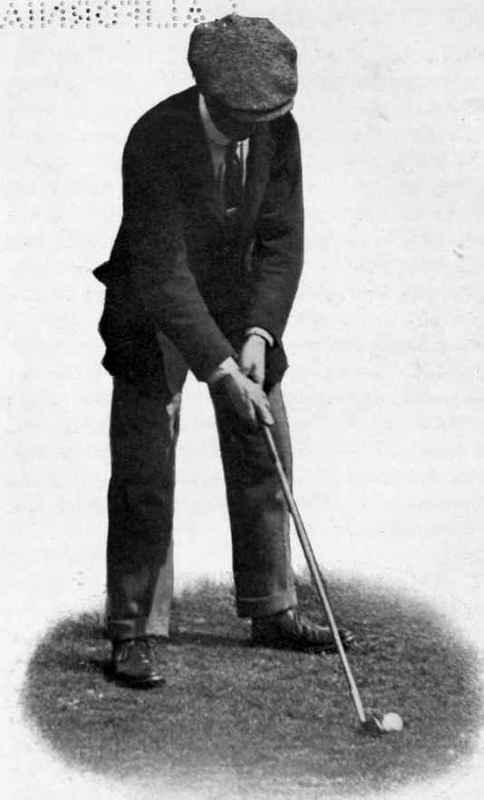
IRON SHOT: STANCE AND GRIP.
[To face p. 197.
Steadiness is after all the best kind of brilliancy.
About playing through the green with wooden clubs there is no need to say much. If the lie is good it is just driving over again. Of course, if there is a downhill lie or an uphill lie the stance must be altered to suit, but there is no difference of opinion as to these points, and enough instruction has been written already upon them. It would be waste of space for me to repeat it.
I must confess to a distinct liking for playing my spoon. It has a fairly long shallow face and a stiff shaft only some two inches shorter than that of my brassie. I swing for a full shot with this club in just the same way as I do with a driver. I frequently use it for short shots - checking the backward swing - and much prefer it to a cleek.
Continue to:


My Books

