


Chapter IV. Wrist Action And Pivoting
Description
This section is from the book "Present-Day Golf", by George Duncan, Bernard Darwin. Also available from Amazon: Present-Day Golf.
Chapter IV. Wrist Action And Pivoting
I have often heard the drive in golf described as a sweep, but I have no doubt in my mind that the tee shot is a hit; and the harder you hit the ball, provided everything is right, the further it will go. All those men who are reckoned the longest drivers, such as Mr. Blackwell, Ray, Braid, and Mitchell, hit and hit mighty hard. They differ just a little in their manner of hitting. First of all they are what I call, for want of a better term, two-handed up-swingers, and naturally they get as much power as possible out of both hands and arms in coming down. The moment at which one really sees the differences in their methods of hitting is when the club reaches the top of the swing. In each case, except Braid's, the club is beyond the horizontal. Braid for a long time also had a long swing, but shortened it in 1912. We see Mr. Blackwell and Ray with the left wrist under the handle at the top and the club-face open. Mitchell's club-face also tends to be open, but not to the same extent as that of Mr. Blackwell or Ray. The position of the hands during address will determine the position of the wrists at the top, and Braid having both hands more over towards the back of the shaft will have the left wrist less under at the top. On the position at this point depends the type of shot that will be struck, whether it will have a low trajectory with run or be one that is all carry.
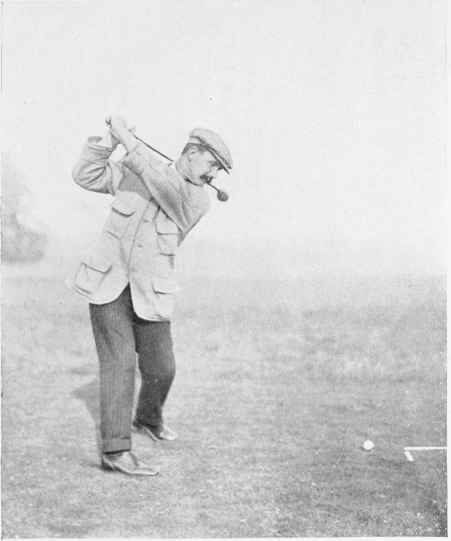
ALEX HERD.
At the top of the swing when playing for a draw.
The left wrist is not under the shaft and the club face shut.

ALEX HERD Coming at the ball "from inside."'.
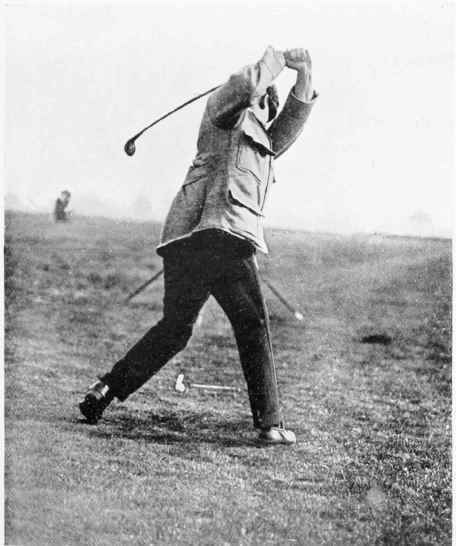
ALEX HERD Playing to "hold up" the ball with a spoon.
The left wrist is under the shaft and the club face open.
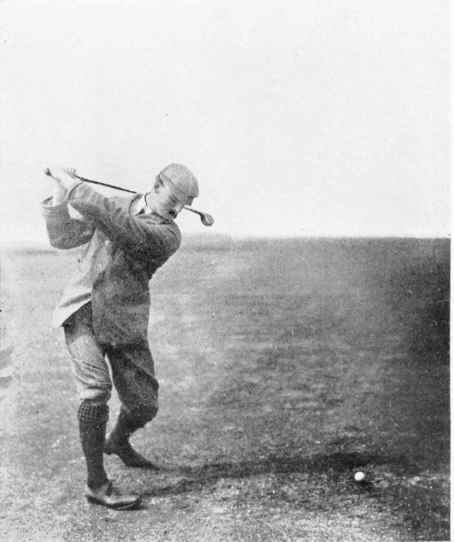
MR. JONN BALL A straight left arm with the left wrist not directly under the shaft at the top. This tends to shut the tare of the club.
It is perhaps a good thing for golfers generally that they cannot see the position of their wrists, at the top ; otherwise they would be struggling with the old-fashioned idea that both wrists must at the top of the swing be under the shaft. As a matter of fact this is the correct thing to do if one wishes a little cut. I am not going to be bold enough to say that having the wrists under the shaft is the initial cause of all slicing, but it has a great deal to do with it. Two very different cases are those of Braid and Ray. Ray grips his club so that both V's point straight down the club, while Braid's V's are pointing at the back of the club. Now the position at the top is that Ray's wrists are much more under the handle than Braid's. Consequently Ray's club-face is open and Braid's is shut-that is to say, pointing upwards. This gives him an inclination when he is off the line to be on the left side of the fairway, whereas Ray is inclined to be on the right.
I have been having a look at Mr. George Beldam's book, Great Golfers, and taking a dozen of the best amateurs or professionals I find that eight of them play most of their shots with the club-face pointing upwards. This means that their wrists are not under the shaft at the top of the swing. Against that we have four who keep the face open although their wrists are not exactly under. Mr. John Ball has his elbows a great way apart at the top for a drive, but when he is playing a high mashie shot the wrists work under the shaft. Mr. Hilton and Sandy Herd, I suppose, are the cleverest golfers at opening and shutting the club-face-that is, the putting under of the wrists or keeping them out according to whether they wish to steer a ball to the right or left. If either of these players wants the ball to go to the right, the left hand will move just a suspicion towards the right of the club and the right hand will move to the left. This will make it easier for them to work their wrists under by the time they get to the top. At the same time their pivoting will be restricted. Should a draw be required the proceedings will be exactly reversed. The hands will move towards the right and the pivoting will be increased.
Of the twelve players in Mr. Beldam's book that I selected, I should say that only one, Taylor, strikes me as employing only one hand, the left, during a part of the uptake of the club. I think this fact may account for his abnormally flat swing. Taylor starts his uptake with a turn of his left wrist, and when this is completed, which is roughly three-quarters of the way up, his right hand takes charge and completes the swing with a half turn towards his head. I should describe Taylor's up-swing as a gradual turning of the wrists, first of the left and then of the right. Now Vardon's swing, which might better be described as a sling, is totally different, in that he uses both hands straight away in taking up the club. He actually drags the club nearly straight back for the first six inches; there is no turning of the left wrist yet, as the right is in charge. Then comes a sudden sling of both wrists which carries him to the top of an upright swing.
The greatest trouble that both Taylor and Vardon have in playing golf is to keep the right from doing more than its share in the up-swing. It is a very common trouble with many less famous golfers, so often are we tempted to try a little extra pressure. Then that right hand increases its pressure and the whole swing is spoiled. Naturally if the right hand is gripping the club tight it will take the nearest way to the top, and instead of our swinging or slinging the club up it is lifted up. It is impossible to get the true arc if the right hand absolutely overpowers the left at the start, as the left shoulder is doing nothing, and a swing cannot be accomplished unless the left shoulder is moving. This brings us to pivoting, but before I say something about that I ought to give a definite opinion as to which is the better method-to have the left wrist under or not. I have little hesitation in saying that for the average golfer it will be better for him to get the left wrist as nearly under the shaft as possible, since the shut-face method is very dangerous. How often does one find a player using a brassy, yes and sometimes a spoon, off the tee! Or perhaps he comes into the shop to have just a little more loft put on the face of his wooden club. And all the time it was not the face but the shutting of it that was the trouble.
Continue to:


My Books

