


The Putters Art. Continued
Description
This section is from the book "Present-Day Golf", by George Duncan, Bernard Darwin. Also available from Amazon: Present-Day Golf.
The Putters Art. Continued
It is a strange thing that we know just how to do a thing at golf and yet we cannot do it. During 1919 I putted, shall I say, moderately well on an average, and yet I knew that, could I only do something different, I could improve. I knew through looking at an old photograph, taken when I was putting well, that my stance was not just the same as in the photograph. I practised for weeks, but I couldn't get my weight back on my heels until the following year, 1920. Then the knack of it suddenly came back, and I managed to keep it as long as it was required. I have lost it meantime through not playing, but I shall not take twelve months to find it this time. I have found this trick of keeping the weight back on the heels the best thing I have ever discovered about putting. The further back I can keep my weight the more stationary my body is and the better I putt. I have always been a good short putter, and the only way I can account for this is that I generally used to leave myself so much to do from the approach putt that something had to be done. Now that I have made myself really believe that I am a good approach putter, I suppose that what I call the law of average in putting will come into operation and I shall be missing a few short ones.
Nearly everybody calls Vardon a bad putter, but it would surprise a good many people if they were to take the trouble to count how many times he hits the ball with his putter as compared with other players. I always rate Vardon as the best approach putter we have, and through watching how he does it I have improved my own long putts. He has a trick of pressing the handle of the putter well forward just before the back-swing. Now what this does is to ensure that the putter-head gets away first with the hands following it, and that is all that matters. It is when the hands and the club-head get in a line that there is a locking of the left wrist at impact which prevents the ball being hit truly. Ray is a good putter, we know, but he often has bouts of this locking of the left wrist because his putter-head never leads unless he is very close to the hole. With the putter the head must be-from the moment you start to make the putt until impact-behind the hands. As a matter of fact it is doubtful whether at any time during the stroke the putter-head should be in front of the hands. I believe that if I could really carry out these instructions I should putt better than I do, but it's fearfully difficult to keep the head behind the hands all the time.
There are two important factors in putting, to my way of thinking. One is to keep the body still, and the best way to ensure this is to keep the weight back on the heels. The other is not to allow the left wrist to bend or, perhaps I should say, to allow the left wrist to bend as little as possible when taking the club back. I have often found myself looking at the putter-head going back and at the same time putting the short ones well. It is when you look at the hole before or just at the moment of impact that you putt badly.
Perhaps in saying that these are the two important things I have assumed a little too much as to the actual method of taking the putter backwards and forwards. I assumed that the club should be taken back with the left hand and the actual hitting done with the right. Perhaps a better word than take is push. The club should be pushed back with the left hand. The great danger is that of getting the left wrist too much bent in the course of this process. If you do this, the wrist seems to get paralysed and the ball cannot be hit truly. There is no patent remedy for this disease. You must just take care not to bend the wrist too much, but keep it as stiff as you reasonably can. Of course you must not make yourself feel too stiff, for that is never a good plan in any stroke ; but almost anything is better than getting that left wrist too much bent, for it is the very devil.
I have talked a good deal about the shut and the open blade in other strokes, and have been generally in favour of the open. In putting the blade should be shut. I do open the blade just a shade, but it is very little. If you will try the experiment I think you will see that to open the blade to any real extent makes putting terribly difficult. Turn the face of the putter away from the ball as you take it back, and see what chance you have of bringing it back accurately. Doesn't it look a very small one? It has got to come back exactly and precisely right or the ball must be either hooked or pushed out. Look at the photographs of Jack White putting and you will see very, very little of his blade open. Of course in a long approach putt when the club is taken well away from the ball there must be rather more opening of the blade. That will come about naturally. Generally speaking, however, it is one of the secrets of putting to keep the blade shut.
I have often been told that in my approach putts the ball never looks as if it would get there, but it keeps on running and, if I have hit it right, it does get the distance. Where my putts, and for that matter a good many more players'putts are deceiving, is in the fact that the ball has been hit near its centre, which keeps it travelling. You can't talk of top spin in hitting a golf ball, but I am firmly convinced that hitting the ball near or above its centre is a better way to putt than to roll the ball or hit it with the putter-head going parallel with the ground. All good putters have the same trick of hitting the ball a slightly descending blow-in other words, putting on 'top.' A ball hit this way will hug the green better than one that has been hit below its centre, especially if it has been hit with a putter that has any loft on it. To hit below the centre with a lofted club makes the ball have a slight pitch on it, and it is more easily 'kicked 'off the line. One hears of drag on a putt, but when it is necessary to make a putt slow up it can only be done by hitting the ball on the heel of the club. A ball can be hit at the bottom that will show a suspicion of drag, but a club with more loft than a putter, such as a mid-iron, has to be used. Drag cannot really be applied with a putter. It is a bad shot to try for. A sounder method is to hit as near in a line with the club-shaft as possible. This has a wonderful slowing-up effect.
I have always been sorry the Royal and Ancient prohibited the Schenectady putter, as I am a great believer in hitting opposite the shaft, and here was a golf club with which any one could apply this method without any trouble. The club was so constructed that it was difficult to do anything else. When Mr. Walter Travis won at Sandwich there was a tremendous run on the American putter, but A. H. Toogood was the only player of note who got it to work. Only one of these instruments remains at Hanger Hill and, sad to relate, it has been converted by the dressing-room attendant, who by the way has never hit a golf ball in his life, into a coal-hammer.
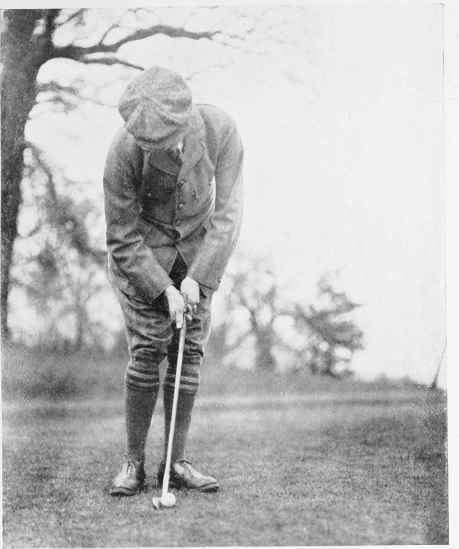
DUNCAN PUTTING Notice the grip of the right thumb straight down the shaft.

JACK WHITE PUTTING With his head well down over the ball.

DUNCAN PUTTING The club has been pushed back with the left hand.
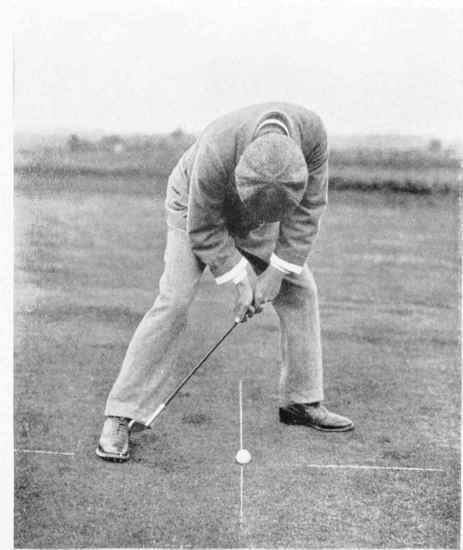
JACK WHITE PUTTING At the end of the back swing. All the work is done with the wrists. There is no movement at the elbows.

DUNCAN AT THE FINISH OF A PUTT The actual hitting is done with the right hand.
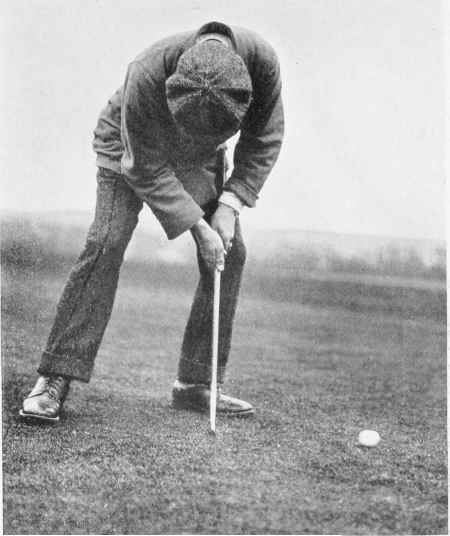
JACK WHITE AT THE FINISH OF A PUTT The head has been kept still and well down.
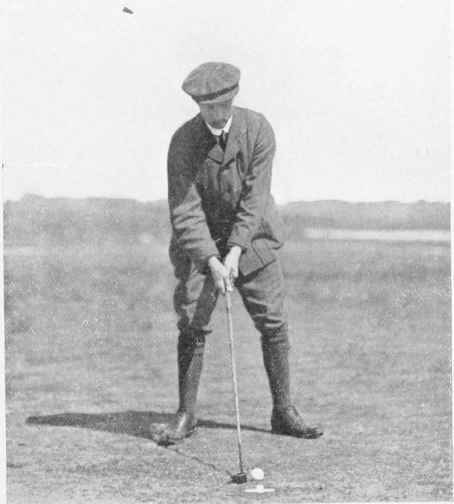
C. H. MAYO. He has his left hand decidedly under the shaft which necessitates a pronounced turning of the wrists.
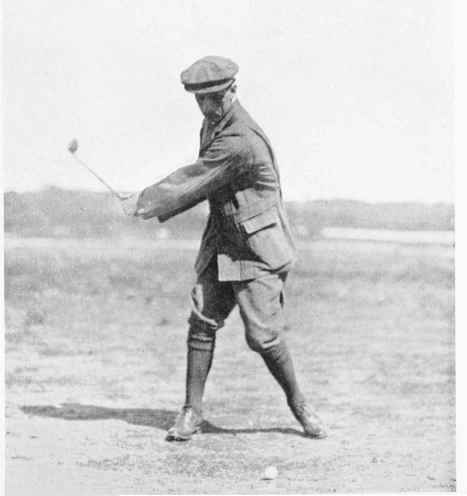
C. H. MAYO. Notice the turn of the wrists at the very start of the swing, he is the only player of note who employs it.
Continue to:


My Books

