


The Power Of The Left. Part 2
Description
This section is from the book "The Soul Of Golf", by P. A. Vaile. Also available from Amazon: The soul of golf.
The Power Of The Left. Part 2
It will be apparent that it is utterly impossible for the arms and wrists to be tighter than they are when they are " in their highest state of tension." Therefore, we must take it that James Braid's advice at page 5 5 of How to Play Golf is over-ridden by his advice at Page 57 of Advanced Golf, for I think that we are entitled to consider that Advanced Golf represents Braid's last word with regard to the science of golf.
Quoting still from the same passage, page 57 of Advanced Golf Braid says: "Every muscle and joint in the human golfing machinery is wound up to the highest point." It is impossible to get away from that. We are told that at the beginning of the downward swing "every muscle and joint in the human golfing machinery is wound up to the highest point."
Now the student of golf who desires to start his swing on a firm and sure foundation must mark this statement well. I repeat it for the third time: "Every muscle and joint in the human golfing machinery is wound up to the highest point," and let it be remembered that Braid is now speaking of the start of the downward swing.
We will now turn to Taylor on Golf At page 193 Taylor says:
My contention is simply this: that the grasp of the right hand upon the club must be sufficiently firm in itself to hold it steady and true, but it must not be allowed on any account to over-power the left. The idea is that the latter arm must exercise a predominant influence in every stroke that may be played. As regards my own position in the matter, my grip with either hand is very firm, yet I should hesitate before I told every golfer to go and do likewise.
Here we see that Taylor distinctly says that "the idea is that the latter arm (i.e. the left) must exercise the predominant influence in every stroke that may be played," and although he says explicitly that his own grip with both hands is very firm, he puts the utterly false idea of the predominance of the left into the minds of those who are influenced by his teaching.
Taylor, at page 107 of Great Golfers, says in dealing with the "Downward Swing":
The club is brought down principally by the left wrist, the right doing very little until the hands are opposite the right leg, when it begins to assert itself, bringing the full face of the club to the ball.
It is almost unnecessary to say, especially in view of Taylor's statement that he holds very firmly with both hands, that he does not carry out this dangerous teaching. Harry Vardon says to attempt it is fatal, and I am pleased to add my corroboration.
This amazing fallacy is wonderfully deeply rooted. A friend of mine some time ago was in trouble about his iron shots. He consulted a professional, who endeavoured to cure him by telling him when playing his stroke to hold so lightly with his right hand that at any time during the stroke he could slide it up and down the shaft.
Oh no ! He is not a duffer, nor is he mentally unbalanced. He is merely a professional golfer who plays for England and suffers from the hallucination handed on to him by more famous players than he.
What could be stronger than this? Let me quote Taylor again. At page 90 of Taylor on Golf he says:
The right hand is naturally the stronger of the two - much more powerful in the average man than the left - and the learner is just as naturally prone to use it. But in the game of golf he must keep in front of him at all times the fact that the left hand should fill the position of guide, and it must have the predominating influence over the stroke.
That this is rather unnatural I am perfectly willing to admit. Its being unnatural is the basis of its great difficulty, but it is a difficulty that must needs be grappled with and overcome by any man who desires to play the game as it should be played.
But Taylor will not give in to this idea himself! Is not this wonderful?
Harry Vardon says of the grip that one should "remember that the grip with both hands should be firm. That with the right hand should not be slack as one is so often told." This is valuable corroboration, for it must be remembered that Vardon only subscribes to the fetich of the left by implication. Nowhere, I think, can we convict him of actually preaching it.
Now let us turn to the volume on Golf in the Badminton Library contributed by Mr. Horace G. Hutchinson. At page 85 Mr. Hutchinson says:
Since, as will be shown later on, the club has to turn in the right hand at a certain point in the swing, it should be held lightly in the fingers, rather than in the palm, with that hand. In the left hand it should be held well home in the palm, and it is not to stir from this position throughout the swing. It is the left hand, mainly, that communicates the power of the swing; the chief function of the right hand is as a guide in direction.
At page 87 Mr. Hutchinson continues:
So much, then, for the grip. Now, when the club, in the course of its swing away from the ball, is beginning to rise from the ground, and is reaching the horizontal with its head pointing to the player's left, it should be allowed to turn naturally in the right hand until it is resting upon the web between the forefinger and the thumb.
We see here that this distinguished amateur is an out and out adherent of the fallacy of the left. He tells us distinctly that it is the "left hand, mainly, that communicates the power of the swing, and that the chief function of the right hand is as a guide in direction," but notwithstanding the fact that "the chief function of the right hand is as a guide in direction," we see that at the top of the stroke it turns loosely in the hand until it is "resting upon the web between the forefinger and the thumb."
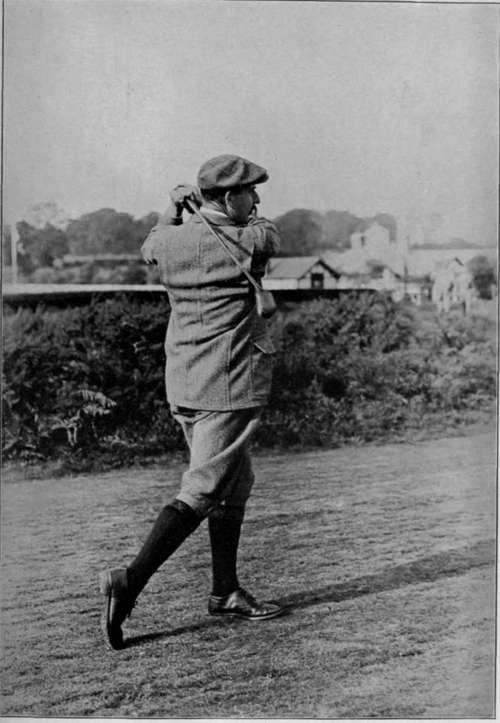
PLATE VII.
Continue to:


My Books

