


Vienna. Part 15
Description
This section is from the book "Vienna - John L. Stoddard's Lectures", by John L. Stoddard. Also available from Amazon: John L. Stoddard's Lectures 13 Volume Set.
Vienna. Part 15
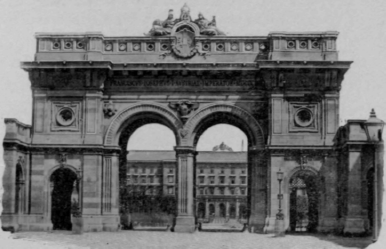
The Gateway To The Barracks.
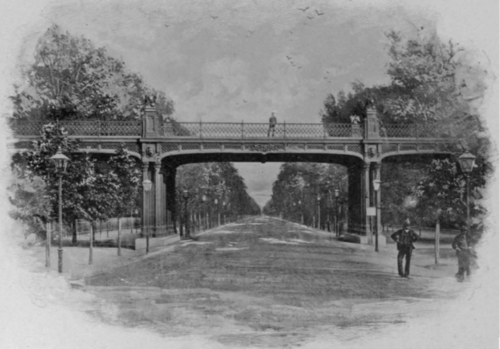
Entrance To Prater.
"Were half the power that fills the world with terror, Were half the wealth bestowed on camps and courts, Given to redeem the human mind from error, There were no need of arsenals or forts."
Of all the pleasure-grounds enjoyed by the Viennese, the largest is the immense park called the Prater, which is more than three miles in length, and has an area of four thousand acres. Up to the time of Joseph II. this was a royal game-preserve, well stocked with deer; but that liberal monarch gave it to the people for a pleasure-resort, and as such it has ever since remained.
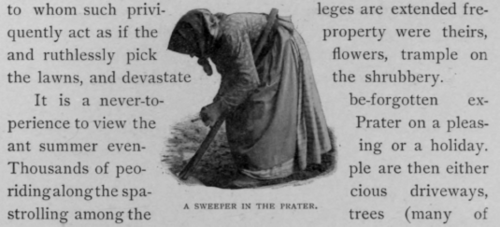
Moreover, as if the enormous areas of the Prater and the various city parks were not sufficient, several extensive private gardens, such as those of Prince Schwarzenberg, of the Lichtenstein family, and of the Belvedere Palace, are thrown open to the public daily, after the fashion of the villas near Rome; nor does such generosity-seem to be abused as in some other countries, where those them brilliantly illuminated), or seated in the numerous concert gardens, listening to those strains of music which seem almost as necessary to the existence of the Viennese as the air they breathe. It was at such a time that, on a scrap of paper, in the midst of innocent merriment and delightful music, in this park, the following lines were traced:
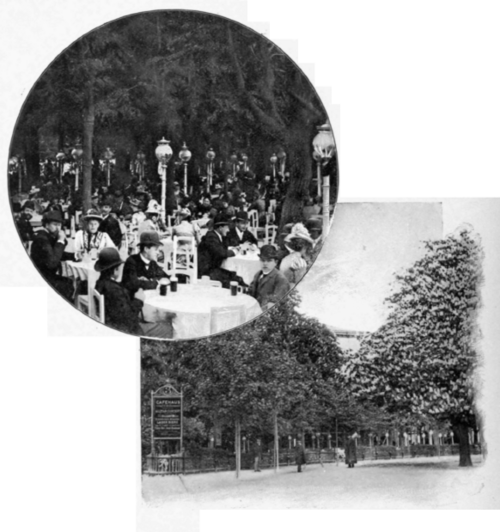
A cafe in the prater.
TO-Day.
"The sun will set at day's decline."
Quimporte ? Quaff off, meanwhile, life's sparkling wine. Of what avail are timorous fears, Foreboding sighs and idle tears ? They hinder not the hurrying years.
Buvons!
"This fleeting hour will soon be past."
Qu'importe ? Enrich its moments while they last. To-day is ours. Be ours its joy. Let not to-morrow's cares annoy. Enough the present to employ.
Vivons'
" These pleasures will not come again."
Qu'importe ? Enjoy their keenest transport, then. If but of these we are secure, Be of their sweetness doubly sure, That long their memory may endure.
Rions!
" With time, love's ardor always cools "
Qu' import ? Leave that lugubrious chant to fools. Must doubt destroy our present bliss ? Shall we, through fear, love's rapture miss, Or lose the honey of its kiss ?
Aimons!
"The sun will set at day's decline."
Qu'importe ? Will not the eternal stars still shine ? So even in life's most dreary night A thousand quenchless suns are bright, Blest souvenirs of past delight.
Allons!
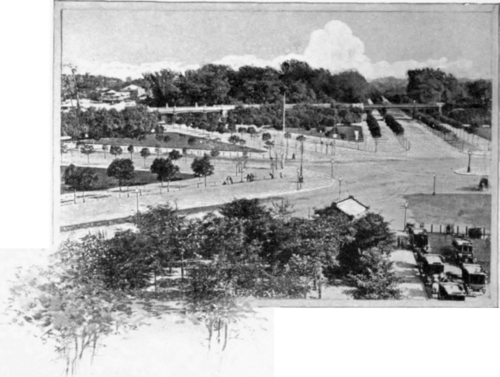
The Prater.
To those who have studied popular gatherings in different lands, the contrast between the North and South of Europe is remarkable. The difference seems to depend largely on the amount of alcohol imbibed. This steadily diminishes as one goes southward, and in Austria the almost universal beverage is the light and wholesome Vienna beer.
Hence we discerned here practically no intoxication, and the happiness and good behavior of a Viennese crowd are proverbial.
The favorite summer residence of the imperial family of Austria is Schonbrunn, situated a few miles distant from the capital. I shall never forget the beautiful spring day when I first visited this Austrian Versailles. Its luxuriant park was at its loveliest; the esplanade was soft with turf and bright with flowers; and, outlined on the sides, against great walls of carefully trimmed foliage, numerous marble statues were so cunningly displayed, that we could almost fancy them the natural inhabitants of the place. At one point, on an elevation overlooking these extensive grounds, is a pretty gallery called the Gloriette. This was, in summer, a favorite resort of the Empress Maria Theresa, who would retire here with books, papers, and despatches and attend to affairs of State in the open air, sentinels having been posted in the vicinity to warn off all intruders. Both the park and palace of Schonbrunn are thronged with interestingmem-ories. It was in this garden, for example,in 1809, when Napoleon had established his headquarters here, that he narrowly escaped assassination. He had just alighted from his horse after a review, when a young German pushed through the crowd and asked if he could speak to the Emperor. Napoleon received him kindly, but could not understand his imperfect French. While speaking, the young man held his right hand under his coat so constantly that General Rapp regarded him with suspicion. He was, accordingly, arrested and found to be armed with a large knife. Far from denying that he had intended to kill the Emperor, he boasted of it, regretting nothing save his failure to accomplish his design. Napoleon sent for the youth, and questioned him. "Why did you wish to kill me?" he asked. " Because you are the oppressor of Germany," was the reply. "Why did you not wish to kill the Emperor Francis?"continued Napoleon; "it was he who commenced the war." "He is only a cipher," replied the young man, "some one could replace him ; but if you were killed, you would have no successor." "If I should pardon you, what would you do?" "You would make a great mistake," was the reply, "for I would try again to kill you." Napoleon, however, offered to pardon him, on the sole condition that he should confess sorrow for his crime; yet the youth persisted in regretting nothing but his ill-success. Accordingly, he was left to his fate and was shot. No doubt Napoleon received a host of congratulations upon his escape; but, after all, should he have been congratulated ? If he had died then, he would have passed away at the very zenith of his power and glory. There would have been no divorce, no second marriage, no little King of Rome to die at Schonbrunn in captivity; no retreat from Moscow, no Water-loo, and no St. Helena. In the light of history, it is not strange that the ancients held that one of man's greatest misfortunes is not to know the proper time at which to leave the world. One of the most interesting and pathetic objects in the palace of Schonbrunn is the room in which Napoleon's son, then called the Duke of Reichstadt, died at the age of twenty-one ; for, by a strange coincidence, this ill-fated Prince expired, not only in the same room, but in the very bed, which had been occupied by his imperial father when conqueror of Vienna.
Continue to:


My Books

