


Belgium. Part 6
Description
This section is from the book "Belgium - John L. Stoddard's Lectures", by John L. Stoddard. Also available from Amazon: John L. Stoddard's Lectures 13 Volume Set.
Belgium. Part 6
The splendor of the Brussels Bourse is now surpassed by that of the new Palace of Justice, the cost of which was more than ten million dollars. It would be difficult to find in any city a secular building more magnificent and imposing. It forms an enormous rectangle, each side of which measures about six hundred feet, while in the centre rises a wellproportioned tower, four hundred feet in height.
The question naturally suggests itself : How there can be in such a tiny realm as Belgium enough judicial business to make so huge a structure necessary. It is a striking illustration of the fact that while the other European nations have been wasting life and treasure on the battle-field, or carrying enormous burdens in preparation for war, Belgium has been employed in peaceful industries, and the most splendid and conspicuous building in her capital, today, is not an arsenal for her soldiers, nor even a fortress for defense, but a palatial temple for the goddess of justice. Almost every European capital is embellished by at least one lofty shaft, characteristic of the nation and commemorative of its history. In London, it is Nelson's column in Trafalgar Square; in Paris, the Napoleonic column in the Place Vendome; Berlin is dominated by her recent Monument of Victory; and in St. Petersburg we find the noble monolith which bears the name of Alexander I. The Belgian capital, also has a historic column, worthy to be compared with those of other lands. It was erected to commemorate the founding of the kingdom in 1831, when its present liberal constitution was adopted, and Prince Leopold of Saxe-Coburg was elected king. A statue of this sovereign (the father of the reigning monarch) crowns the summit of the column at a height of two hundred and eighty-five feet; and at the corners of the pedestal are four bronze figures, which symbolize the basic principles of the government: Liberty of the Press, Liberty of Education, Liberty of Public Assemblage, and Freedom of Religious Worship. These are four elements from which we might expect an almost perfect state to be constructed; and where in Europe (all things considered) can we find a nation better governed, a constitution more implicitly obeyed, a king more liberal and progressive, and a people happier and more prosperous?
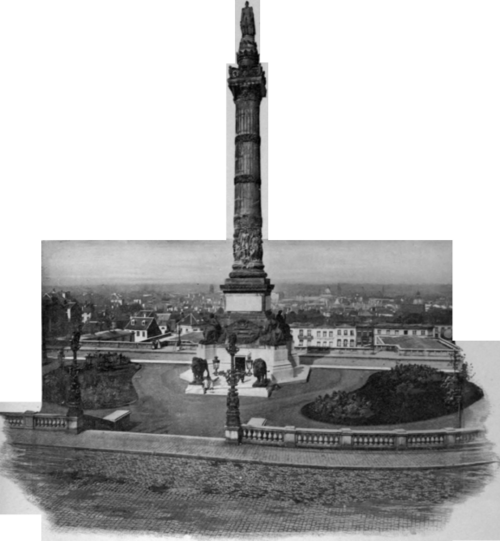
The Column Of Congress.
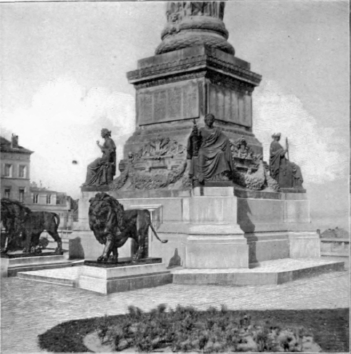
The Base Of The Column.
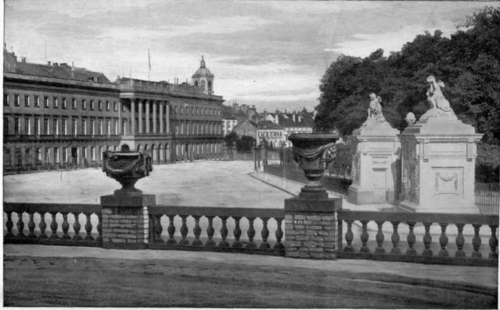
The Royal Palace, Brussels.
Leopold II. of Belgium is distinguished among other sovereigns of Europe for his unassuming manners and industrious habits, as well as for the remarkable ability with which he conducts the onerous and responsible duties of his high position. I have been told by those who are well informed that he is the busiest man in his kingdom. He usually rises before six in the morning, and may be seen soon after superintending the rebuilding of his beautiful Chateau of Laeken, recently destroyed by fire, or consulting with his chief gardener over the rare plants and flowers cultivated in his superb conservatory. At nine o'clock he is in the palace at Brussels, and during the entire day is deeply engrossed in the affairs of State: examining voluminous reports, consulting with his cabinet officers, receiving visits from ambassadors and other distinguished people, making plans for the amelioration of the inhabitants of his Congo-State, and for the development of its commercial life; or employed in the many details which demand the close attention of an enlightened and progressive ruler, desirous of securing the prosperity of his country and the welfare of his people. A brilliant diplomat, a shrewd, far-seeing statesman, liberal in all his ideas of government and administration, thoroughly in sympathy with the progressive ideas of the century, and sharing the hopes and aspirations of his people, King Leopold II. stands out conspicuous as one of the most eminent sovereigns of his time. The Chateau of Laeken, the King's summer home, situated about three miles from Brussels, was, a few years ago, destroyed by fire. It was a most beautiful residence, and during the time when Belgium constituted a part of the Empire of France, under the first Napoleon, it was a favorite abode of the Emperor whenever he visited that part of his dominions. A friend of mine was recently honored with an invitation to dine with the King at Laeken, and, after the repast, as the King and Queen were strolling with their guests through some of the most interesting rooms of the chateau, Leopold II. suddenly stopped, and remarked, "This is historically a very interesting apartment, for from this room and from that little table in the centre began the downfall of Napoleon." To my friend, who inquired how this could be, the King replied : "In this room and on that table the Emperor Napoleon wrote his declaration of war against Russia, in 1812, from which moment I consider, dates the commencement of his downfall." When this chateau was burned, the King and royal family were at the palace in Brussels, holding their New Year's reception. The grenadiers on guard at Laeken, seeing that the building was doomed, and knowing how highly Leopold II. prized the Napoleon table, made extraordinary efforts to force their way into the building through fire, smoke, and falling timbers to secure it, and, finally, to the great delight of the King, succeeded in rescuing it before it had been injured.
Continue to:


My Books

