


Canada. Part 22
Description
This section is from the book "Canada - John L. Stoddard's Lectures", by John L. Stoddard. Also available from Amazon: John L. Stoddard's Lectures 13 Volume Set.
Canada. Part 22

Cliffs Worn By The Tide.

Steamship " Lake Ontario.
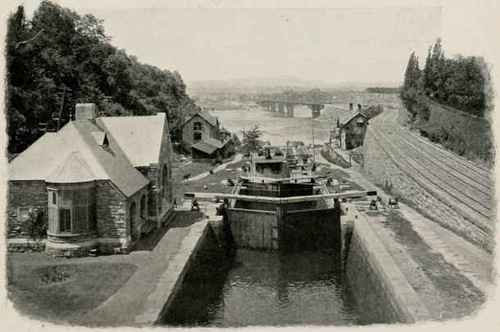
Canadian Locks.
The lowest rapids have been named the Lachine, after the town now located beside them, nine miles west of the metropolis. Lachine has played a memorable part in the history of Canada. It was originally founded by the gallant leader and discoverer, La Salle, to whom a grant of territory in this region had been given. It has, moreover, the unenviable distinction of having been the scene of the most horrible massacre that ever marked with blood and fire the homes of the Canadian colonists. At midnight, on the 5th of August, 1689, the dreaded Iroquois attacked the village during a storm, butchered with fiendish cruelty two hundred men, women, and children, and carried off, for a more lingering death with nameless tortures, at least one hundred and twenty more.
"What's in a name?'
Much in the old French names of early Canada.
Most of them owe their origin to some pious priest, intrepid soldier, or enthusiastic conqueror, who made the region better and mankind the wiser by his life or death. The name Lachine recalls much more than its appalling massacre. It is commemorative of a nation's dream, of a great hero's disillusion, and of the cheap derision of his enemies. La Salle, like most of those who penetrated the American wilderness, believed that he should find upon the farther side of it a highway to the Orient. Of the remoteness of that western limit and of the awful difficulties and dangers lying between him and his goal, La Salle had no conception; but his indomitable constancy and courage enabled him at least to discover and investigate the Illinois and Ohio rivers, and to sail down the Mississippi to its terminus and ascertain its outlet into the Gulf of Mexico. In his far greater plan of finding a western route to China, he failed, however, like all of his contemporaries. Hence envious inferiors, after the fashion of their kind in every age, tried to belittle his magnificent achievements, and called his settlement here sarcastically "La Chine," as being all of the rich China of his hopes that he had ever found. Yet history has proved his views in general to have been correct; and his fond dream has, after all, been realized in a vastly broader sense than he could then have possibly imagined. For to-day, traversing the very town from which he started out to force his way through trackless wastes into a great unknown, an uninterrupted path of steel, more than three thousand miles in length, extends across the entire continent from the Atlantic to the Pacific coast, whence a fine steamer of six thousand tons will bring the traveler in thirteen days to Yokohama and in another five to the Celestial Empire.

Old Windmill Near Lachine.

Caughnawaga, Indian Village Near Lachine.

Station Of The Canadian Pacific Railroad, Montreal.
The rapids of the St. Lawrence have the remarkable peculiarity, that while they are too swift and turbulent for steamers to ascend them, they can be "shot" in safety by descending vessels. This is a feature of Canadian travel not to be neglected. No fatal accident has ever yet occurred in the adventure; and where the chances are so manifestly in our favor, there is a fascination in gambling with danger. This is what makes the running of the Lachine Rapids so attractive. For a brief time we put our lives into the hands of an Indian pilot. Grave from a sense of his responsibility, he stands beside the helm. The steamer leaves Lachine, and swings out into the current. Suddenly the surface of the river changes from a tranquil level to a heaving mass of elevations and depressions. For here the bed of the St. Lawrence shelves abruptly; and its descending path is strewn with rocks, which churn the river into wrathful foam, card masses of it into silvery spray, and stir it into swirling vortices of glaucous water, from which emerge strange, gurgling sounds, as if they were the maws of hungry monsters in the depths below. A wild exhilaration - half terror, half excitement - seizes us. It would be too intense, but for the recollection that such trips are made here every day in safety, and that the Indian pilots know the channel like a trail. Yet, as the steamer with its precious life-freight darts along its devious path between a thousand Scyllas and Charybdes, should the trained eye miscalculate, or the hand fail to execute instantly the mandate of the brain, the vessel might at any moment strike a rock and go to pieces like a house of cards. It is the consciousness of this, together with the firm belief that all will end well this time, as it has before, that makes this strange experience enjoyable; and when we feel the last swift sinking of the steamer's deck, and, with a final rush of lightning-like velocity, glide once more into placid water, a sigh of mingled satisfaction and regret escapes us, as when the curtain falls on an absorbing play.
Continue to:


My Books

