


Canada. Part 38
Description
This section is from the book "Canada - John L. Stoddard's Lectures", by John L. Stoddard. Also available from Amazon: John L. Stoddard's Lectures 13 Volume Set.
Canada. Part 38

Emerald Lake, Near Mount Burgess.

Lake Agnes And Mount Whyte.
Mirror Lake and Not far from Lake Louise, in fact at the first station west of Laggan, we reach the summit of this Rocky Mountain pass, which bears the title of the "Great Divide." It is one of those interesting and impressive spots, where a mere shelving ledge or fallen boulder decides the destiny of mighty rivers by changing the direction of their baby rills, so lately liberated from the parent source. Here, for example, a bright streamlet separates into two branches, - one of which hastens east and northward, to end in Hudson's Bay, while its twin sister turns, to follow down the western slope and lose itself in the Pacific.

Mirror Lake, At Foot Of Goat Mountain.

Lake Louise And Mount Victoria.
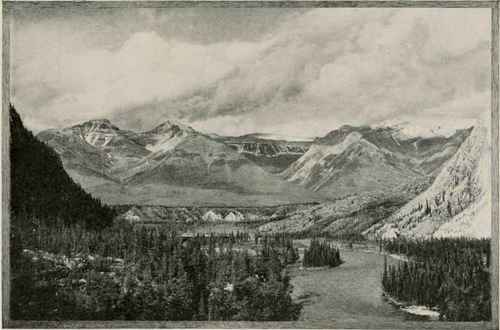
Bow Valley, From Hotel, Banff.

Ponies At Lake Louise.
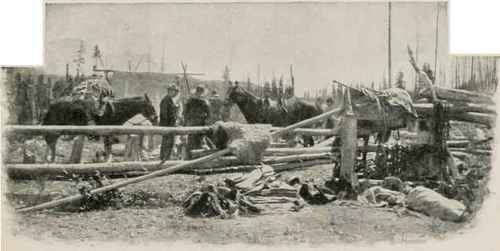
Preparing To Start From Corral At Laggan.
" From the same cradle's side,
From the same mother's knee, One to long darkness and the frozen tide, One to the peaceful sea".
If one could rise in a balloon above the heaving mass of mountains covering almost the entire surface of British Columbia, how marvelously intricate would seem the river system of this Province! Spread out in silvery lines beneath him, what turbulent and tortuous streams he would discover, all coming ultimately to the ocean, but on their pathways thither, twisting abruptly north, south, east, and west, as the irregular mountain bases shape their course! The sinuosities of the Columbia and the Koo-tenay would especially fill h i m w i t h astonishment. For, as an illustration of coquetry exemplified by rivers, nothing approaches the conduct of this largest tributary to the Pacific and its principal affluent. Born in the same locality among the glaciers of the Selkirks, they seem at the very outset to have had a quarrel; for both flow past each other in opposite directions, coming, however, at one point so near a reconciliation that a canal a mile long makes an effort to unite them. Nevertheless, the breach grows wider. The Kootenay flows due south, and passes into the United States, while the Columbia journeys northward to the very-head of the Selkirk range. When they are separated by a distance of three hundred miles, they appear to change their minds; for both turn squarely round, and counterflow in opposite directions toward each other, the Kootenay traveling north and reentering British territory, the Columbia sweeping southward to pass within the great

On The Columbia River.
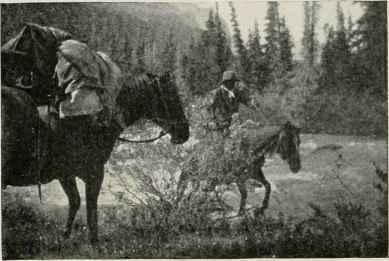
A Bright Streamlet.

At The Base Of The Mountain.

Cathedral Spires, From Mount Stephen.
An Ice Cornice.

Valley Of The Ten Peaks And Lake Moraine.
Republic. Twenty miles north of the frontier they at last unite, their blended torrents being thenceforth known by the one name, Columbia. As such, long before it reaches the Pacific in the State of Oregon, it assumes a depth and breadth which make its progress royal, for it is navigable for twelve hundred miles, and at its terminus is six miles wide. Immediately after crossing the "Great Divide," the traveler finds himself surrounded by stupendous mountains, to some of which such names as Stephen, Field, Sir Donald, Hunter, and Van Home are given, in honor of the brave explorers, skillful engineers, and prominent officials of the Canadian Pacific railway. Although these are the titles of our own contemporaries, and are bestowed on mountain monarchs antedating man's arrival on the planet, they do not seem incongruous, since they commemorate men who made this wilderness accessible. Till recently no Indian or white man had crossed this seemingly insuperable barrier.
Continue to:


My Books

