


Canada. Part 7
Description
This section is from the book "Canada - John L. Stoddard's Lectures", by John L. Stoddard. Also available from Amazon: John L. Stoddard's Lectures 13 Volume Set.
Canada. Part 7
Although Great Britain has completely wrested from the hands of France all but a tiny fraction of her western empire, there still remain in Canada indisputable evidences of the French regime. The language of the conquerors has not replaced the language of the conquered. Nor have the habits of the Saxon superseded the customs of the Celt. In Montreal the two races are about equal in number; but in the enormous Province of Quebec, which has an area of more than a quarter of a million square miles, and sends to the Dominion Parliament twenty-four senators and sixty-five representatives, eighty per cent. of the people still speak French as their mother tongue, and eighty-five per cent. are Roman Catholics. In several communities of eastern Canada, away from the St. Lawrence River, English is neither spoken nor understood, except perhaps by the village priest or notary. Hence, this part of the Dominion, like many other portions of the British Empire, is bi-lingual; and in its legislative assemblies both French and English are heard; the former oftener than the latter. All public documents also are printed here in both languages, and in the law courts pleas are made in either tongue, the lawyers as a rule using both with equal readiness. It is significant, too, that though the criminal law of Canada is English, and uniform all over the Dominion, the civil code of the Province of Quebec is still the old civil law of France.

Place D'Armes, Quebec.

Parliament Buildings, Quebec.

A French Canadian Spinning.
Another interesting memorial of France in the New World is found in the nomenclature of Canada. Everywhere east of the Mississippi we meet, appropriately bestowed on rivers, lakes, and cities, the names of French saints, princes, statesmen, missionaries, soldiers, and adventurers, like a long chain of sacred, royal, and heroic souvenirs, the first link fastened to the cliffs of Newfoundland, the last one anchored at the exit of the central river of the continent, where the remotest corner of the Bourbon empire met the Gulf of Mexico, and bore the name of the French king in the euphonious title given to it by La Salle - Louisiana. Some of these proofs of French discovery, conquest, and religion occur to us at once, such as St. Johns, Trinity Bay, Richelieu River, Lake Champlain, Montreal (Mont Royal), Sault Ste. Marie, La Salle. Duluth, St. Louis, Joliet, Detroit, Marquette, and Lachine. The rocky height, just opposite Quebec, is called Point Levis, from a general of France scarcely less illustrious than Montcalm; the lovely island near it, which Cartier found so overhung with grapes that he immediately named it the Island of Bacchus, still bears the title of the Isle of Orleans, bestowed upon it later, when Champlain had replaced the vines with fleurs-de-lis; and Lake George, the delightful "Como of the wilderness," was called originally by the French the Lake of the Holy Sacrament, and kept that title for a hundred years, until its present name was given it in honor of the English sovereign.

Weaving At Home, Near The ST. Lawrence.

The Isle Of Orleans.
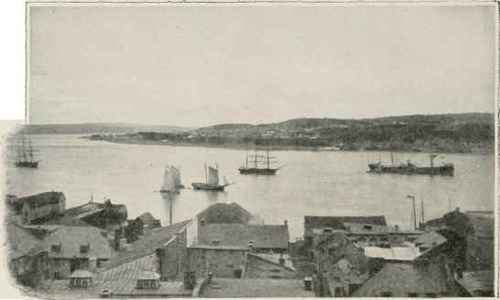
Point Levis, From Quebec.
Commemorative, too, of one of the noblest of French families, the name of Montmorenci still adheres to several prominent objects near Quebec, among which none is so remarkable as the famous Montmorenci Falls, formed eight miles from the city, where the Montmorenci River, hastening to swell the flood of the St. Lawrence, leaps boldly over a precipice two hundred and fifty feet in height, and heralds its approach to the grand stream of which it is the vassal with a roar like that of breakers on a rocky coast. If Hunker Hill Monument were placed erect within this cataract, its capstone would be buried under thirty feet of water. A flight of steps leads downward over the dark cliff beside the fall, and one should make at least a part of the descent to gain a just conception of the height and grandeur of the torrent, the narrowness of which intensifies its volume and impressiveness. Magnificent as is the breathless rush of the great river in mid-air, its principal charm is the huge mound of luminous mist which rises from the floor of the abyss, light as a cloud in summer, but changed in winter into a snow-white, icy cone, sufficiently substantial to form a steep toboggan slide, enjoyed by hundreds of the pleasure-seekers of Quebec. Well worth a visit, too, is the preliminary course of the Mont-morenci, just before it makes its mighty plunge through what are called The Natural Steps. These are a series of broad limestone ledges, lying one upon another like the leaves of a closed volume, through which a jagged cleavage has been made. One might at first suppose that the sides of this irregular chasm had been rent asunder by a cataclysm. But it is all the result of erosion; and the swift stream, apparently so soft and pliable, has gradually cut its way down through a deep accumulation of thin layers, built up in geologic epochs long anterior to the river's birth. Ah, if this foaming flood could speak, what stories it might tell us of the ages which, contemporaneously with its current, have passed on into the gulf of time! But the events which have occurred here left no record on the pages of this volume. Bound, locked, and sealed, long before man appeared upon the planet, its dark stone covers guard its secrets well. The river which has furrowed it has bounded joyously in summer, or struggled through the icy barriers of winter, century after century, alike when the entire continent was an unpeopled wilderness, and later, when unnumbered tribes of hungry savages rose, lived their brutish lives, and disappeared as autumn leaves hundreds of years before a white man's face gleamed, flower-like, in these sombre forests. And so it doubtless will roll on, when mankind shall have run its course, and vanished from a worn-out world. It was this thought that haunted me when standing here; and realizing anew humanity's ephemeral history, compared with that of nature's forces, I called to mind the cry of the old Persian:
Continue to:


My Books

