


Denmark
Description
This section is from the book "Denmark - John L. Stoddard's Lectures", by John L. Stoddard. Also available from Amazon: John L. Stoddard's Lectures 13 Volume Set.
Denmark

Denmark.
Is the most oddly shaped country in the world. One-half of it is a peninsula, the other half an archipelago. The former juts out almost at right angles from the coast of central Europe, curving a little backward at the point, like the prow of a Viking ship. Behind it lies a group of islands of all shapes and sizes, on the largest of which is situated Copenhagen. Eastward, these islands shield the mainland from the billows of the Baltic; westward, in its turn, the peninsula serves as a gigantic break-water, to shelter them from the North Sea. The Danish territory, therefore, separates two oceans, both of which vent their fury on the barrier that divides them, for it compels their currents to pass round the northern point of Denmark by the treacherous, stormy channels of the Skager Rack and Cattegat. All sections of the little kingdom show traces of a fearful conflict with the sea. A good-sized map reveals the ravages thus inflicted. Not only have the edges of both peninsula and islands been gnawed away by the rapacious waves in all conceivable degrees of raggedness, but in a number of places the sea has stabbed the islands almost to the heart, leaving deep wounds that never heal. In other instances it has divided and subdivided them into a multitude of islets, between which labyrinthine channels wind like the tentacles of some huge sea-monster, preparing to enmesh and drag them down. Nor does this fate seem utterly impossible; for, were a subsidence of ninety feet to occur, the majority of these islands would disappear. Even the peninsula has been unable wholly to withstand the onslaught of the ocean, which has quite recently cut through its northern part, detaching a large section of it from the mainland. Denmark's irregular form, deeply indented shores and numerous islands, give it a coast-line out of all proportion to its size. Thus it is said to have a mile of seaboard for every square mile of land, while so strong and shifting are the currents rushing through the archipelago that over one hundred lighthouses and lightships are necessary to protect the navigators of these seas. Even these beacons on the western coast are insufficient to avert disasters. Mariners dread the currents, fogs and reefs which there combine with the North Sea in its ugly moods to drive them to destruc-ti on. So fierce and cutting are the winds that sweep that edge of the peninsula that women, working in the fields, protect their faces from them with black masks. Few people live along that coast, where sand-hills covered with rough grass seem like a motionless imitation of white-crested waves. Yet some of these mounds are relics of an age anterior to all other human memorials that we find in Denmark. They are the prehistoric "kitchen middens," consisting principally of discarded bones.of animals and fishes, thrown into heaps by the original dwellers on these shores, the men and women of the Stone Age, whose wild lives are completely lost in the dark night before the dawn of Danish history.

Christian IX., King Of Denmark.

The Sea's Deep Wounds.
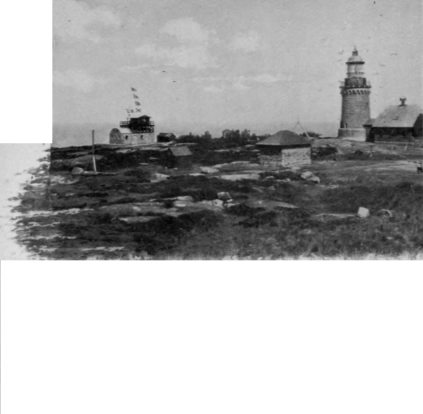
A Danish Lighthouse.

A Kitchen Midden.
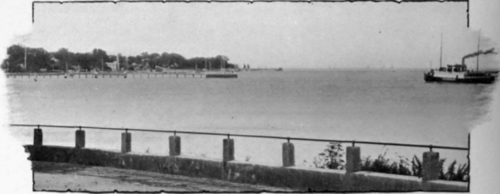
Among The Islands.
After a time the tourist in Denmark feels almost amphibious, so frequently is he obliged to change from land to water, or from water to land. These transitions are made over creeks, fjords, or ocean-straits varying in breadth from a few hundred yards to several miles. Sometimes the railway carriages run directly on to spacious ferry-boats, and are conveyed by steam from shore to shore. At other times a train awaits the passengers on the opposite bank. In one place there are actually "Amphibious Steamboats," which by turns crawl like monster turtles over the land on wheels, and paddle through the water of the lakes.

Two Danish Sea-Dogs.
Unfortunately for travelers who are subject to seasickness, Copenhagen lies a little too far from the Continent to be easy of access. The distance seems a trifle on the map, but it expands enormously when looked at in bad weather with the naked eye. The route from Hamburg through the Danish peninsula has the least amount of sea-travel, but almost every tourist avoids it, partly because it is by several hours the longest, partly because the ocean passages connected with the shorter routes appear so insignificant. After experience, however, one grows wiser. At least one ought to do so. I did not. Ten years before, I had made the six hours' voyage from KieltoKorsor, and my remembrance of it was still so vivid that I at once rejected it as undesirable. As a substitute for this, the journey from Berlin to Copenhagen via Warnemtinde was recommended as the best and shortest. It certainly was the shortest, according to the time-table, requiring but eleven hours from the German to the Danish capital. Moreover, only two of those hours had, in good weather, to be spent at sea. Lured by these prospects, therefore, I once more turned my back upon the long peninsula railway, and trusted to the mercies of the Baltic. In a compartment of the train that left Berlin at half-past eight in the morning I had for traveling companions a Danish gentleman and his daughter returning from Carlsbad. Scarcely had we started, when I noticed that both of them were exceedingly anxious about the weather. They watched the grass and trees to see how strongly and in which direction blew the wind, they looked askance at every cloud, and shuddered when the sky grew overcast. At last I asked them if they thought the passage would be smooth.
Continue to:


My Books

